Great Plains Weather: Land of Extremes
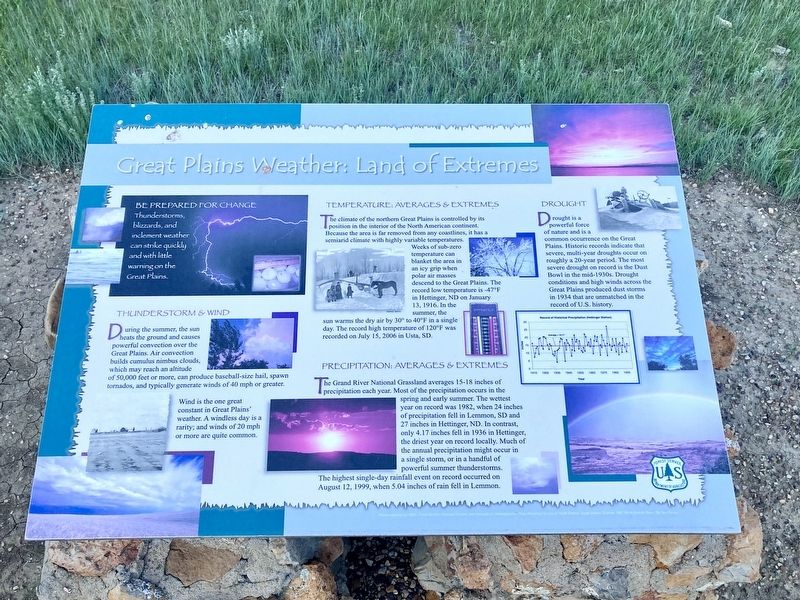
Thunderstorms, blizzards, and inclement weather can strike quickly and with little warning on the Great Plains.
Thunderstorms & Wind
uring the summer, the sun
heats the ground and causes
powerful convection over the
Great Plains. Air convection
builds cumulus nimbus clouds,
which may reach an altitude
of 50,000 feet or more, can produce baseball-size hail, spawn
tornados, and typically generate winds of 40 mph or greater.
Wind is the one great constant in Great Plains' weather. A windless day is a rarity; and winds of 20 mph or more are quite common.
Temperature: Averages & Extremes
T he climate of the northern Great Plains is controlled by its
position in the interior of the North American continent.
Because the area is far removed from any coastlines, it has a
semiarid climate with highly variable temperatures.
Weeks of sub-zero
temperature can
blanket the area in
an icy grip when
polar air masses
descend to the Great Plains. The
record low temperature is -47°F
in Hettinger, ND on January
13, 1916. In the
summer, the
sun warms the dry air by 30° to 40°F in a
this page online
Precipitation: Averages & Extremes
T he Grand River National Grassland averages 15-18 inches of
precipitation each year. Most of the precipitation occurs in the
spring and early summer. The wettest
year on record was 1982, when 24 inches
of precipitation fell in Lemmon, SD and
27 inches in Hettinger, ND. In contrast,
only 4.17 inches fell in 1936 in Hettinger,
the driest year on record locally. Much of
the annual precipitation might occur in
a single storm, or in a handful of
powerful summer thunderstorms.
The highest single-day rainfall event on record occurred on
August 12, 1999, when 5.04 inches of rain fell in Lemmon.
Drought
Drough is a
powerful force
of nature and is a
common occurrence on the Great
Plains. Historic records indicate that
severe, multi-year droughts occur on
roughly a 20-year period. The most
severe drought on record is the Dust
Bowl in the mid-1930s. Drought
conditions and high winds across the
Great Plains produced dust storms
in 1934 that are unmatched in the
record of U.S. history.
Erected by US
Topics. This historical marker is listed in this topic list: Environment. A significant historical date for this entry is January 13, 1916.
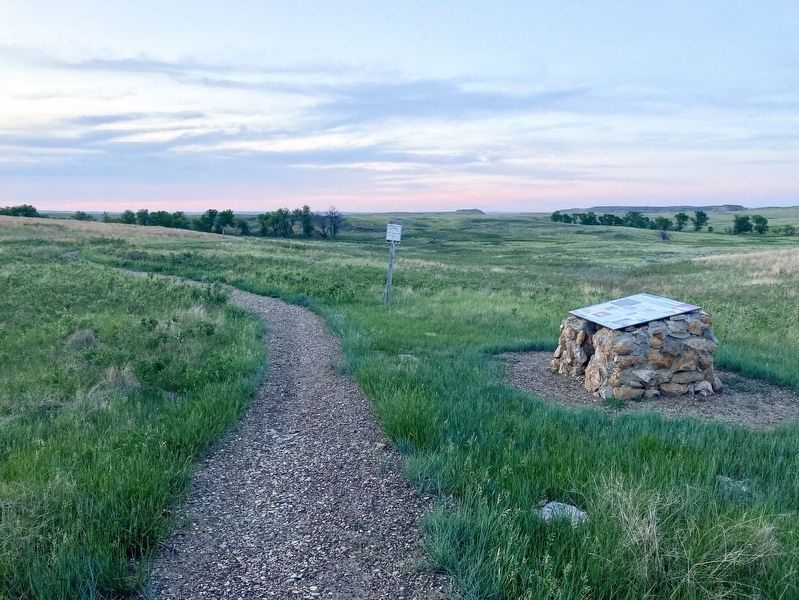
Location. 45° 43.247′ N, 102° 9.419′ W. Marker is near Shadehill, South Dakota, in Perkins County. It can be reached from Forest Road 5740 one mile north of Forest Road 5626. Located on the Blacktail Trail. Touch for map. Marker is in this post office area: Lemmon SD 57638, United States of America. Touch for directions.

Regionally, this marker is in the Standing Rock Sioux Tribe, on the Cheyenne River Reservation, and in West River. It is also in the American Lewis & Clark Corridor, on the prairies, and on the Northern Plains. Globally, it is in North America, the Western Hemisphere, the Western World, and the Anglosphere. Historically, it finds itself in what was once Rupert’s Land and also the Louisiana Purchase.
Other nearby markers. At least 8 other markers are within 13 miles of this marker, measured as the crow flies: Welcome to the Grand River National Grassland (about 600 feet away, measured in a direct line); Public Land Surveying (approx. 0.2 miles away); From Bison to Cattle (approx. 0.2 miles away); Hugh Glass - Adventurer (approx. 3.9 miles away); Shadehill Dam & Reservoir (approx. 4.3 miles away); a different marker also named Hugh Glass (approx. 4.3 miles away); Seim, South Dakota (approx. 4.3 miles away); WWII Bomber Crashes near Meadow, SD (approx. 12½ miles away). Touch for a list and map of all markers in Shadehill.
Another marker is no longer nearby. Hugh Glass (was approx. 4.3 miles away but has been replaced with another marker now near it).
Credits. This page was last revised on June 6, 2021. It was originally submitted on June 4, 2021, by Connor Olson of Menomonee Falls, Wisconsin. This page has been viewed 282 times since then and 19 times this year. Photos: 1, 2. submitted on June 4, 2021, by Connor Olson of Menomonee Falls, Wisconsin. • Mark Hilton was the editor who published this page.
