
Taking Action: Barbara Johns
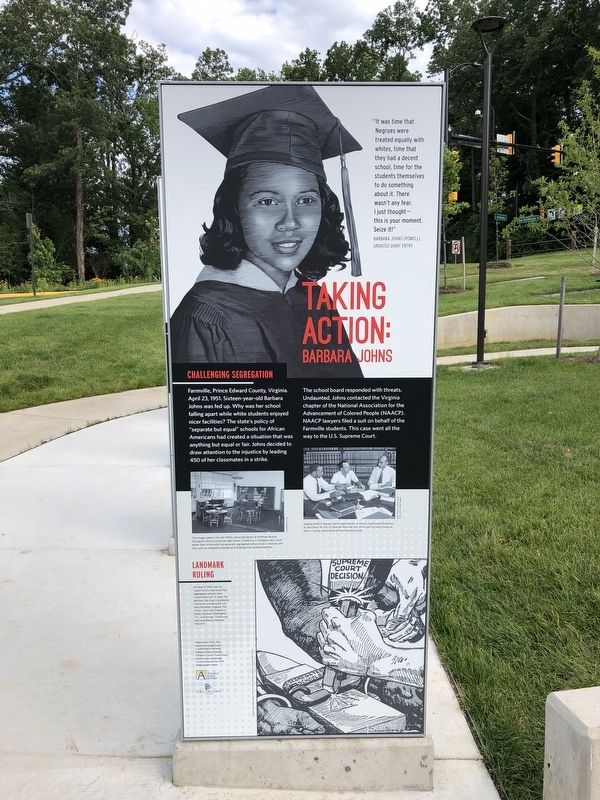
"It was time that Negroes were treated equally with whites, time that they had a decent school, time for the students themselves to do something about it. There wasn't any fear. I just thought — this is your moment. Seize it!"
Barbara Johns (Powell), undated diary entry
Challenging Segregation
Farmville, Prince Edward County, Virginia, April 23, 1951. Sixteen-year-old Barbara Johns was fed up. Why was her school falling apart while white students enjoyed nicer facilities? The state's policy of "separate but equal" schools for African Americans had created a situation that was anything but equal or fair. Johns decided to draw attention to the injustice by leading 450 of her classmates in a strike.
The school board responded with threats. Undaunted, Johns contacted the Virginia chapter of the National Association for the Advancement of Colored People (NAACP). NAACP lawyers filed a suit on behalf of the Farmville students. This case went all the way to the U.S. Supreme Court.
Landmark Ruling
On May 17, 1954, the U.S. Supreme Court declared that segregated schools were unconstitutional. To make the decision, the Court considered five cases, including the suit from Farmville, Virginia. The others were from Delaware, South Carolina, Washington, D.C., and Kansas. The Kansas case was Brown v. Board of Education.
[Captions:]
This image, taken in the late 1940, shows the library at Hoffman-Boston, Arlington's African American high school. Conditions in Arlington were much better than in Farmville, but generally segregated schools had to make do with less, such as outdated textbooks and buildings that lacked amenities.
Virginia NAACP lawyers (left to right) Martin A. Martin, Spottswood Robinson III, and Oliver W. Hill Sr. filed the Farmville suit, which was formally known as Davis v. County School Board of Prince Edward County.
Erected 2021
this page online
Topics. This historical marker is listed in these topic lists: African Americans • Civil Rights • Education. A significant historical date for this entry is April 23, 1951.
Location. 38° 53.963′ N, 77° 6.722′ W. Marker is in Arlington, Virginia, in Arlington County. It is in Cherrydale. It can be reached from Vacation Lane 0.1 miles east of 23rd Street North, on the right when traveling east. Touch for map. Marker is at or near this postal address: 4064 22nd St N, Arlington VA 22207, United States of America. Touch for directions.

Regionally, this marker is in the Washington Metropolitan Area and in Northern Virginia. It is also in the American South, specifically in the Upper South, in the Mid-Atlantic, and on the Eastern Seaboard. Globally, it is in the North Atlantic Region, North America, the Western Hemisphere, the Western World, and the Anglosphere. Historically, it finds itself in what was once the territory of the Mississippian Culture, one of the original Thirteen Colonies, one of the
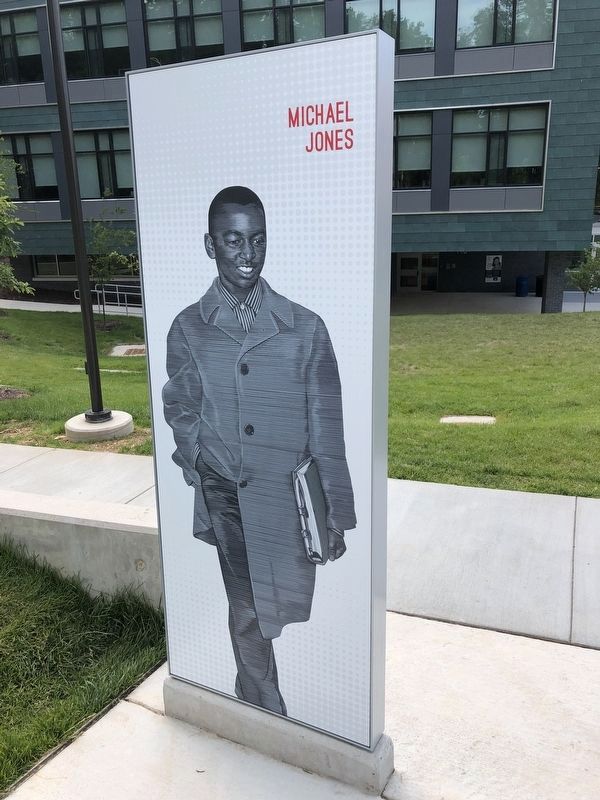
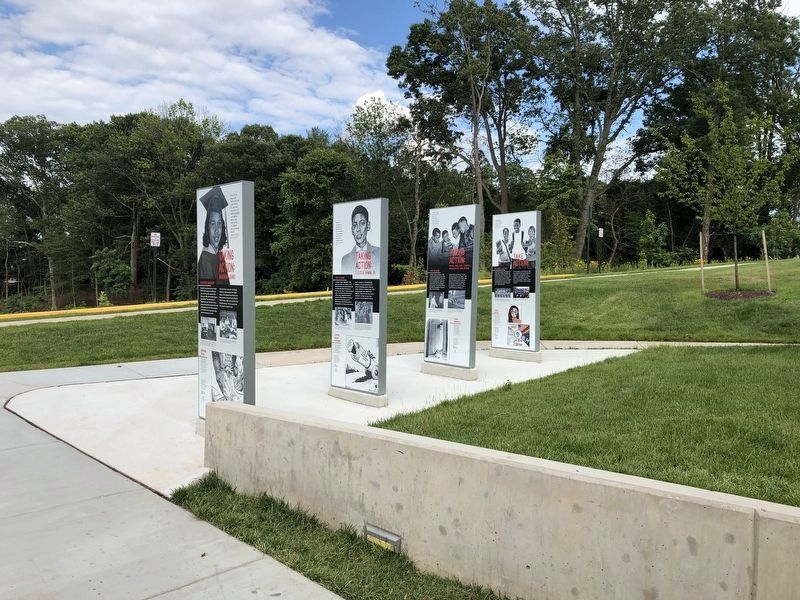
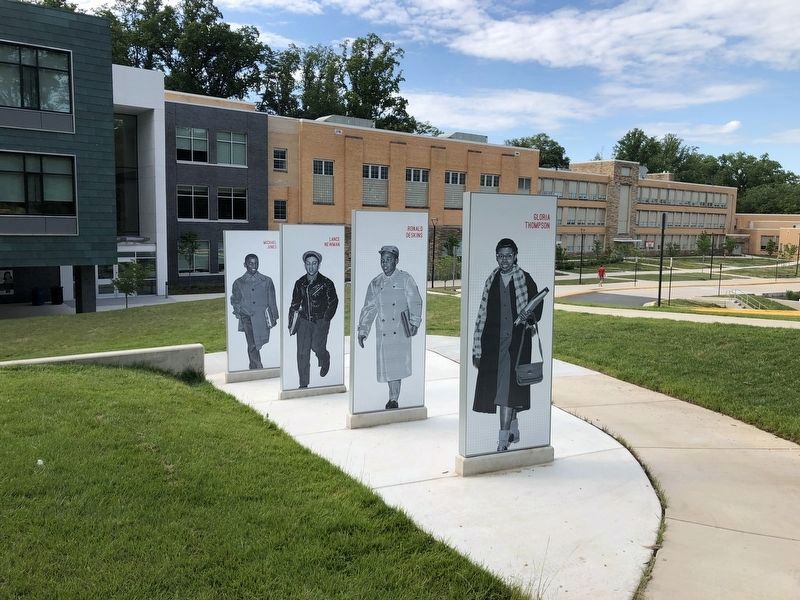
Other nearby markers. At least 8 other markers are within walking distance of this marker: Take Action! (a few steps from this marker); Taking Action: E. Leslie Hamm, Jr. (a few steps from this marker); Taking Action: Michael Jones, Gloria Thompson, Ronald Deskins, Lance Newman (a few steps from this marker); Taking Action: Dorothy M. Bigelow Hamm (within shouting distance of this marker); Stratford Junior High School (about 500 feet away, measured in a direct line); Cherrydale (approx. 0.2 miles away); Cherrydale Volunteer Firehouse (approx. 0.3 miles away); Cherrydale Drug Fair Sit-In (approx. 0.3 miles away). Touch for a list and map of all markers in Arlington.
Credits. This page was last revised on February 1, 2023. It was originally submitted on June 15, 2021, by Devry Becker Jones of Washington, District of Columbia. This page has been viewed 625 times since then and 28 times this year. Photos: 1, 2, 3, 4. submitted on June 15, 2021, by Devry Becker Jones of Washington, District of Columbia.
