
Gold Mining
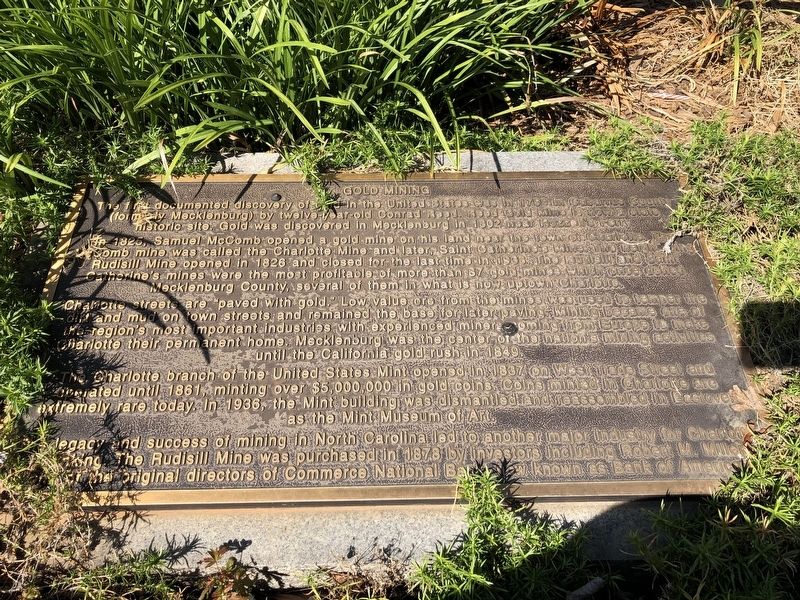
The first documented discovery of gold in the United States was in 1799 in Cabarrus County (formerly Mecklenburg) by twelve-year-old Conrad Reed. Reed Gold Mine is now a state historic site. Gold was discovered in Mecklenburg in 1802 near Hozzell's Ferry.
In 1825, Samuel McComb opened a gold mine on his land near the town of Charlotte. The Comb mine was called the Charlotte Mine and later, Saint Catherine's Mine.The neighboring Rudisill Mine opened in 1826 and closed for the last time in 1938. The Rudisill and Saint Catherine's mines were the most profitable of more than 87 gold mines, which once dotted Mecklenburg County, several of them in what is now in uptown Charlotte.
Charlotte streets are "paved with gold." Love value ore from the mines was used to temper the dirt and mud on town streets and remained the base for later paving. Mining became one of the region's most important industries with experienced miners coming from Europe to make Charlotte their permanent home. Mecklenburg was the center of the nation's mining activities until the California gold rush in 1849.
The Charlotte branch of the United States Mint opened in 1837 on West Trade Street and operated until 1861, minting over $5,000,000 in gold coins. Coins minted in Charlotte are extremely rare today. In 1936, the Mint building was dismantled and reassembled in Eastover as the Mint Museum of Art.
The legacy and success of mining in North Carolina led to another major industry for Charlotte: banking. The Rudisill Mine was purchased in 1878 by investors including Robert M. Miller for the original directors of Commerce National Bank, now known as Bank of America.
Topics.
this page online
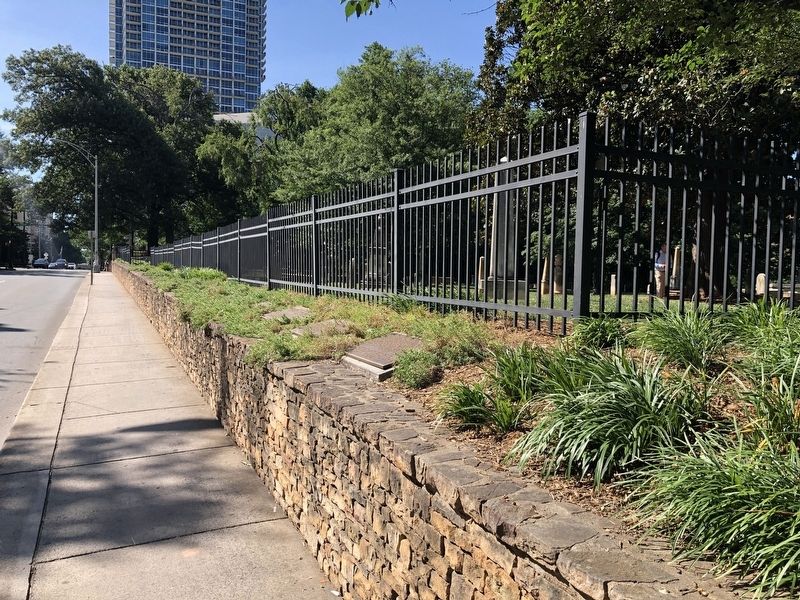
Location. 35° 13.752′ N, 80° 50.593′ W. Marker is in Charlotte, North Carolina, in Mecklenburg County. It is in Charlotte center city. It is on West 5th Street just west of North Church Street, on the right when traveling west. Touch for map. Marker is at or near this postal address: 200 W Trade St, Charlotte NC 28202, United States of America. Touch for directions.

Regionally, this marker is in North Carolina’s Piedmont. It is also in the American South and specifically in the Upper South. Globally, it is in North America, the Western Hemisphere, the Western World, and the Anglosphere. Historically, it finds itself in what was once the territory of the Mississippian Culture, one of the original Thirteen Colonies, one of the Confederate States of America, and the Antebellum South.
Other nearby markers. At least 8 other markers are within walking distance of this marker: Early Education (here, next to this marker); The Importance Of Religion (here,
Credits. This page was last revised on June 20, 2024. It was originally submitted on June 20, 2021, by Devry Becker Jones of Washington, District of Columbia. This page has been viewed 1,115 times since then and 39 times this year. Last updated on June 20, 2021, by Bradley Owen of Morgantown, West Virginia. Photos: 1, 2. submitted on June 20, 2021, by Devry Becker Jones of Washington, District of Columbia.
