Innovations from the Saint Paul Campus
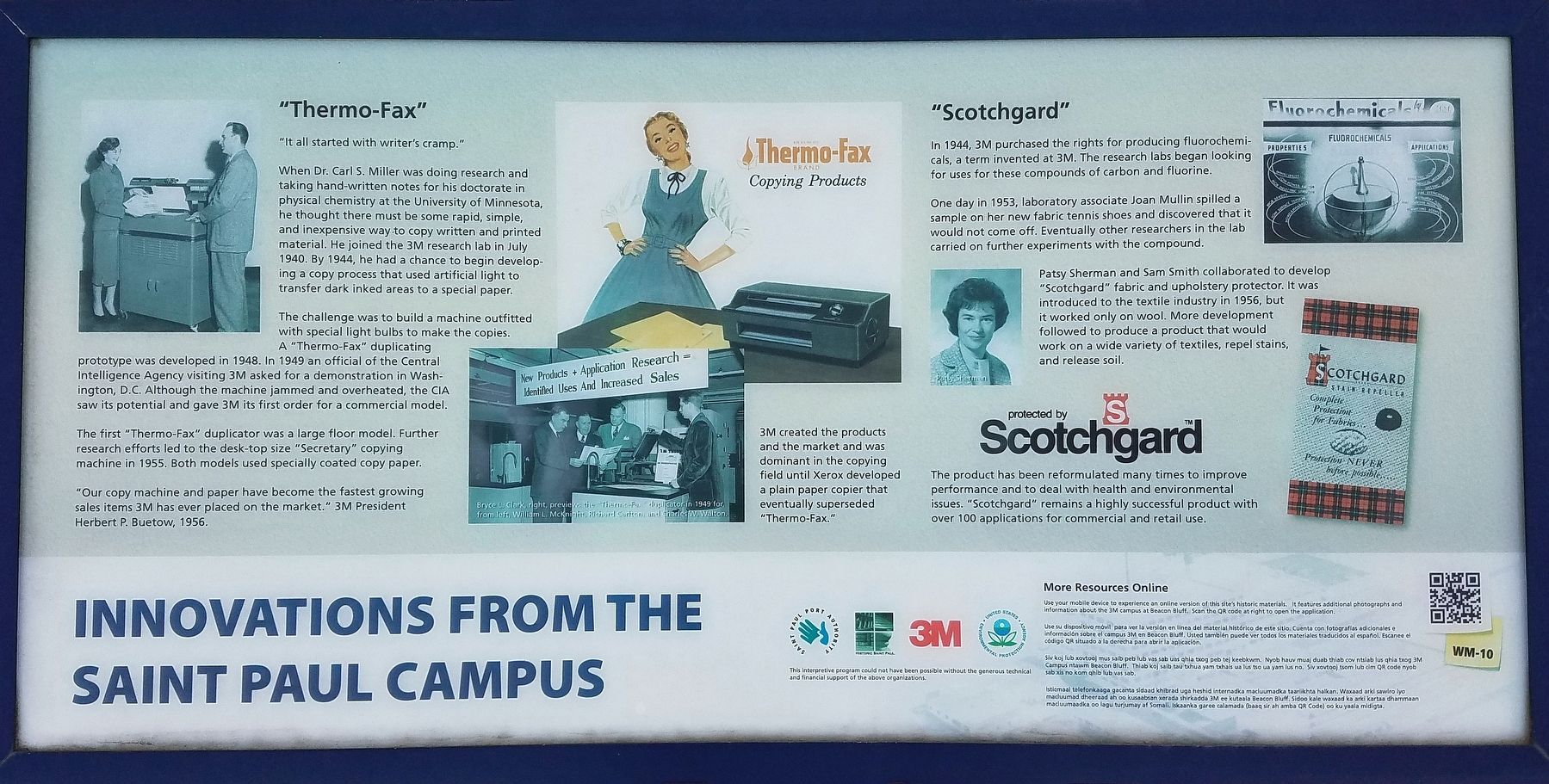
"Thermo-Fax"
"It all started with writer's cramp."
When Dr. Carl S. Miller was doing research and taking hand-written notes for his doctorate in physical chemistry at the University of Minnesota, he thought there must be some rapid, simple, and inexpensive way to copy written and printed material. He joined the 3M research lab in July 1940. By 1944, he had a chance to begin developing a process that used artificial light to transfer dark inked areas to a special paper.
The challenge was to build a machine outfitted with special light bulbs to make the copies. A "Thermo-Fax" duplicating prototype was developed in 1948. In 1949 an official of the Central Intelligence Agency visiting 3M asked for a demonstration in Washington, D.C. Although the machine jammed and overheated, the CIA saw its potential and gave 3M its first order for a commercial model.
The first "Thermo-Fax" duplicator was a large floor model. Further research efforts led to the desk-top size "Secretary" copying machine in 1955. Both models used specially coated copy paper.
"Our copy machine and paper have become the fastest growing sales
this page online
3M created the products and the market and was dominant in the copying field until Xerox developed a plain paper copier that eventually superseded "Thermo-Fax."
"Scotchguard"
In 1944, 3M purchased the rights for producing fluorochemicals, a term invented at 3M. The research labs began looking for uses for these compounds of carbon and fluorine.
One day in 1953, laboratory associate Joan Mullin spilled a sample on her new fabric tennis shoes and discovered that it would not come off. Eventually other researchers in the lab carried on further experiments with the compound.
Patsy Sherman and Sam Smith collaborated to develop "Scotchguard" fabric and upholstery protector. It was introduced to the textile industry in 1956, but it worked only on wool. More development followed to produce a product that would work on a wide variety of textiles, repel stains, and release soil.
The product has been reformulated many times to improve performance and to deal with health and environmental issues. "Scotchguard" remains a highly successful product with
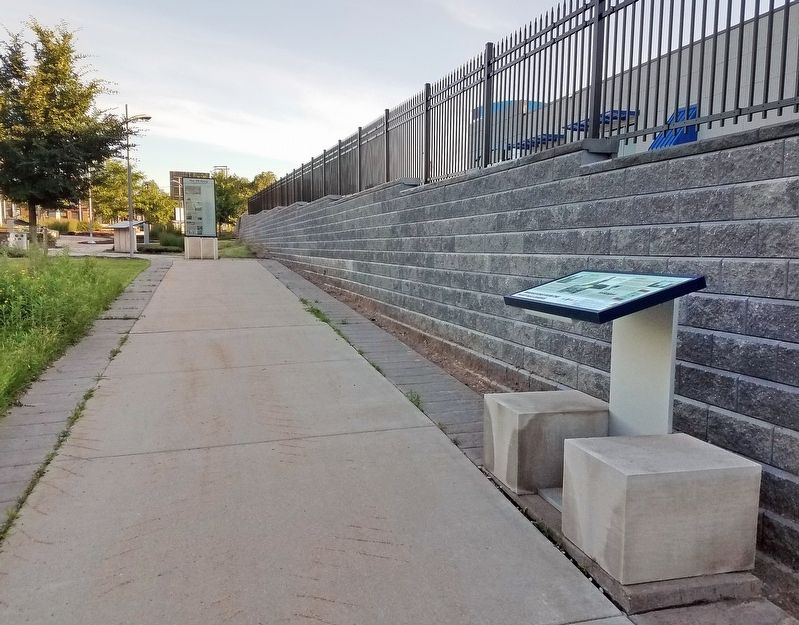
Erected by Saint Paul Port Authority, Historic Saint Paul, 3M, United States Environmental Protection Agency. (Marker Number WM-10.)
Topics. This historical marker is listed in these topic lists: Industry & Commerce • Science & Medicine. A significant historical year for this entry is 1944.
Location. 44° 57.84′ N, 93° 3.816′ W. Marker is in Saint Paul, Minnesota, in Ramsey County. It is in Dayton's Bluff. It can be reached from the intersection of 7th Street East and Minnehaha Avenue East. Located in the Beacon Bluff Art and History park, on the walkway north of the main plaza. Touch for map. Marker is at or near this postal address: 895 7th St E, Saint Paul MN 55106, United States of America. Touch for directions.

Regionally, this marker is in the Twin Cities Metropolitan Area. It is also in the American Midwest, in the Corn Belt, and in the Great River Road Region. Globally, it is in North America, the Western Hemisphere, the Western World, and the Anglosphere. Historically, it finds itself in what was once Rupert’s Land, the territory of the Mississippian Culture, and the Louisiana Purchase.
Other nearby markers. At least 8 other markers are within walking distance of this marker: The 3M Story (a few steps from this marker); "Scotch" Tape to the Rescue of General Gray (within shouting distance of this marker); 3M Vision & Growth (within shouting distance of this marker); People & Times: 3M & Saint Paul's East Side (within shouting distance of this marker); Scotch Brand (within shouting distance of this marker); 3M, a Family Affair (within shouting distance of this marker); "The Mining" (within shouting distance of this marker); Marketing 3M & Its Products (within shouting distance of this marker). Touch for a list and map of all markers in Saint Paul.
Additional keywords. inventions
Credits. This page was last revised on February 12, 2023. It was originally submitted on June 20, 2021, by McGhiever of Minneapolis, Minnesota. This page has been viewed 294 times since then and 26 times this year. Photos: 1, 2. submitted on June 20, 2021, by McGhiever of Minneapolis, Minnesota. • Mark Hilton was the editor who published this page.
