West Point in King William County, Virginia — The American South (Mid-Atlantic)
Indians Poisoned At Peace Meeting
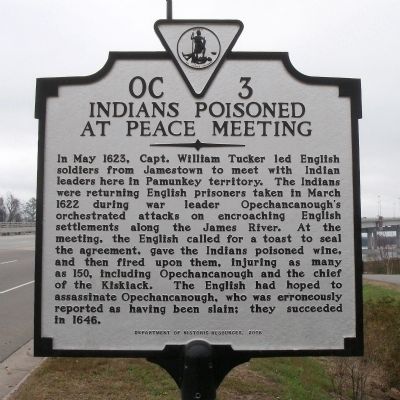
Photographed by Bernard Fisher, March 28, 2009
1. Indians Poisoned At Peace Meeting Marker
Erected 2008 by Department of Historic Resources. (Marker Number OC-3.)
Topics and series. This historical marker is listed in these topic lists: Colonial Era • Indigenous Peoples and Communities. In addition, it is included in the Virginia Department of Historic Resources (DHR) series list. A significant historical month for this entry is March 1622.
Location. 37° 32.289′ N, 76° 47.68′ W. Marker is in West Point, Virginia, in King William County. It is at the intersection of 14th Street (Virginia
this page online

Regionally, this marker is on the Middle Peninsula. It is also in the American South, specifically in the Upper South, in the Tidewater, in the Chesapeake Bay Region, and on the Eastern Seaboard. Globally, it is in the North Atlantic Region, North America, the Western Hemisphere, the Western World, and the Anglosphere. Historically, it finds itself in what was once the territory of the Mississippian Culture, one of the original Thirteen Colonies, one of the Confederate States of America, and the Antebellum South.
Other nearby markers. At least 8 other markers are within walking distance of this marker: Indian Treaty of 1646 (within shouting distance of this marker); King William County / King and Queen County (within shouting distance of this marker); Lt. Gen. Lewis Burwell “Chesty” Puller (approx. ¼ mile away); Mt. Nebo Baptist Church (approx. 0.3 miles away); The Grove Hotel (approx. 0.4 miles away); L. E. Mumford Banking Company
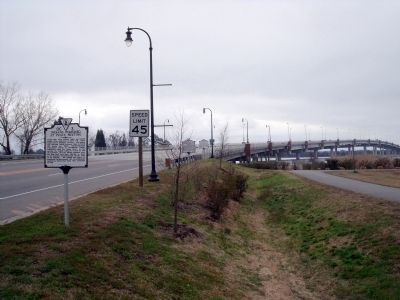
Photographed by Bernard Fisher, March 28, 2009
2. Indians Poisoned At Peace Meeting Marker
Another marker is no longer nearby. Home of Signer (was approx. 0.3 miles away but has been confirmed missing).
Also see . . . Wikipedia article on Opchanacanough. (Submitted on March 23, 2019, by Mark Hilton of Montgomery, Alabama.)
Public domain (Public Domain)
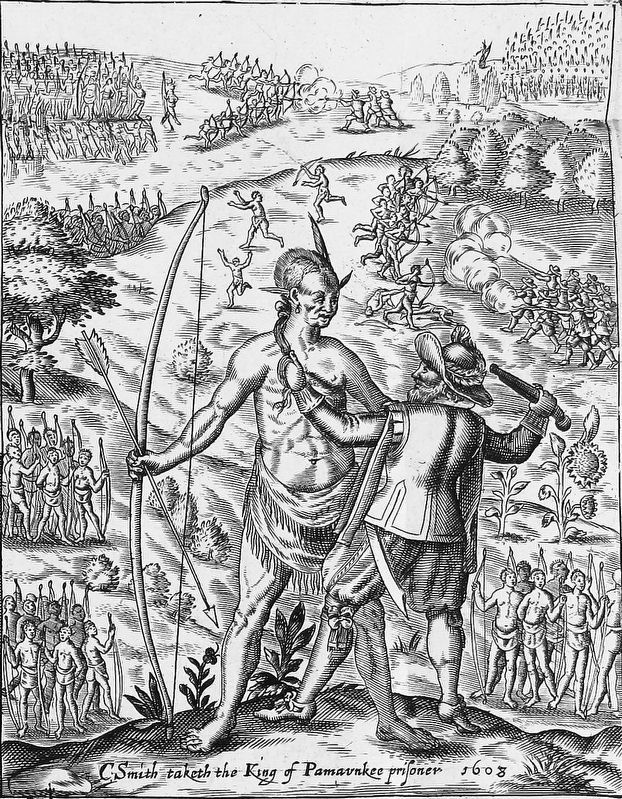
3. John Smith taking the King of Pamunkey (Opechancanough) prisoner.
The image of Opechancanough is based on a 1585 painting of another native warrior by John White.
Credits. This page was last revised on November 13, 2023. It was originally submitted on April 3, 2009, by Bernard Fisher of Richmond, Virginia. This page has been viewed 19,231 times since then and 367 times this year. Photos: 1, 2. submitted on April 3, 2009, by Bernard Fisher of Richmond, Virginia. 3. submitted on March 23, 2019, by Mark Hilton of Montgomery, Alabama.
