Historic Fort Ransom
⎯⎯⎯
Life at the Fort
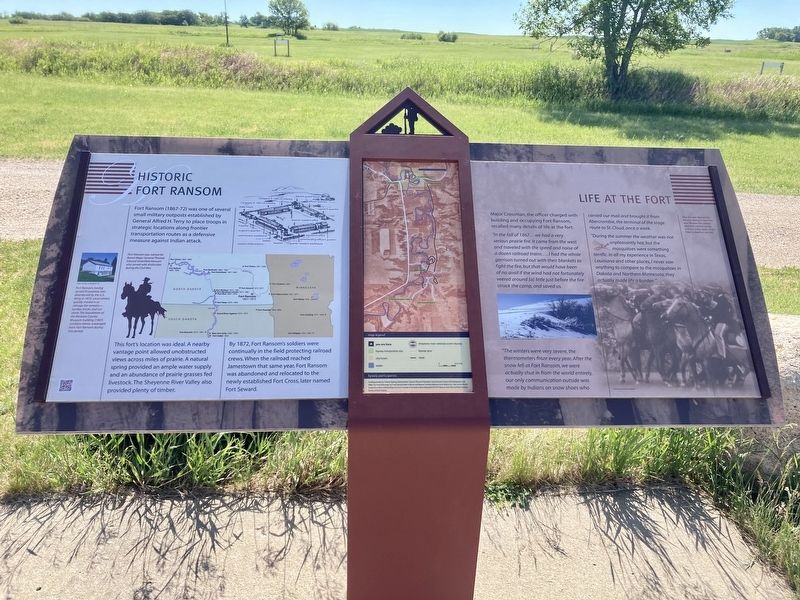
This fort’s location was ideal. A nearby vantage point allowed unobstructed views across miles of prairie. A natural spring provided an ample water supply and an abundance of prairie grasses fed livestock. The Sheyenne River also provided plenty of timber.
By 1872, Fort Ransom’s soldiers were continually in the field protecting railroad crews. When the railroad reached Jamestown that same year, Fort Ransom was abandoned and relocated to the newly established Fort Cross, later named Fort Seward.
“In the fall of 1867…we had a very serious prairie fire. It came from the west and traveled with the speed and noise of a dozen railroad trains…I had the whole garrison turned out with their blankets to fight the fire, but that would have been of no avail if the wind had not fortunately veered around [a] little just before the fire struck the camp, and saved us.
“The winters were very severe, the thermometers froze every year. After the snow fell at Fort Ransom, we were actually shut in from the world entirely, our only communication outside was made by Indians on snow shoes who carried out mail and brought it from Abercrombie, the terminal of the stage route to St. Cloud, once a week.
“During the summer the weather was not unpleasantly hot, but the mosquitoes were something terrific. In all my experience in Texas, Louisiana and other places, I never saw anything compare to the mosquitoes in Dakota and Northern Minnesota; they actually made life a burden."
this page online
Fort Ransom was named for Brevet Major General Thomas Edward Greenfield Ransom who served with distinction during the Civil War.
Fort Ransom, having served its purpose, was abandoned by the US Army in 1872. Local settlers quickly moved in to salvage the remains-lumber, bricks, and cut stone. The foundation of the Ransom County Museum building (1907) contains stones scavenged from Fort Ransom during this period.
Very few men died at Fort Ransom during its brief five-year lifespan; five soldiers died from natural causes and two Indian mail carriers froze to death on the trail.
Topics. This historical marker is listed in these topic lists: Forts and Castles • Indigenous Peoples and Communities • Settlements & Settlers. A significant historical year for this entry is 1867.
Location. 46° 31.114′ N, 97° 56.487′ W. Marker is near Fort Ransom, North Dakota, in Ransom County. It is on West Hjelle Parkway near 62nd Street Southeast, on the right when traveling north. Touch for map. Marker is at or near this postal address: 6194 W Hjelle Pkwy, Fort Ransom ND 58033, United States of America. Touch for directions.

Regionally,
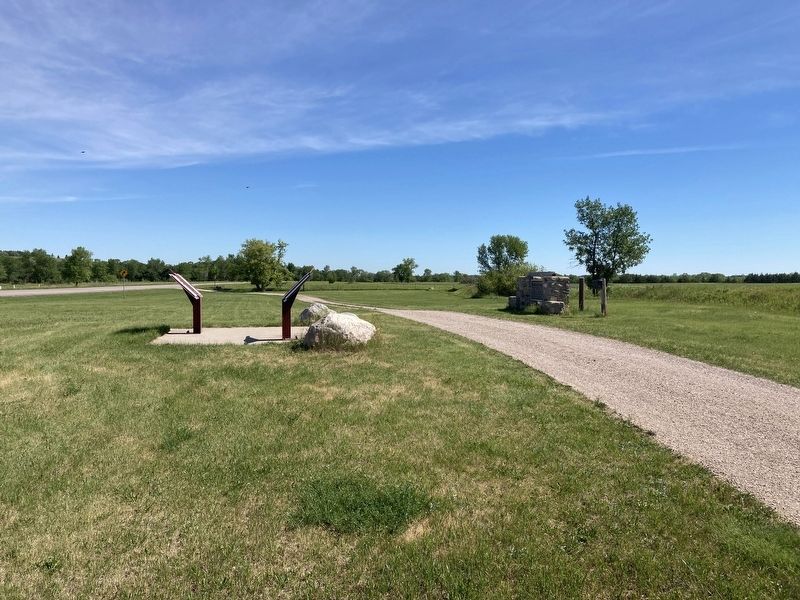
Other nearby markers. At least 8 other markers are within 8 miles of this marker, measured as the crow flies: Writing Rock / Native American Legends (here, next to this marker); Fort Ransom Historic Site (a few steps from this marker); Pyramid Hill / Fort Ransom’s Remarkable Survival (approx. 0.9 miles away); Standing Rock Lutheran Church (approx. 2 miles away); Timber Trestle Bridge (approx. 2.1 miles away); An Ancient Sea / Glacial Meltwater Trench (approx. 2½ miles away); Native Prairies / Ecosystem Under Siege (approx. 2.6 miles away); Standing Rock Hill Historic Site (approx. 7.4 miles away). Touch for a list and map of all markers in Fort Ransom.
Credits. This page was last revised on July 3, 2021. It was originally submitted on June 28, 2021, by Connor Olson of Menomonee Falls, Wisconsin. This page has been viewed 782 times since then and 54 times this year. Photos: 1, 2. submitted on June 28, 2021, by Connor Olson of Menomonee Falls, Wisconsin. • Mark Hilton was the editor who published this page.
