Fredericksburg, Virginia — The American South (Mid-Atlantic)
Voices of the Present
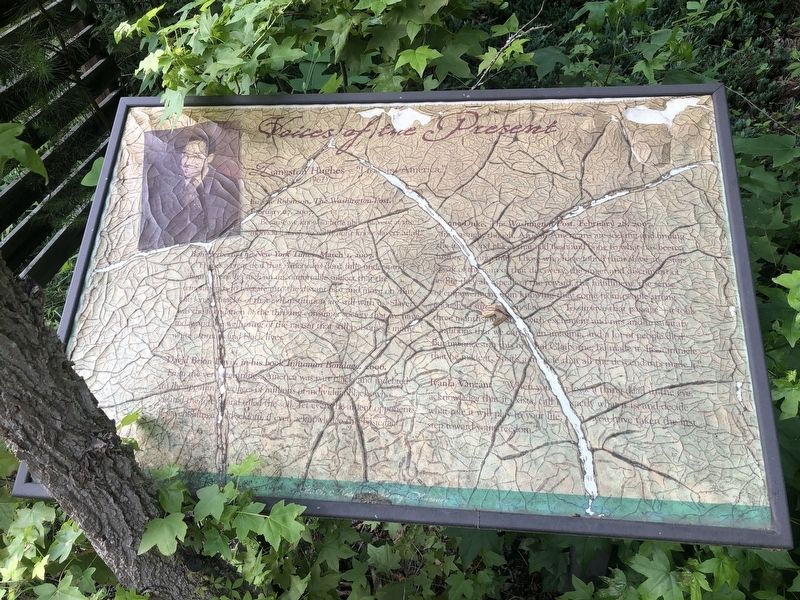
Langston Hughes (1902-1967) —
"I too am America."
Eugene Robinson. The Washington Post. February 27, 2007.
"Because we know so little about slavery at the individual level, we really don't know slavery at all."
Bob Herbert. The New York Times. March 1, 2007.
"…There's a great deal that Americans don't fully understand about slavery. It's such an uncomfortable subject that the temptation is to relegate it to the distant past and move on. But the long tentacles of that evil institution are still with us. Slavery was the foundation of the thriving consumer society that we have today, and the wellspring of the racism that still poisons so many white attitudes and black lives."
David Brion Davis, in his book Inhuman Bondage. 2006.
"From the very beginnings, America was part black and indebeted to the appalling sacrifices of individual blacks who cleared the forests and tilled the soil. Yet even the ardent opponents of slave holding could seldom, if ever, acknowledge this basic fact."
Dionne Duke. The Washington Post. February 28, 2007.
"Increasingly, though, African Americans are seeking and findingthe names and places that add flesh and bone to what has been a history of anonymity . Those who have found their slave ancestors speak of the pain of that discovery, the anger and discomfort of it. But they also speak of the reward, the fulfillment, the sense of empowerment from knowing they come from people strong enough to survive even slavery. To survive that passage—it took three months on a ship with excrement and rats and unsanitary conditions that we can't even imagine, and a lot of people died. But my ancestor, this original Claiborne, he made it. It's a miracle that he made it. So it's a miracle that all the descendants made it."
Click or scan to see
this page online
Iyanla Vanzant —
"When you can look a thing dead in the eye, acknowledge that it exists, call it exactly what it is, and decide what role it will play in your life, then you have taken the first step toward your freedom."
Topics. This historical marker is listed in these topic lists: Abolition & Underground RR • African Americans • Civil Rights • Industry & Commerce. A significant historical date for this entry is February 27, 2007.
Location. 38° 19.324′ N, 77° 30.509′ W. Marker is in Fredericksburg,

Regionally, this marker is in the Washington Metropolitan Area and in Northern Virginia. It is also in the American South and specifically in the Upper South. Globally, it is in North America, the Western Hemisphere, the Western World, and the Anglosphere. Historically, it finds itself in what was once the territory of the Mississippian Culture, one of the original Thirteen Colonies, one of the Confederate States of America, and the Antebellum South.
Other nearby markers. At least 8 other markers are within walking distance of this marker: Harriet Jacobs (here, next to this marker); Henry "Box" Brown (a few steps from this marker); Middle Passage (a few steps from this marker); Voices of the Past (a few steps from this marker); Acts of Bravery (a few steps from this marker); Hallelujah (a few steps from this marker); Abolitionists (a few steps from this marker); Quest For Knowledge (a few steps from this marker). Touch for a list and map of all markers in Fredericksburg.
Also see . . . Abandoned National Slavery Museum. Atlas Obscura article (Submitted on June 29, 2021, by Devry Becker Jones of Washington, District of Columbia.)
Credits. This page was last revised on July 16, 2025. It was originally submitted on June 29, 2021, by Devry Becker Jones of Washington, District of Columbia. This page has been viewed 212 times since then and 26 times this year. Photos: 1, 2. submitted on June 29, 2021, by Devry Becker Jones of Washington, District of Columbia.
