Near Raymond in Hinds County, Mississippi — The American South (East South Central)
Whitworth Breechloading Rifle
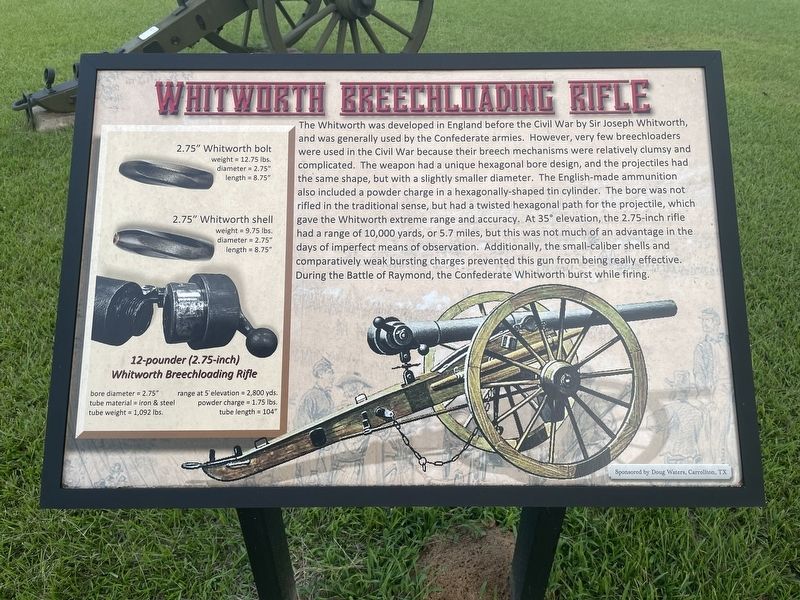
Photographed by Mark Hilton, July 30, 2021
1. Whitworth Breechloading Rifle Marker
Erected 2016 by the Friends of Raymond Battlefield.
Topics. This historical marker is listed in this topic list:
this page online
Location. 32° 14.86′ N, 90° 26.569′ W. Marker is near Raymond, Mississippi, in Hinds County. It can be reached from the intersection of Old Port Gibson Road and Port Gibson Street, on the right when traveling west. Touch for map. Marker is in this post office area: Raymond MS 39154, United States of America. Touch for directions.

Regionally, this marker is in Natchez Trace Corridor and in Greater Jackson. It is also in the American South and specifically in the Deep South. Globally, it is in North America, a Gulf of Mexico state, the Western Hemisphere, the Western World, and the Anglosphere. Historically, it finds itself in what was once the territory of the Mississippian Culture, one of the Confederate States of America, and the Antebellum South.
Other nearby markers. At least 8 other markers are within walking distance of this marker: Artillery Ammunition (a few steps from this marker); C.S. Gregg's Task Force (a few steps from this marker); C.S. Bledsoe's Missouri Battery (3 Guns) (within shouting distance of this marker); a different marker also named
Photographed by Mark Hilton, July 30, 2021
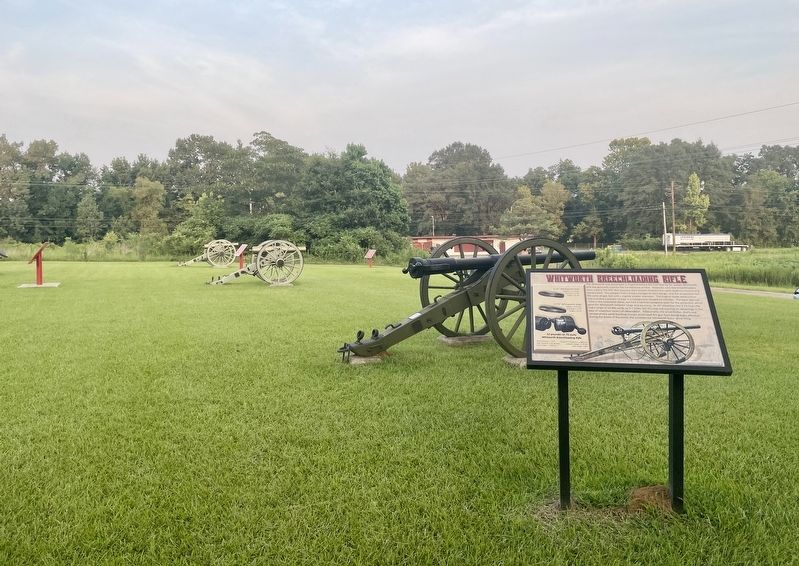
2. Whitworth Breechloading Rifle, behind marker, at Bledsoes Battery.
Behind the marker is a working replica Whitworth Rifle barrel installed in November, 2016.
Another marker is no longer nearby. Bledsoe's Battery (was within shouting distance of this marker but has been confirmed missing).
More about this marker. The Friends of Raymond Battlefield signed a 25-year lease with Hinds Community College in February, 2014, for approximately one acre of land where the Confederate artillery and this marker is located, in front of the old Magna America plant.
Also see . . . Wikipedia article on the Whitworth Rifle. (Submitted on August 1, 2021, by Mark Hilton of Montgomery, Alabama.)
Photographed by Mark Hilton, July 30, 2021
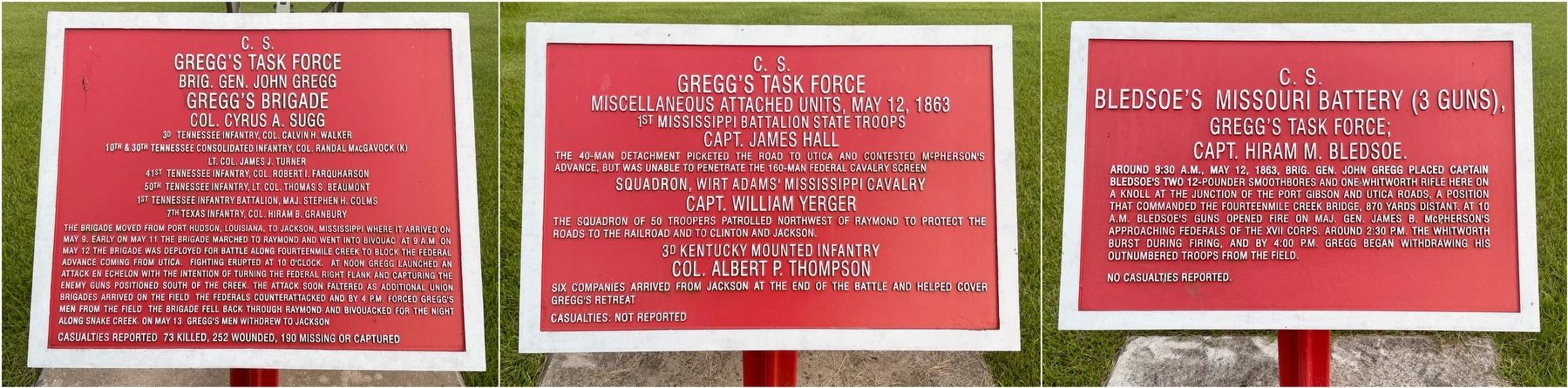
3. Three interpretive markers about the Confederate gun battery here.
Credits. This page was last revised on August 1, 2021. It was originally submitted on August 1, 2021, by Mark Hilton of Montgomery, Alabama. This page has been viewed 1,006 times since then and 114 times this year. Photos: 1, 2, 3. submitted on August 1, 2021, by Mark Hilton of Montgomery, Alabama.
