Montparnasse in Paris in Département de Paris, Île-de-France, France — Western Europe
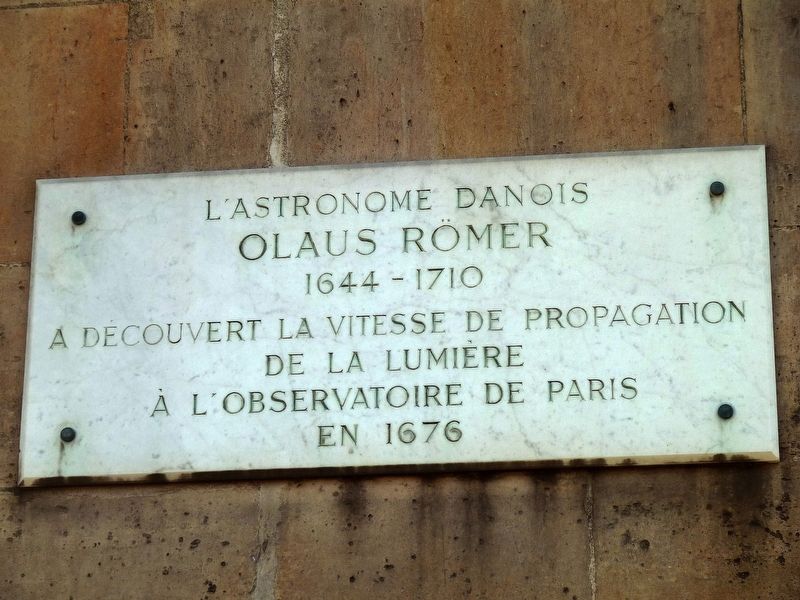
L'Astronome Danois Olaus Römer
Photographed by Roger W. Sinnott, October 2, 2019
1. L'Astronome Danois Olaus Römer Marker

Olaus Römer
1644-1710
à découvert la vitesse de propagation
de la lumière
à l'Observatoire de Paris
en 1676
The Danish astronomer Olaus Römer, 1644-1710, discovered the speed of propagation of light at the Paris Observatory in 1676.
Topics. This historical marker is listed in this topic list: Science & Medicine. A significant historical year for this entry is 1676.
Location. 48° 50.2′ N, 2° 20.192′ E. Marker is in Paris, Île-de-France, in Département de Paris. It is in Montparnasse. It is on Avenue de l'Observatoire 0.1 kilometers south of Rue Cassini when traveling south. Starting at the intersection of Avenue Denfert Rochereau with Avenue de l'Observatoire, proceed south along the latter to the Paris Observatory. As you look through the locked gate, the marker can be seen on the wall of the main building, just right of the front door. Binoculars may be needed to read it. Touch for map. Marker is at or near this postal address: 61 Avenue de l'Observatoire, Paris, Île-de-France 75014, France. Touch for directions.

Regionally, it is in the North Atlantic Region, Europe,
this page online
Other nearby markers. At least 8 other markers are within walking distance of this marker: La Maternite Ecole d’Accouchement (approx. 0.3 kilometers away); Bombardement de Paris (approx. 0.3 kilometers away); Ancienne abbaye de Port-Royal (approx. 0.3 kilometers away); Marechal Ney (approx. 0.4 kilometers away); Romain Rolland (approx. 0.4 kilometers away); Lila Kedrova (approx. 0.4 kilometers away); Square de l’Abbé Migne (1880) (approx. 0.4 kilometers away); Square Jacques Antoine 1896 (approx. 0.4 kilometers away). Touch for a list and map of all markers in Paris.
Regarding L'Astronome Danois Olaus Römer. Nowadays this astronomer's name is often written Ole Roemer. He had been studying telescopic timings of eclipses of Jupiter's satellites. Roemer noticed that whenever the Earth, in its orbit, was moving away from Jupiter, these eclipses began to lag behind the predictions. But after the Earth rounded
Photographed by Roger W. Sinnott, October 2, 2019
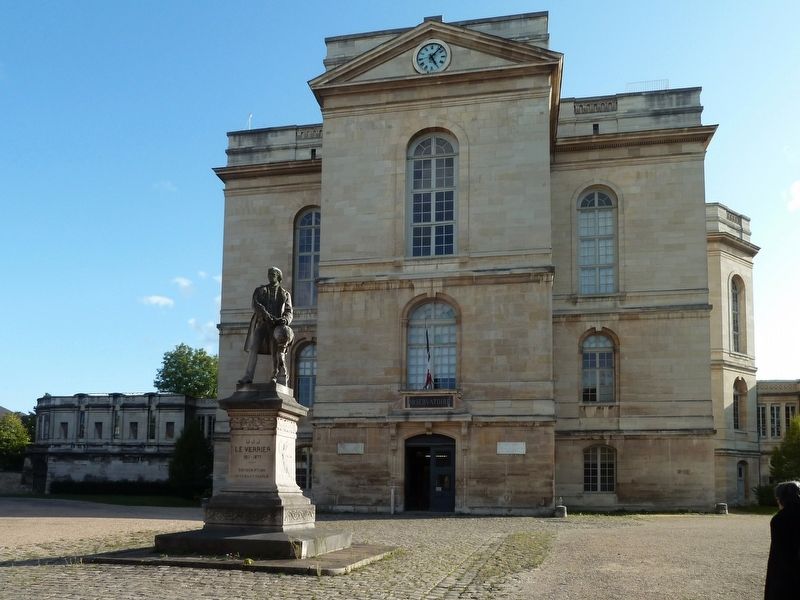
2. Wider View Showing Front of Observatory
The marker is on the wall of the building, to the right of the main door. In the foreground is a statue of the famous astronomer Urbain J. J. Le Verrier (1811-1877).
Roemer's value (214,000 kilometers per second) was fairly crude, mainly because he did not accurately know the size of the Earth's orbit. The modern value for the speed of light is just over 299,792 kilometers per second.
(Some of these details are from K. D. Froome and L. Essen, The Velocity of Light and Radio Waves, Academic Press, 1969.)
Photographed by Roger W. Sinnott, October 2, 2019
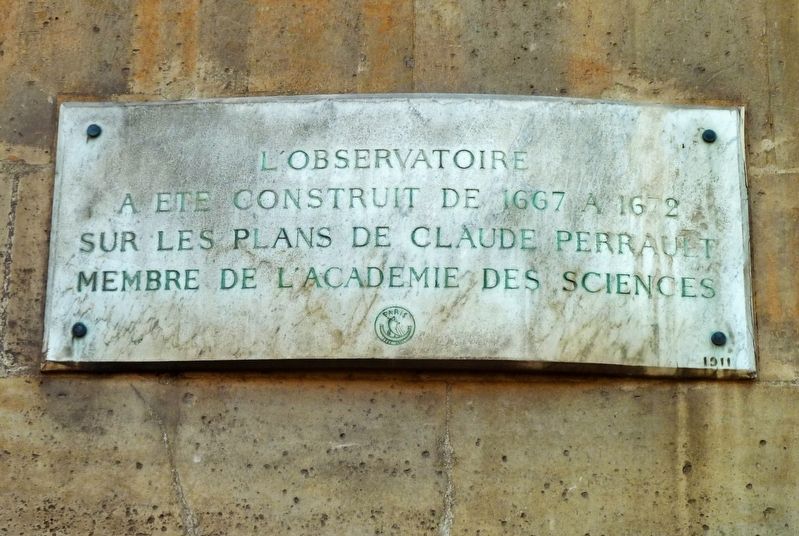
3. Another Marker on Front of Observatory
To the left of the main door is this plaque, which reads in translation, "The observatory was constructed from 1667 to 1672 on the plans of Claude Perrault, member of the Academy of Sciences."
Photographed by Jacob Coning (via Wikimedia Commons), circa 1700
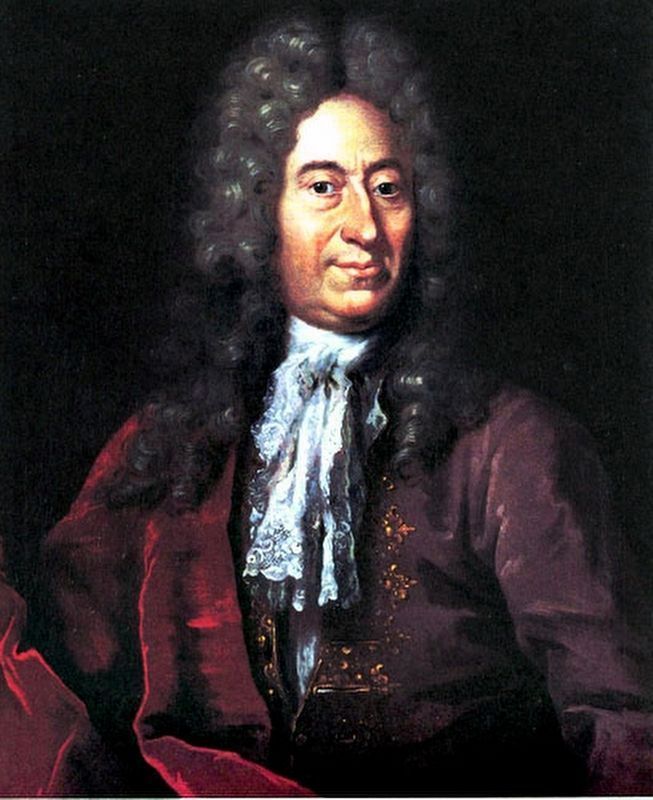
4. Ole Roemer (1644-1710)
This portrait of the astronomer was made in about 1700 by Dutch-Danish painter Jacob Coning.
Credits. This page was last revised on January 30, 2023. It was originally submitted on July 27, 2021, by Roger W. Sinnott of Norwell, Massachusetts. This page has been viewed 328 times since then and 37 times this year. Last updated on August 2, 2021, by Roger W. Sinnott of Norwell, Massachusetts. Photos: 1, 2, 3, 4. submitted on July 27, 2021, by Roger W. Sinnott of Norwell, Massachusetts. • J. Makali Bruton was the editor who published this page.
