Unionville in Putnam County, Missouri — The American Midwest (Upper Plains)
Unionville
Photographed by Cosmos Mariner, August 15, 2021
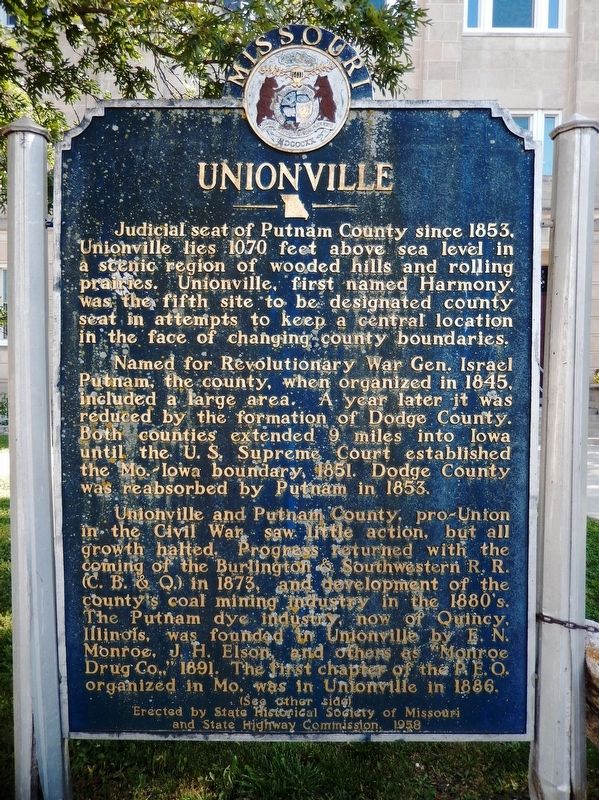
1. Unionville Marker (side 1)
[side 1]
Judicial seat of Putnam County since 1853, Unionville lies 1070 feet above sea level in a scenic region of wooded hills and rolling prairies. Unionville, first named Harmony, was the fifth site to be designated county seat in attempts to keep a central location in the face of changing county boundaries.
Named for Revolutionary War Gen. Israel Putnam, the county, when organized in 1845, included a large area. A year later it was reduced by the formation of Dodge County. Both counties extended 9 miles into Iowa until the U.S. Supreme Court established the Mo.-Iowa boundary, 1851. Dodge County was reabsorbed by Putnam in 1853.
Unionville and Putnam County, pro-Union in the Civil War, saw little action, but all growth halted. Progress returned with the coming of the Burlington & Southwestern R.R. (C.B. & Q.) in 1873, and development of the county's coal mining industry in the 1880's. The Putnam dye industry, now of Quincy, Illinois, was founded in Unionville by E. N. Monroe, J. H. Elson, and others as "Monroe Drug Co.," 1891.1 The first chapter of the P.E.O. organized in Mo. was in Unionville in 1886.
[side 2]
Unionville
this page online
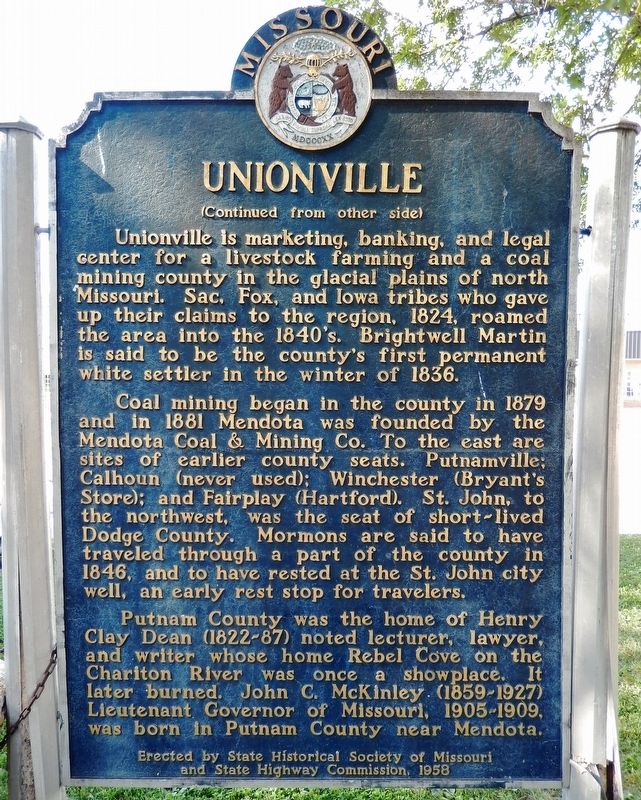
Coal mining began in the county in 1879 and in 1881 Mendota was founded by the Mendota Coal & Mining Co. To the east are sites of earlier county seats, Putnamville; Calhoun (never used); Winchester (Bryant's Store); and Fairplay (Hartford). St. John, to the northwest, was the seat of short-lived Dodge County. Mormons are said to have traveled through a part of the county in 1846, and to have rested at the St. John city well, an early rest stop for travelers.
Putnam County was the home of Henry Clay Dean (1822-87) noted lecturer, lawyer, and writer whose home Rebel Cove on the Chariton River was once a showplace. It later burned. John C. McKinley (1859-1927) Lieutenant Governor of Missouri, 1905-1909, was born in Putnam County near Mendota.
Erected 1958 by State Historical Society of Missouri; and State
Photographed by Cosmos Mariner, August 15, 2021
2. Unionville Marker (side 2)
Topics and series. This historical marker is listed in these topic lists: Indigenous Peoples and Communities • Industry & Commerce • Railroads & Streetcars • Settlements & Settlers. In addition, it is included in the Missouri, The State Historical Society of series list. A significant historical year for this entry is 1853.
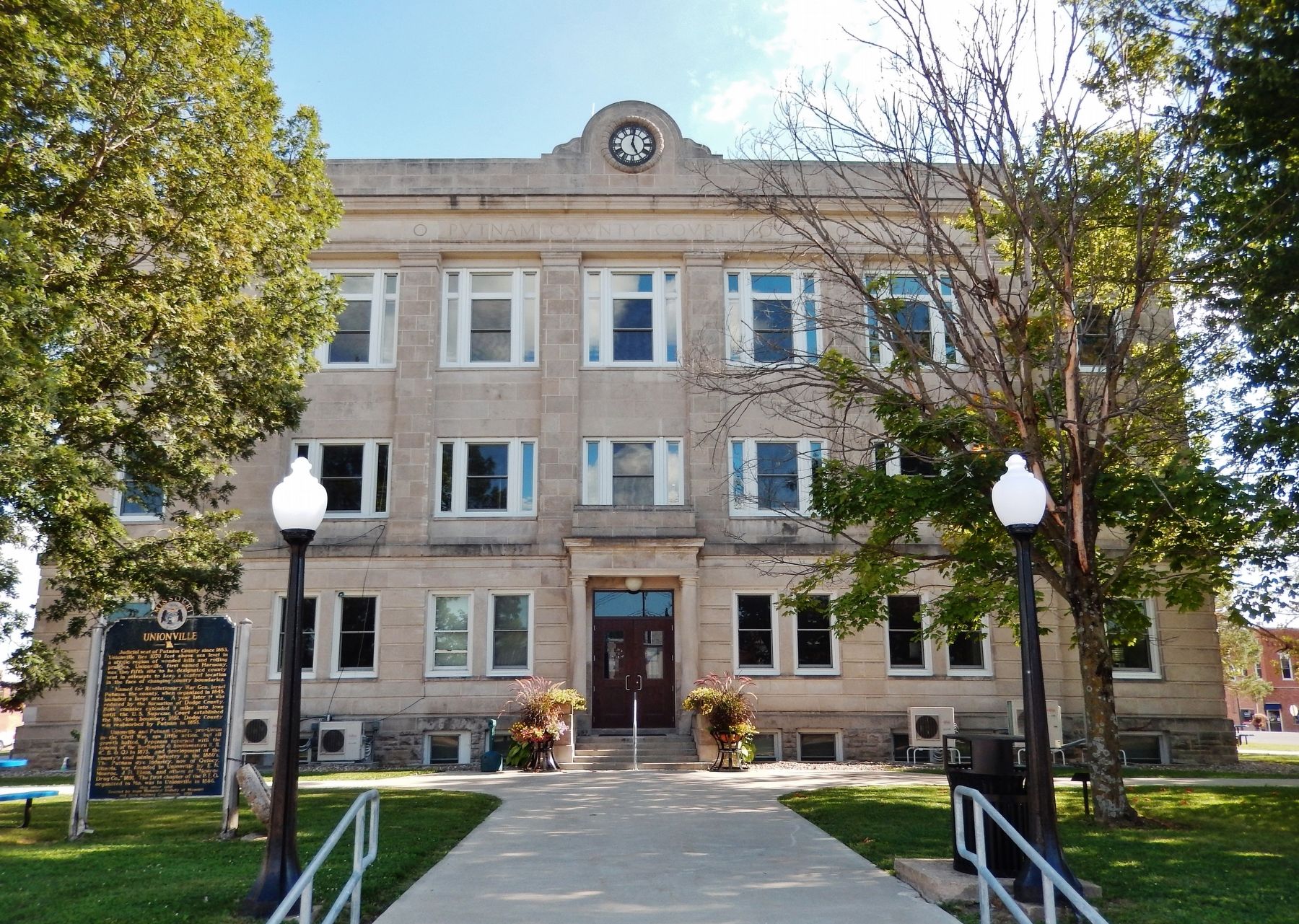
Location. 40° 28.604′ N, 93° 0.148′ W. Marker is in Unionville, Missouri, in Putnam County. It is on Main Street (U.S. 136) just east of South 17th Street, on the right when traveling east. Marker is located beside the sidewalk, directly in front of the Putnam County Courthouse. Touch for map. Marker is at or near this postal address: 1601 Main Street, Unionville MO 63565, United States of America. Touch for directions.

Regionally, this marker is in North Missouri. It is also in the American Midwest, in the Lewis & Clark Corridor, and in the Corn Belt. Globally, it is in North America, the Western Hemisphere, the Western World, and the Anglosphere. Historically, it finds itself in what was once the territory of the Mississippian Culture, the Louisiana Purchase, and the

Photographed by Cosmos Mariner, August 15, 2021
3. Unionville Marker
Other nearby markers. At least 5 other markers are within walking distance of this marker: Basking Ridge Oak (here, next to this marker); Continental Flight 11 Memorial (a few steps from this marker); Johnny Appleseed Tree (within shouting distance of this marker); Clark Coffeetree (within shouting distance of this marker); Moon Sycamore (within shouting distance of this marker).
Also see . . .
1. Unionville, Missouri (Wikipedia). Unionville was first named Harmony when established in 1853 as the county seat for Putnam County. Prior to that the county seat had moved several times, often with heated debate, thus the centralized location hoping to bring "harmony" to all concerned. (Submitted on August 18, 2021, by Cosmos Mariner of Cape Canaveral, Florida.)
2. Putnam County (Wikipedia). In the 1860 U.S. Census Putnam County had 9,240 residents, with eighteen sawmills and three flour mills. Coal had been an abundant since its earliest settlement, and coal mining became a major industry. At one time three railroads crossed Putnam county: the Chicago, Milwaukee and St. Paul; the Chicago, Burlington
Photographed by Cosmos Mariner, August 15, 2021
4. Putnam County Courthouse (north/front elevation)
Credits. This page was last revised on September 3, 2021. It was originally submitted on August 17, 2021, by Cosmos Mariner of Cape Canaveral, Florida. This page has been viewed 1,801 times since then and 191 times this year. Photos: 1, 2, 3, 4. submitted on August 18, 2021, by Cosmos Mariner of Cape Canaveral, Florida.
