Vincennes in Knox County, Indiana — The American Midwest (Great Lakes)
LVT-4
Landing Vehicle Tracked
A.K.A. Alligator
Photographed by Jason Voigt, July 23, 2021
1. LVT-4 Marker
Inscription.
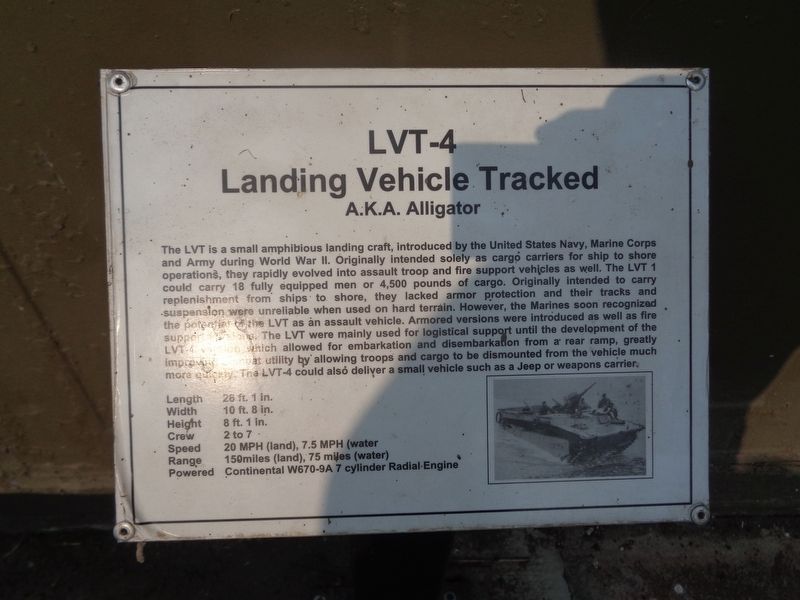
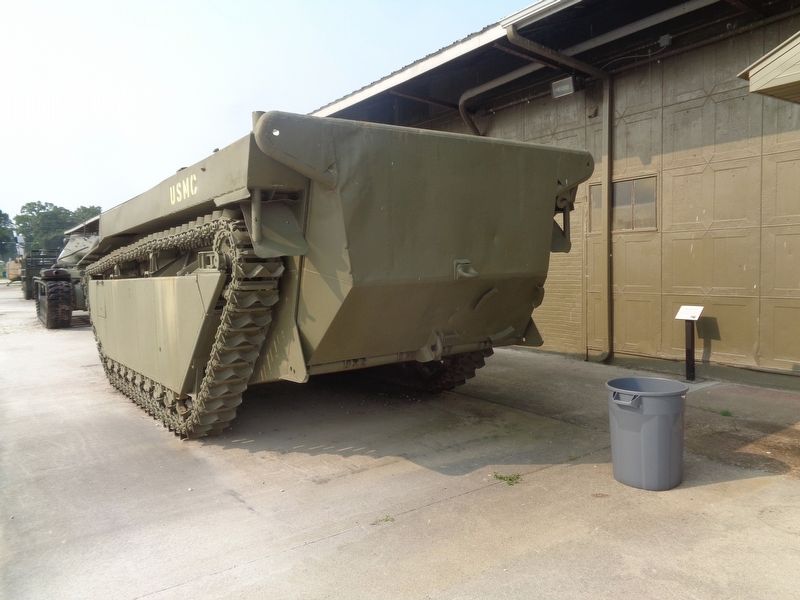
LVT-4. Landing Vehicle Tracked. The LVT is a small amphibious landing craft, introduced by the United States Navy, Marine Corps and Army during World War II. Originally intended solely as cargo carriers for ship to shore operations, they rapidly evolved into assault troop and fire support vehicles as well. The LVT 1 could carry 18 fully equipped men or 4,500 pounds of cargo. Originally intended to carry replenishment from ships to shore, they lacked armor protection and their tracks and suspension were unreliable when used on hard terrain. However, the Marines soon recognized the potential of the LVT as an assault vehicle. Armored versions were introduced as well as fire support (unreadable). The LVT were mainly used for logistical support until the development of the LVT-4 (unreadable) which allowed for embarkation and disembarkation from a rear ramp, greatly improving combat utility by allowing troops and cargo to be dismounted from the vehicle much more quickly. The LVT-4 could also deliver a small vehicle such as a Jeep or weapons carrier. , Length - 26 ft. 1 in. , Width - 10 ft. 8 in. , Height - 8 ft. 1 in. , Crew - 2 to 7 , Speed - 20 MPH (land), 7.5 MPH (water) , Range - 150 miles (land), 75 miles (water) , Powered - Continental W670-9A 7 cylinder Radial-Engine
The LVT is a small amphibious landing craft, introduced by the United States Navy, Marine Corps and Army during World War II. Originally intended solely as cargo carriers for ship to shore operations, they rapidly evolved into assault troop and fire support vehicles as well. The LVT 1 could carry 18 fully equipped men or 4,500 pounds of cargo. Originally intended to carry replenishment from ships to shore, they lacked armor protection and their tracks and suspension were unreliable when used on hard terrain. However, the Marines soon recognized the potential of the LVT as an assault vehicle. Armored versions were introduced as well as fire support (unreadable). The LVT were mainly used for logistical support until the development of the LVT-4 (unreadable) which allowed for embarkation and disembarkation from a rear ramp, greatly improving combat utility by allowing troops and cargo to be dismounted from the vehicle much more quickly. The LVT-4 could also deliver a small vehicle such as a Jeep or weapons carrier.
Length - 26 ft. 1 in.
Width - 10 ft. 8 in.
Height - 8 ft. 1 in.
Crew - 2 to 7
Speed - 20 MPH (land), 7.5
Click or scan to see this page online
MPH (water)
Range - 150 miles (land), 75 miles (water)
Powered - Continental W670-9A 7 cylinder Radial-Engine
Topics. This historical marker is listed in this topic list: Roads & Vehicles.
Location. 38° 40.398′ N, 87° 32.281′ W. Marker is in Vincennes, Indiana, in Knox County. It can be reached from South 6th Street west of Willow Street (Business U.S. 41). Marker is located on the grounds of Indiana Military Museum. Touch for map. Marker is at or near this postal address: 715 S 6th St, Vincennes IN 47591, United States of America. Touch for directions.

Regionally, this marker is in Indiana’s Tri-State Region, in Southern Indiana, and in the Wabash Valley. It is also in the American Midwest and in the Corn Belt. Globally, it is in North America, the Western Hemisphere, the Western World, and the Anglosphere. Historically, it finds itself in what was once the Viceroyalty of New France, the territory of the Mississippian Culture, and the Northwest Territory.
Other nearby markers. At least 8 other markers are within walking distance of this marker: M-47 (a few steps
Credits. This page was last revised on September 1, 2021. It was originally submitted on September 1, 2021, by Jason Voigt of Glen Carbon, Illinois. This page has been viewed 332 times since then and 33 times this year. Photos:1, 2. submitted on September 1, 2021, by Jason Voigt of Glen Carbon, Illinois.