Fremont in Sandusky County, Ohio — The American Midwest (Great Lakes)
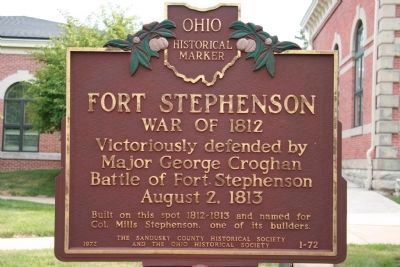
Fort Stephenson
War of 1812
Photographed by Dale K. Benington, August 6, 2008
1. Fort Stephenson Marker (front)
Victoriously defended by Major George Croghan. Battle of Fort Stephenson, August 2, 1813.
Built on this spot 1812-1813 and named for Col. Mills Stephenson, one of its builders.
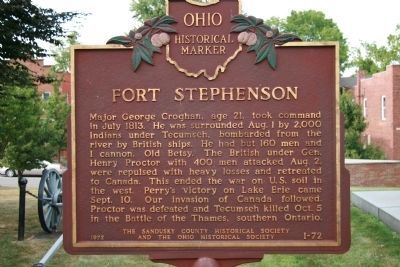
Major George Croghan, age 21, took command in July 1813. He was surrounded Aug. 1 by 2,000 Indians under Tecumseh, bombarded from the river by British ships. He had but 160 men and 1 cannon, Old Betsy. The British under Gen. Henry Proctor with 400 men attacked Aug. 2, were repulsed with heavy loses and retreated to Canada. This ended the war on U.S. soil in the west. Perry's victory on Lake Erie came Sept. 10. Our invasion of Canada followed. Proctor was defeated and Tecumseh killed Oct. 5 in the Battle of the Thames, southern Ontario.
Erected 1972 by The Sandusky County Historical Society and The Ohio Historical Society. (Marker Number 1-72.)
Topics and series. This historical marker is listed in these topic lists: Forts and Castles • Indigenous Peoples and Communities • War of 1812. In addition, it is included in the Ohio Historical Society / The Ohio History Connection series list. A significant historical month for this entry is July 1813.
Location. 41° 20.766′ N,
this page online

Regionally, this marker is on the Lake Erie Shore and in the Toledo Metropolitan Area. It is also in the American Midwest and in the Corn Belt. Globally, it is in North America, on the Great Lakes, in the Western Hemisphere, in the Western World, and in the Anglosphere. Historically, it finds itself in what was once the Viceroyalty of New France, the Haudenosaunee (Iroquois) Confederacy, the territory of the Mississippian Culture, and the Northwest Territory.
Other nearby markers. At least 8 other markers are within walking distance of this marker: A different marker also named Fort Stephenson (a few steps from this marker); Old Betsy (within shouting distance
Photographed by Dale K. Benington, August 6, 2008
2. Fort Stephenson Marker (reverse)
Another marker is no longer nearby. In Commemoration (was about 400 feet away, measured in a direct line but has been confirmed missing).
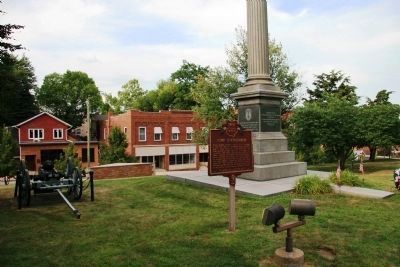
More about this marker. This historical marker is located on a rise, overlooking the Sandusky River Valley, on the former site of Fort Stephenson, surrounded by a cluster of additional memorials, plaques, and monuments, all of which are there to commemorate the events that took place at Fort Stephenson during the war of 1812.
Regarding Fort Stephenson. As part of his preparations to recapture Detroit and invade Canada, General William Henry Harrison built a chain of forts northward, along both the Sandusky River Valley and the Sandusky-Scioto Trail, from what is now Upper Sandusky, Ohio (Fort Ferree), to what is now Tiffin, Ohio (Fort Ball), to what is
Photographed by Dale K. Benington, August 6, 2008
3. Fort Stephenson Monument and Marker
The British General Henry Proctor, on the other hand, was seeking to take the battle to the Americans and deal them a set back in their invasion plans. He had been unsuccessful in his attempt to hand the Americans a major defeat in his seige of Fort Meigs on the Maumee River, but rather than returning to Canada and appearing weak to his Native American allies he sought to gain some advantage by attacking what he felt would be a softer and more vulnerable target, the considerably smaller fortification and garrison at Fort Stephenson on the banks of the Sandusky River.
Photographed by Dale K. Benington, August 6, 2008
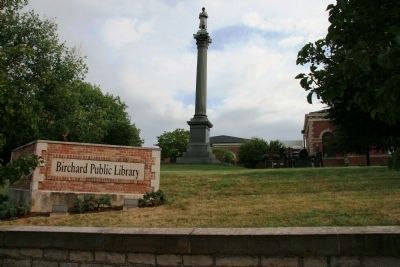
4. Fort Stephenson /Birchard Public Library
View of the rise that Fort Stephenson was built on, and the current site of the Birchard Public Library
Internet Archive
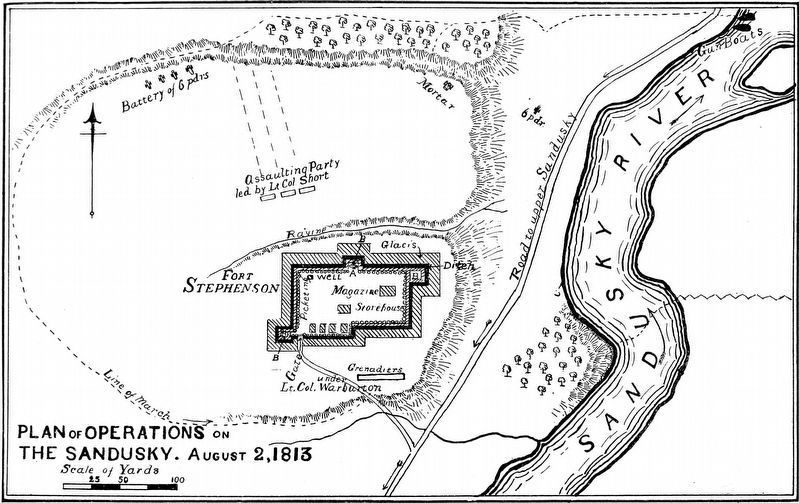
5. Plan of Operations
The Sandusky
August 2, 1813
The Sandusky
August 2, 1813
This map of Fort Stephenson and the Sandusky River August 2, 1813 appeared in The War of 1812 by John Richardson and Alexander Clark Casselman 1902.
Credits. This page was last revised on November 13, 2024. It was originally submitted on April 19, 2009, by Dale K. Benington of Toledo, Ohio. This page has been viewed 3,819 times since then and 218 times this year. Photos: 1, 2, 3, 4. submitted on April 19, 2009, by Dale K. Benington of Toledo, Ohio. 5. submitted on April 23, 2018, by Allen C. Browne of Silver Spring, Maryland. • Kevin W. was the editor who published this page.
