Summerfield in Claiborne Parish, Louisiana — The American South (West South Central)
Scottsville
⎯⎯⎯
Corney Bayou
Photographed by Wesley Harris, September 2, 2021
1. Scottsville Marker
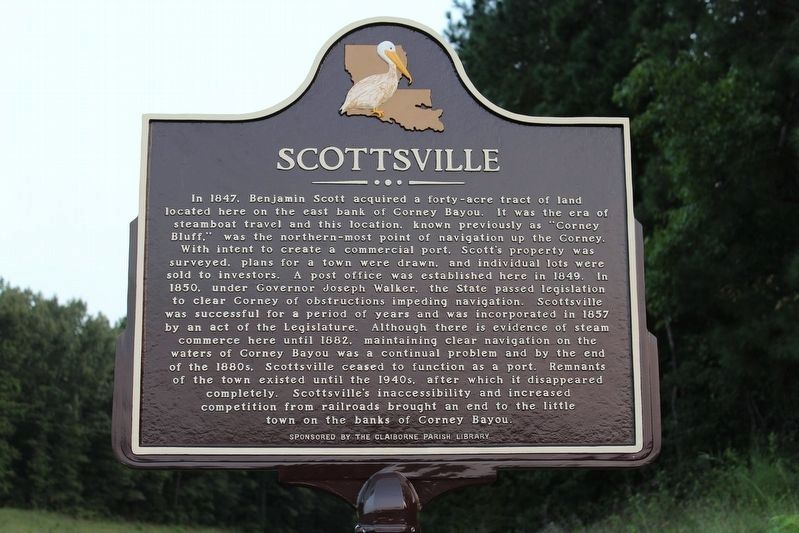
Scottsville. In 1847, Benjamin Scott acquired a forty-acre tract of land located here on the east bank of Corney Bayou. It was the era of steamboat travel and this location, previously known as "Corni Bluff," was the northern-most point of navigation up the Corney. With intent to create a commercial port, Scott's property was surveyed, plans for a town were drawn, and individual lots were sold to investors. A post office was created here in 1849. In 1850, under Governor Joseph Walker, the State passed legislation to clear Corney of obstructions impeding navigation. Scottsville was successful for a period of years and was incorporated in 1857 by an act of the Legislature. Although there is evidence of steam commerce here until 1882, maintaining clear navigation on the waters of Corney Bayou was a continual problem and by the end of the 1880s, Scottsville ceased to function as a port. Remnants of the town existed until the 1940s, after which it disappeared completely. Scottsville's inaccessibility and increased competition from railroads brought an end to the little town on the banks of Corney Bayou.
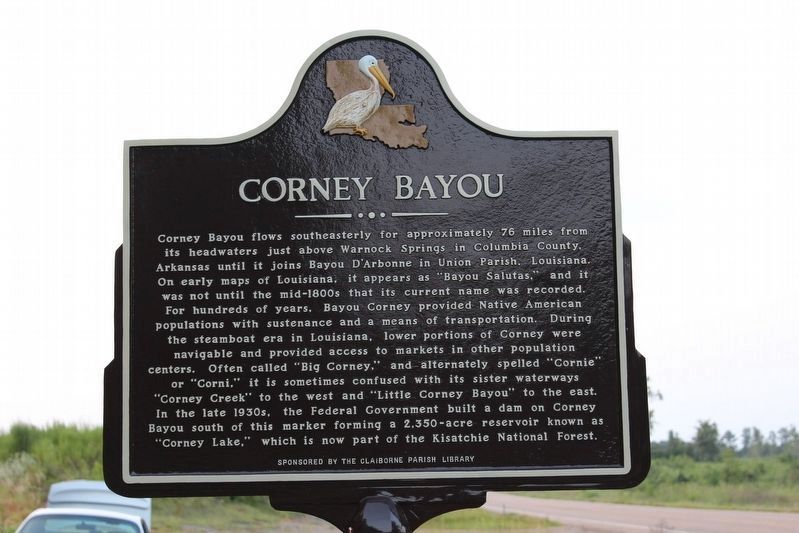
Corney Bayou. Corney
this page online
Erected 2021 by the Claiborne Parish Library.
Topics. This historical marker is listed in these topic lists: Indigenous Peoples and Communities • Industry & Commerce •
Photographed by Wesley Harris
2. Corney Bayou Marker
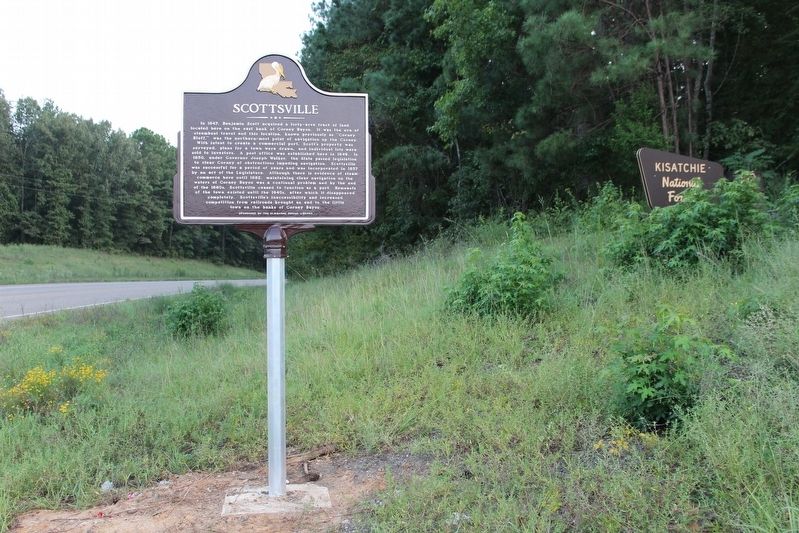
Location. 32° 56.368′ N, 92° 45.984′ W. Marker is in Summerfield, Louisiana, in Claiborne Parish. It is on Louisiana Route 9 half a mile north of Corney Lake Boat Ramp Road, on the left when traveling north. Lcoated north of the Corney Bayou Bridge in the Kisatchie National Forest. Touch for map. Marker is in this post office area: Summerfield LA 71079, United States of America. Touch for directions.

Regionally, this marker is in North Louisiana. It is also in the American South, specifically in the Deep South, and in the Piney Woods. Globally, it is in North America, a Gulf of Mexico state, the Western Hemisphere, the Western World, and the Anglosphere. Historically, it finds itself in what was once the territory of the Mississippian Culture, the Louisiana Purchase, one of the Confederate States of America, and the Antebellum South.
Other nearby markers. At least 8 other markers are within 11 miles of this marker, measured as the crow flies: Junction City (approx. 5.7 miles away in Arkansas); Alabama Methodist Church (approx.
Photographed by Wesley Harris
3. Scottsville/Corney Bayou Marker
Regarding Scottsville / Corney Bayou. One of the steamboats that frequented Scottsville was the St. Francis Belle. Contact the Claiborne Parish Library for more information.
Additional commentary.
1.
The text of this marker was researched, composed and submitted to the Louisiana State Office of Tourism by Vincent P. Ory and Beverly E. Smith of Claiborne Parish. The Claiborne Parish Public Library was the Sponsor.
— Submitted June 1, 2025, by Vincent P. Ory of Lisbon, Louisiana.
Credits. This page was last revised on June 14, 2025. It was originally submitted on September 3, 2021, by Wesley Harris of Ruston, Louisiana. This page has been viewed 1,691 times since then and 82 times this year. Last updated on June 1, 2025, by Vincent P. Ory of Lisbon, Louisiana. Photos: 1, 2, 3. submitted on September 3, 2021, by Wesley Harris of Ruston, Louisiana. • Devry Becker Jones was the editor who published this page.
