Farmville in Prince Edward County, Virginia — The American South (Mid-Atlantic)
First Baptist Church
Farmville, Virginia
| — | Prince Edward County | — |
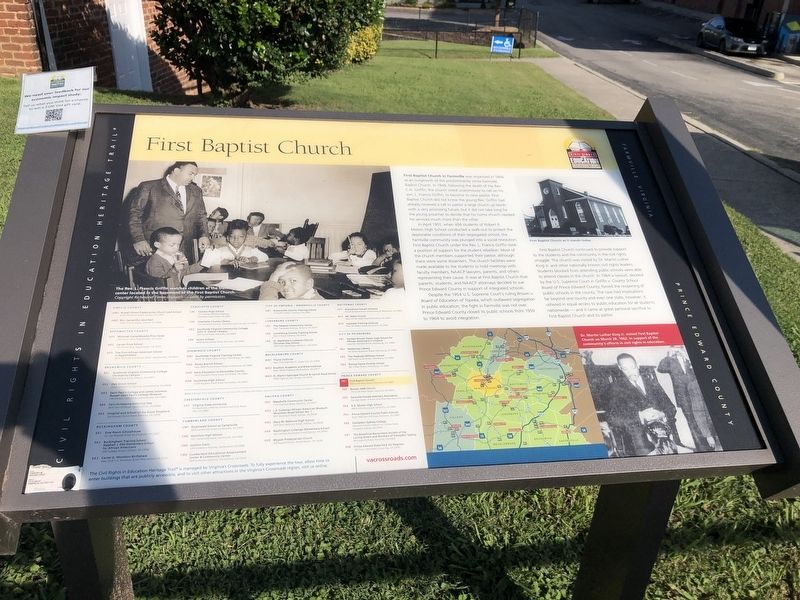
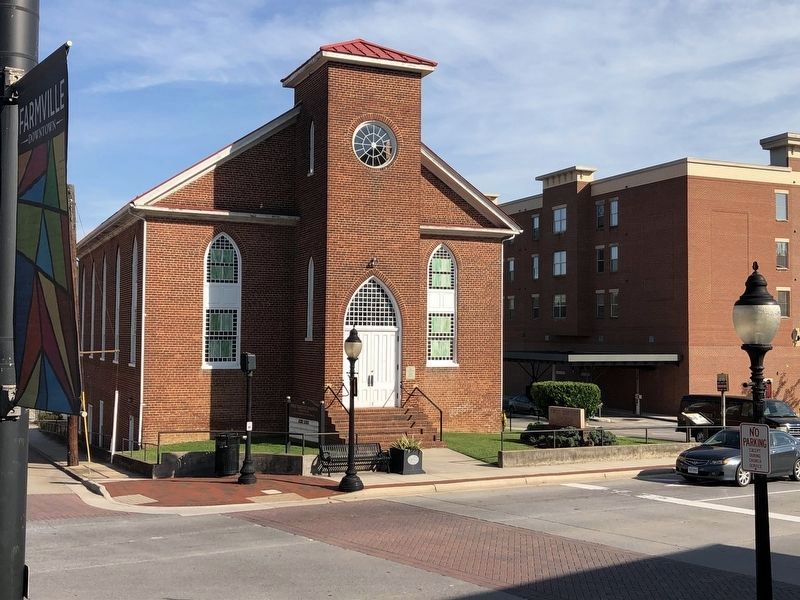
First Baptist Church in Farmville was organized in 1866 as an outgrowth of the predominantly white Farmville Baptist Church. In 1949, following the death of the Rev. C.H. Griffin, the church voted unanimously to call on his son, L. Francis Griffin, to become its new pastor. First Baptist Church did not know the young Rev. Griffin had already received a call to pastor a large church up North with a very promising future, but it did not take long for the young preacher to decide that his home church needed his services much more than the other.
In April 1951, when 456 students of Robert R. Moton High School conducted a walk-out to protest the deplorable conditions of their segregated school, the Farmville community was plunged into a social revolution. First Baptist Church under the Rev. L. Francis Griffin took a position of support for the student rebellion. Most of the church members supported their pastor, although there were some dissenters. The church facilities were made available to the students to hold meetings with faculty members, NAACP lawyers, parents, and others representing their cause. It was at First
this page online
Despite the 1954 U.S. Supreme Court's ruling Brown v. Board of Education of Topeka, which outlawed segregation in public education, the fight in Farmville was not over. Prince Edward County closed its public schools from 1959 to 1964 to avoid integration.
First Baptist Church continued to provide support to the students and the community in the civil rights struggle. The church was visited by Dr. Martin Luther King Jr. and other nationally known civil rights leaders. Students blocked from attending public schools were able to attend classes in the church. In 1964 a lawsuit, decided by the U.S. Supreme Court in Griffin v. County School Board of Prince Edward County, forced the reopening of public schools in the county. The case had implications far beyond one county and even one state, however; it ushered in equal access to public education for all students nationwide — and it came at great personal sacrifice to First Baptist Church and its pastor.
[Caption:]
Dr. Martin Luther King Jr. visited First Baptist Church on March 28, 1962, in support of the community's efforts in civil rights in education.
Erected by Civil
Topics and series. This historical marker is listed in these topic lists: African Americans • Civil Rights • Education • Religion & Religious Structures. In addition, it is included in the Civil Rights in Education Heritage Trail, and the Martin Luther King, Jr. series lists. A significant historical date for this entry is March 28, 1962.
Location. 37° 18.049′ N, 78° 23.59′ W. Marker is in Farmville, Virginia, in Prince Edward County. It is on North Main Street (Business U.S. 15) just south of 4th Street, on the right when traveling north. Touch for map. Marker is at or near this postal address: 100 N Main St, Farmville VA 23901, United States of America. Touch for directions.

Regionally, this marker is in the Piedmont, in Southside Virginia, and specifically in Central Virginia. It is also in the American South and specifically in the Upper South. Globally, it is in North America, the Western Hemisphere, the Western World, and the Anglosphere. Historically, it finds itself in what was once the territory of the Mississippian Culture, one of the original Thirteen Colonies, one of the Confederate States of America, and the Antebellum South.
Other nearby markers. At least 8 other markers are within walking distance of this marker: A different marker also named First Baptist Church (here, next to this marker); Main Street / Mayor J. David Crute / EACO Theatre (within shouting distance of this marker); a different marker also named Beulah AME Church (within shouting distance of this marker); World War II Memorial (about 300 feet away, measured in a direct line); World War I Memorial (about 300 feet away); Veterans Memorial (about 300 feet away); The Light of Reconciliation / Now, Therefore Be It Resolved, (about 400 feet away); Dr. William W. H. Thackston (about 500 feet away). Touch for a list and map of all markers in Farmville.
Other markers no longer nearby. First Baptist Church (was a few steps from this marker but has been replaced with another marker now near it); Beulah AME Church (was within shouting distance of this marker but has been replaced with another marker now near it).
Related marker. Click here for another marker that is related to this marker. This marker has replaced the linked marker.
Credits. This page was last revised on September 6, 2021. It was originally submitted on September 6, 2021, by Devry Becker Jones of Washington, District of Columbia. This page has been viewed 742 times since then and 60 times this year. Photos: 1, 2. submitted on September 6, 2021, by Devry Becker Jones of Washington, District of Columbia.
