Locke in Sacramento County, California — The American West (Pacific Coastal)
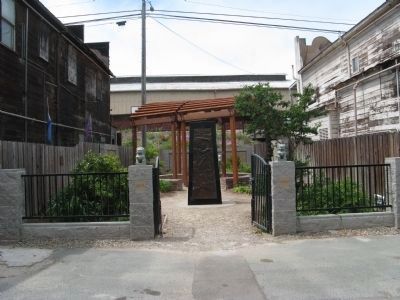
Locke Memorial Park
Photographed by Syd Whittle, April 23, 2009
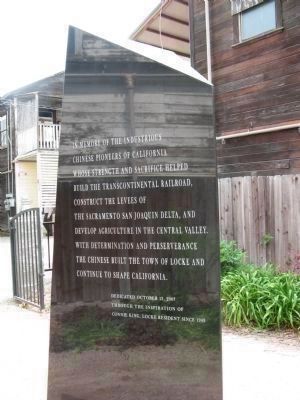
1. Locke Memorial Park Marker
Northwest side of the three sided monument.
In memory of the industrious Chinese pioneers of California whose strength and sacrifice helped build the transcontinental railroad, construct the levees of the Sacramento San Joaquin Delta, and develop agriculture in the Central Valley. With determination and perserverance the Chinese built the town of Locke and continue to shape California.
Dedicated October 13, 2007 through the inspiration of Connie King, Locke resident since 1948.
Erected 2007 by Inspiration of Connie King, Locke Resident.
Topics and series. This historical marker is listed in these topic lists: Asian Americans • Parks & Recreational Areas • Settlements & Settlers. In addition, it is included in the Chinese Heritage Sites of the American West, and the National Historic Landmarks series lists. A significant historical date for this entry is October 13, 1990.
Location. 38° 15.047′ N, 121° 30.589′ W. Marker is in Locke, California, in Sacramento County. It is on Main Street, on the right when traveling south. Touch for map. Marker is at or near this
this page online

Regionally, this marker is in Sacramento Metro, in the Sacramento Valley, and specifically in the Central Valley. It is also on the American Pacific Coast. Globally, it is in North America, on the Ring of Fire, on the Pacific Rim, in the Western Hemisphere, in the Western World, and in the Anglosphere. Historically, it finds itself in what was once New Spain and also Mexico’s Alta California.
Other nearby markers. At least 8 other markers are within walking distance of this marker: Locke (here, next to this marker); 打更 The Bok Bok Man 更夫 (within shouting distance of this marker); Al the Wop's / Bing Lee's Noodle House (within shouting distance of this marker); Locke Chinese School Museum (within shouting distance of this marker); Welcome to Locke (within shouting distance of this marker); Locke, California (within shouting distance of this marker); a different marker also named Locke (about
Photographed by Syd Whittle, April 23, 2009
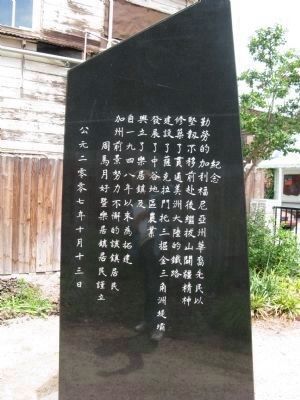
2. Locke Memorial Park Marker
Southwest side of the three-sided monument.
Regarding Locke Memorial Park. The Locke Historical District has been designated as a National Historical Landmark.
Statement of Significance (as of designation - December 14, 1990):
Founded in 1915, Locke is the largest and most intact surviving example of an historic rural Chinese-American community in the United States, including more than 50 commercial and residential frame buildings and covering approximately 14 acres along the east bank of the Sacramento River, south of the city of Sacramento. Locke is the only such community remaining in the Sacramento-San Joaquin River Delta, which was a particularly important area of rural Chinese settlement.
Locke Historical District was placed on the National Register of Historic Places on May 6, 1971.
Also see . . .
1. Photos of the Town of Locke. Library of Congress entry. (Submitted on April 24, 2009, by Syd Whittle of Mesa, Arizona.)
2. Locke Historic District, CA.
Photographed by Syd Whittle, April 23, 2009
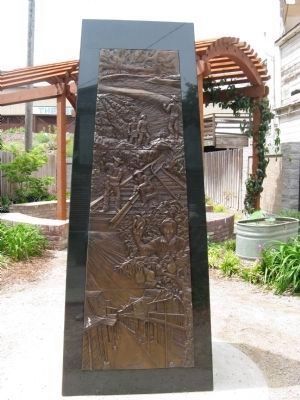
3. Locke Memorial Park Marker
Additional commentary.
1. History of Locke
Established in 1915, Locke is the only existing town in America built and inhabited almost exclusively by Chinese until recent years. During its heyday from the 1920's to 1940's, Locke was an island of Chinese culture with a permanent population of about 600, including many families, and a seasonal farm labor population of an additional thousand. At one time it had four restuarants, a half dozen markets, dry goods stores, five brothels, a post office, two slaughter houses, a flour mill, canneries, shipping wharves, an opera, speakeasies during Prohibition, and five gambling houses.
Source: Locke Foundation Brochure
— Submitted April 24, 2009, by Syd Whittle of Mesa, Arizona.
Additional keywords. Chinese Americans
Photographed by Syd Whittle, April 23, 2009
4. Locke Memorial Park
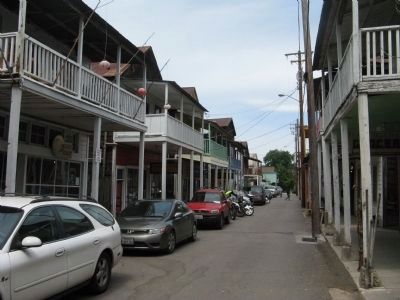
Photographed by Syd Whittle, April 23, 2009
5. Main Street
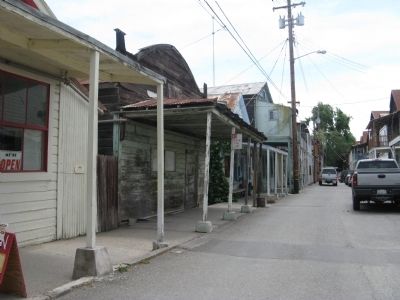
Photographed by Syd Whittle, April 23, 2009
6. Main Street
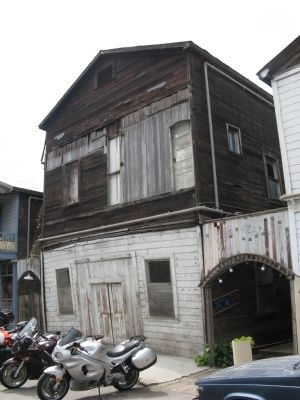
Photographed by Syd Whittle, April 23, 2009
7. The Star Theater
Served as a Chinese opera house, gambling den, and a brothel.
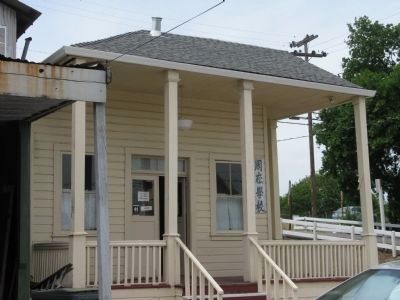
Photographed by Syd Whittle, April 23, 2009
8. Locke Chinese School
A language school, established in 1926, for the children of Locke.
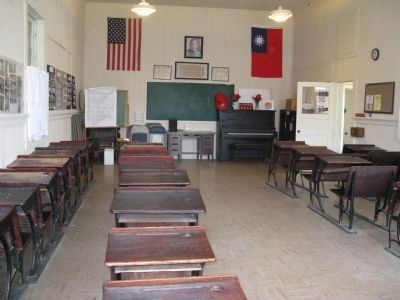
Photographed by Syd Whittle, April 21, 2009
9. Interior of the School
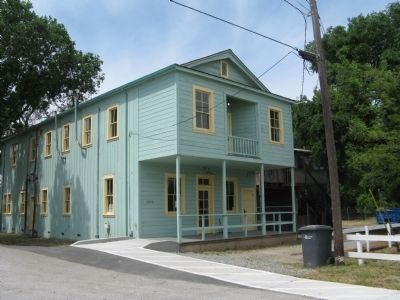
Photographed by Syd Whittle, April 23, 2009
10. Locke Boarding House Vistors' Center
An exhibit and research facility open to the public.
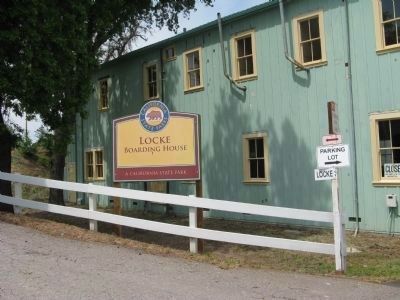
Photographed by Syd Whittle, April 21, 2009
11. Locke Boarding House
This building is a California State Park.
Credits. This page was last revised on July 17, 2025. It was originally submitted on April 24, 2009, by Syd Whittle of Mesa, Arizona. This page has been viewed 2,636 times since then and 104 times this year. Photos: 1, 2, 3, 4, 5, 6, 7, 8. submitted on April 24, 2009, by Syd Whittle of Mesa, Arizona. 9. submitted on December 27, 2009, by Syd Whittle of Mesa, Arizona. 10. submitted on April 24, 2009, by Syd Whittle of Mesa, Arizona. 11. submitted on December 27, 2009, by Syd Whittle of Mesa, Arizona.
