Lincoln in Middlesex County, Massachusetts — The American Northeast (New England)
At This Well
Photographed by Bill Coughlin, April 17, 2009
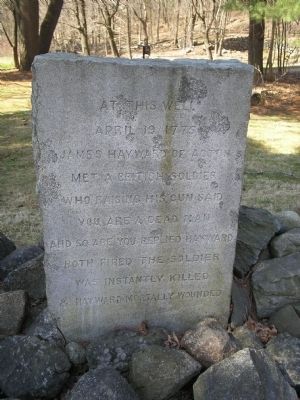
1. At This Well Marker
April 19, 1775
James Hayward of Acton
met a British soldier
who raising his gun said
You are a dead man.
And so are you, replied Hayward
Both fired. The soldier
was instantly killed
& Haywood mortally wounded.
Topics. This historical marker is listed in these topic lists: Notable Events • War, US Revolutionary. A significant historical month for this entry is April 1870.
Location. 42° 26.827′ N, 71° 15.403′ W. Marker is in Lincoln, Massachusetts, in Middlesex County. It is on Battle Road, on the right when traveling east. Marker is located in the extreme eastern part of Minute Man National Historic Park, along the Battle Road. Touch for map. Marker is in this post office area: Lincoln MA 01773, United States of America. Touch for directions.

Regionally, this marker is in Greater Boston. It is also in the American Northeast, in New England, and on the Eastern Seaboard. Globally, it is in the North Atlantic Region, North America, the Western Hemisphere, the Western World, and the Anglosphere. Historically, it finds itself in what was once one of the original Thirteen Colonies.
Other nearby markers. At least 8 other
this page online
Also see . . .
1. Minute Man National Historical Park. National Park Service website. (Submitted on April 24, 2009, by Bill Coughlin of Woodland Park, New Jersey.)
2. The Battle of Concord. The American Revolutionary War website. (Submitted on May 7, 2009, by Bill Coughlin of Woodland Park, New Jersey.)
Additional commentary.
1. Placement of Hayward Well and area of shooting incident.
Besides Mr. Hayward, who lingered from his wounds for approximately 36 hours, there were no other witnesses who lived through the incident. What we know comes from Mr.
Photographed by Bill Coughlin, April 17, 2009
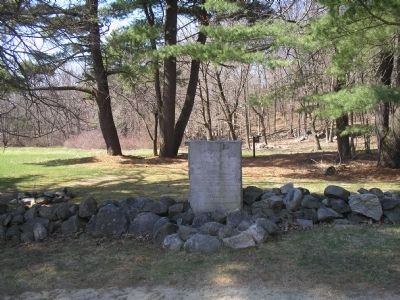
2. Marker on the Battle Road
The first published account appeared six days later in the Boston Gazette, and mentions that Hayward and a British regular were both killed drinking from a well. From there, the story begins to include an exchange of words, which most likely did happen.
The issue is the well. Multiple archaeological studies done on the property have uncovered five separate wells. The original published recollections claim the well was in the front yard; the current cairns behind the monument would place that well fifty or more feet to the left side of the house. It is now believed the incident most likely took place on the paved road to the southeast of the marker.
As many may know, there are photographs of a second Fiske House from the 19th century, in which the Hayward cairn and monument would place the well in the front yard. Also, the 19th-century well pump is the property of the Lexington Historical Society. Note To Editor only visible by Contributor and editor
Photographed by Bill Coughlin, April 17, 2009
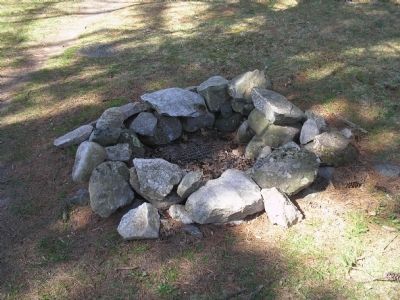
3. Colonial Well
This well was the site of the April 19, 1775 encounter between James Hayward and the British soldier which resulted in the death of both men.
— Submitted June 7, 2026, by Kevin J. Robichuad of Waltham, Commonwealth of Massachusetts.
Credits. This page was last revised on June 20, 2026. It was originally submitted on April 24, 2009, by Bill Coughlin of Woodland Park, New Jersey. This page has been viewed 2,046 times since then and 42 times this year. Photos: 1, 2, 3. submitted on April 24, 2009, by Bill Coughlin of Woodland Park, New Jersey.
