
Decatur in Macon County, Illinois — The American Midwest (Great Lakes)
Lincoln's First Speech
Looking for Lincoln
Photographed by Duane and Tracy Marsteller, October 10, 2021
1. Lincoln's First Speech Marker
Inscription.
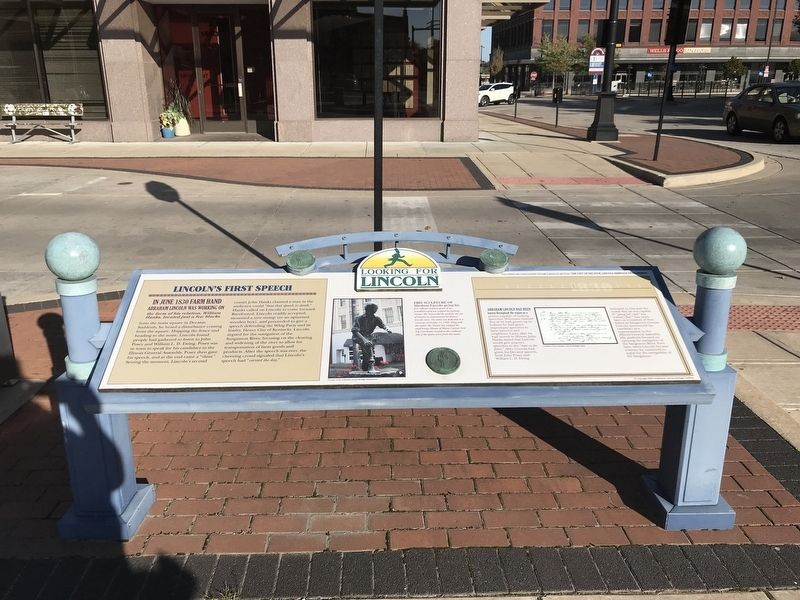
Lincoln's First Speech. Looking for Lincoln. In June 1830 farm hand Abraham Lincoln was working on the farm of his relation, William Hanks, just a few blocks from the main square in Decatur. Suddenly, he heard a disturbance coming from the square. Hopping the fence and heading to the noise, Lincoln found people had gathered to listen to John Posey and William L. D. Ewing. Posey was in town to speak for his candidacy to the Illinois General Assembly. Posey then gave his speech, and at the end came a shout. Seizing the moment, Lincoln's second cousin John Hanks claimed a man in the audience could beat that speech to death. Hanks called on Lincoln to come forward. Barefooted, Lincoln readily accepted, mounted a tree stump (or an upturned wooden box), and proceeded to give a speech defending the Whig Party and its leader, Henry Clay of Kentucky. Lincoln argued for the navigation of the Sangamon River, focusing on the clearing and widening of the river to allow for transportation of farm goods and products. After the speech was over, the cheering crowd signaled that Lincoln's speech had carried the day., Abraham Lincoln had been known known throughout the region as a person capable of making speeches. Witnesses claimed that as he had grown up in Indiana he had given impromptu speeches to farm laborers and neighbors. Later, after he had moved to Illinois, John Hanks stated that Lincoln would give practice speeches to the trees in the forest. After Lincoln had given his Decatur speech, both John Posey and William L. D. Ewing indicated to him and the crowd that he was capable of going far and was nobody's fool. Two years later, as a resident of New Salem in Sangamon County, Lincoln announced his candidacy as a representative to the Illinois General Assembly. His platform focused on opening the navigation of the Sangamon River. Even later, when Lincoln became a lawyer, he continued to argue for the navigability of the Sangamon., Caption: This sculpture of Abraham Lincoln giving his first official political speech to an assembled crowd was sculpted by Anthony Vestuto. Mr. Vestuto did the work for the city of Decatur to commemorate the historic Lincoln event. The statue was dedicated in a ceremony on October 12, 1968. Along with this statue, Mr. Vestuto also sculpted the small bronze likeness of Macon County's First Log Courthouse, located on the southwest side of the square across from this statue.
In June 1830 farm hand Abraham Lincoln was working on the farm of his relation, William Hanks, just a few blocks from the main square in Decatur. Suddenly, he heard a disturbance coming from the square. Hopping the fence and heading to the noise, Lincoln found people had gathered to listen to John Posey and William L. D. Ewing. Posey was in town to speak for his candidacy to the Illinois General Assembly. Posey then gave his speech, and at the end came a shout. Seizing the moment, Lincoln's second cousin John Hanks claimed a man in the audience could beat that speech to death. Hanks called on Lincoln to come forward. Barefooted, Lincoln readily accepted, mounted a tree stump (or an upturned wooden box), and proceeded to give a speech defending the Whig Party and its leader, Henry Clay of Kentucky. Lincoln argued for the navigation of the Sangamon River, focusing on the clearing and widening of the river to allow for transportation of farm goods and products. After the speech was over, the cheering crowd signaled that Lincoln's speech had carried the day.
Abraham Lincoln had been known known throughout the region
Click or scan to see this page online
as a person capable of making speeches. Witnesses claimed that as he had grown up in Indiana he had given impromptu speeches to farm laborers and neighbors. Later, after he had moved to Illinois, John Hanks stated that Lincoln would give practice speeches to the trees in the forest. After Lincoln had given his Decatur speech, both John Posey and William L. D. Ewing indicated to him and the crowd that he was capable of going far and was nobody's fool. Two years later, as a resident of New Salem in Sangamon County, Lincoln announced his candidacy as a representative to the Illinois General Assembly. His platform focused on opening the navigation of the Sangamon River. Even later, when Lincoln became a lawyer, he continued to argue for the navigability of the Sangamon.
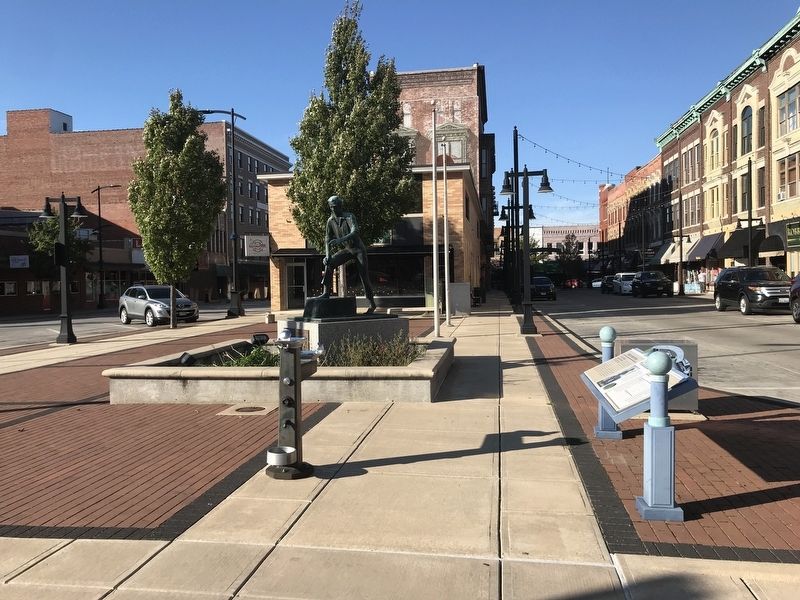
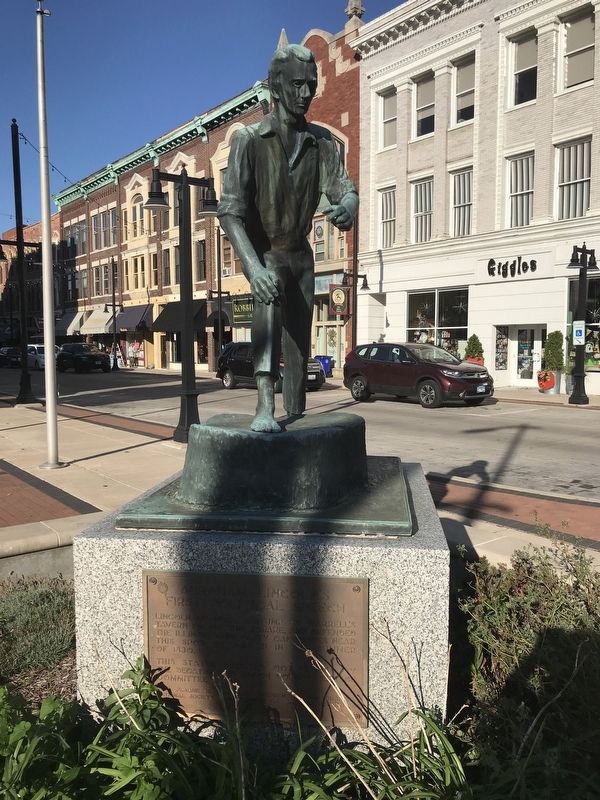
Caption: This sculpture of Abraham Lincoln giving his first official political speech to an assembled crowd was sculpted by Anthony Vestuto. Mr. Vestuto did the work for the city of Decatur to commemorate the historic Lincoln event. The statue was dedicated in a ceremony on October 12, 1968. Along with this statue, Mr. Vestuto also sculpted the small bronze likeness
Photographed by Duane and Tracy Marsteller, October 10, 2021
2. Lincoln's First Speech Marker
of Macon County's First Log Courthouse, located on the southwest side of the square across from this statue.
Erected by Looking for Lincoln Heritage Coalition City of Decatur, Lincoln Heritage Development.
Location. 39° 50.492′ N, 88° 57.339′ W. Marker is in Decatur, Illinois, in Macon County. It is at the intersection of North Merchant Street and East Main Street, on the right when traveling south on North Merchant Street. Touch for map. Marker is in this post office area: Decatur IL 62523, United States of America. Touch for directions.

Regionally, this marker is in Central Illinois. It is also in the American Midwest and in the Corn Belt. Globally, it is in North America, the Western Hemisphere, the Western World, and the Anglosphere. Historically, it finds itself in what was once the territory of the Mississippian Culture and also the Northwest Territory.
Photographed by Duane and Tracy Marsteller, October 10, 2021
3. Lincoln's First Speech Statue
Anthony Vestuto's sculpture depicts a barefoot Lincoln making an impromptu speech before a Decatur crowd. It was dedicated in 1968.
Credits. This page was last revised on October 15, 2021. It was originally submitted on October 14, 2021, by Duane and Tracy Marsteller of Murfreesboro, Tennessee. This page has been viewed 936 times since then and 47 times this year. Photos:1, 2, 3. submitted on October 14, 2021, by Duane and Tracy Marsteller of Murfreesboro, Tennessee.
