
Downtown in Sioux Falls in Minnehaha County, South Dakota — The American Midwest (Upper Plains)
Eliza Tupper Wilkes
(1844-1917)
October 23, 2021
1. Eliza Tupper Wilkes Marker
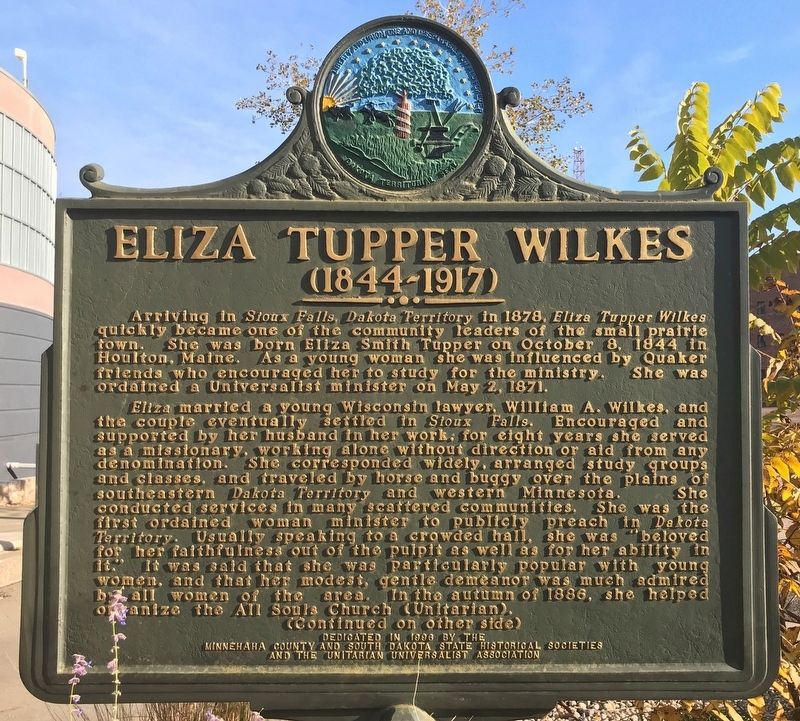
Arriving in Sioux Falls, Dakota Territory in 1878, Eliza Tupper Wilkes quickly became one of the community leaders of the small prairie town. She was born Eliza Smith Tupper on October 8, 1844 in Houlton, Maine. As a young woman she was influenced by Quaker friends who encouraged her to study for the ministry. She was ordained a Universalist minister on May 2, 1871.
Eliza married a young Wisconsin lawyer, William A. Wilkes, and the couple eventually settled in Sioux Falls. Encouraged and supported by her husband in her work, for eight years she served as a missionary, working alone without direction or aid from any denomination. She corresponded widely, arranged study groups and classes, and traveled by horse and buggy over the plains of southeastern Dakota Territory and western Minnesota. She conducted services in many scattered communities. She was the first ordained woman minister to publicly preach in Dakota Territory. Usually speaking to a crowded hall, she was "beloved for her faithfulness out of the pulpit as well as for her ability in it." It was said that she was particularly popular with young women, and
this page online
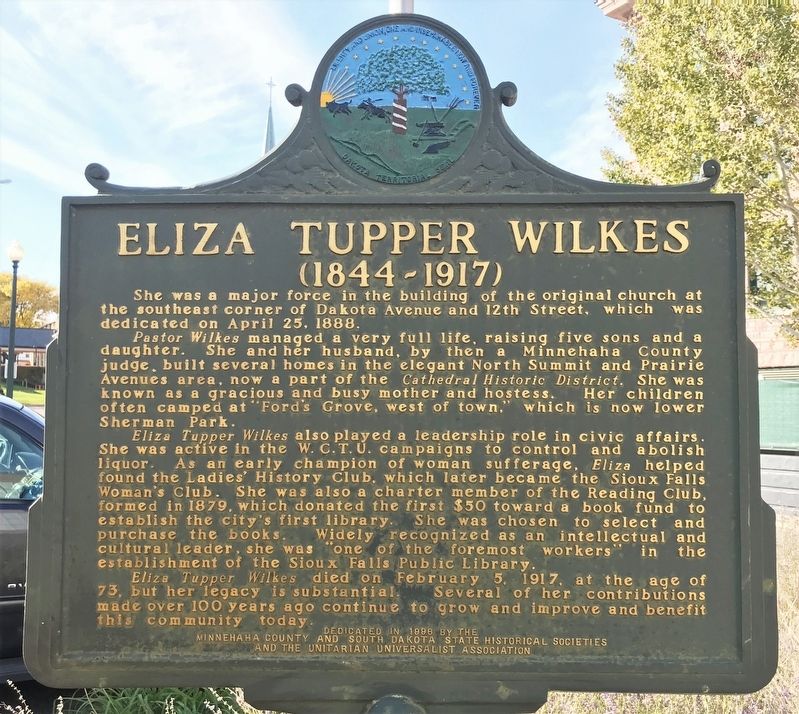
She was a major force in the building of the original church at the southeast corner of Dakota Avenue and 12th Street, which was dedicated on April 25, 1888.
Pastor Wilkes managed a very full life, raising five sons and a daughter. She and her husband, by then a Minnehaha County judge, built several homes in the elegant North Summit and Prairie Avenues area, now a part of the Cathedral Historical District. She was known as a gracious and busy mother and hostess. Her children often camped at "Ford’s Grove, west of town," which is now lower Sherman Park.
Eliza Tupper Wilkes also played a leadership role in civic affairs. She was active in the W.C.T.U. campaigns to control and abolish liquor. As an early champion of woman suffrage, Eliza helped found the Ladies’ History Club, which later became the Sioux Falls Woman’s Club. She was also a charter member of the Reading Club, formed in 1879, which donated the first $50 toward a book fund to establish the city’s first library. She
October 23, 2021
2. Eliza Tupper Wilkes Marker
Eliza Tupper Wilkes died on February 5, 1917, at the age of 73, but her legacy is substantial. Several of her contributions made over 100 years ago continue to grow and improve and benefit this community today.
Erected 1996 by the Minnehaha County and South Dakota State Historical Societies and the Unitarian Universalist Association. (Marker Number 671.)
Topics and series. This historical marker is listed in these topic lists: Religion & Religious Structures • Women. In addition, it is included in the Quakerism, the South Dakota State Historical Society Markers, and the Unitarian Universalism (UUism) series lists. A significant historical date for this entry is May 2, 1871.
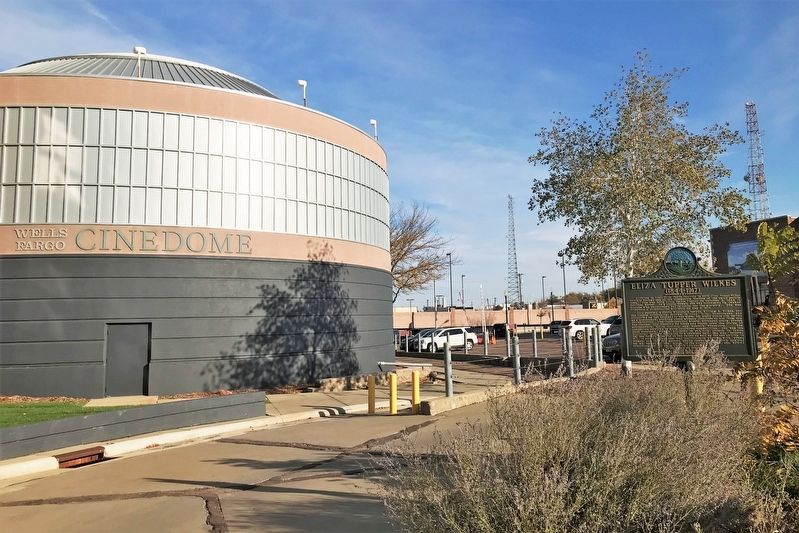
Location. 43° 32.605′ N, 96° 43.747′ W. Marker is in Sioux Falls, South Dakota, in Minnehaha County. It is in Downtown. It is on West 12th Street just east of South Dakota Avenue, on the right when traveling east. Touch for map. Marker is at or near this postal address:
October 23, 2021
3. Eliza Tupper Wilkes Marker, from the west

Regionally, this marker is in East River. It is also in the American Midwest, in the Lewis & Clark Corridor, in the Corn Belt, on the prairies, and on the Northern Plains. Globally, it is in North America, the Western Hemisphere, the Western World, and the Anglosphere. Historically, it finds itself in what was once Rupert’s Land and also the Louisiana Purchase.
Other nearby markers. At least 8 other markers are within walking distance of this marker: Washington High School (within shouting distance of this marker); The First School House (within shouting distance of this marker); Official Olympic Flagpole (within shouting distance of this marker); First Lutheran Church (within shouting distance of this marker); Lt. Jonas Lien (about 300 feet away, measured in a direct line); Sculptor H. Daniel Webster (about 400 feet away); Nils A. Boe (about 400 feet away); Calvary Cathedral (about 500 feet away). Touch for a list and map of all markers in Sioux Falls.
Additional commentary.
1. Female Universalist Ministers
There is a strong tradition

October 23, 2021
4. Eliza Tupper Wilkes Marker, from the east
— Submitted October 27, 2021, by Devry Becker Jones of Washington, District of Columbia.
Credits. This page was last revised on May 8, 2024. It was originally submitted on October 27, 2021. This page has been viewed 833 times since then and 20 times this year. Photos: 1, 2, 3, 4. submitted on October 27, 2021. • Devry Becker Jones was the editor who published this page.
