Near Chester in Chesterfield County, Virginia — The American South (Mid-Atlantic)
Sgt. James Engle
Medal of Honor Recipient
| — | Bermuda Hundred | — |

Photographed by Bradley Owen, October 19, 2021
1. Sgt. James Engle Marker
(Preface) Early 1864, Gen. Ulysses S. Grant, commander of all Federal armies, ordered advances throughout the Confederacy in the spring. On May 5, General Benjamin F. Butler's Army of the James landed Bermuda Hundred to begin operations against Richmond, Petersburg, and Confederate lines of supply. Confederate Gen. P.G.T. Beauregard countered Union advances against the Richmond and Petersburg Railroad and Drewry's Bluff, and Petersburg. By June 1864, be effectively "bottled up" Butler's army behind fortifications across the Bermuda Hundred peninsula for the rest of the war.
(Main Text) During the Civil War, this area was known as Foster's Farm. The trenches here are part of the main Federal line that stretched from the James River to the Appomattox River in 1864. On May 18, 1864, three regiments of Confederate Gen. George S. Pickett's division attacked and drove the 8th Maine Infantry from its advance line about one mile northwest of here. The 97th Pennsylvania Infantry counterattacked and retook the line. That day, the Pennsylvanians defended their position with almost uninterrupted fire, and by afternoon the men
this page online
(Postscript) On May 20, 1864, Federal and Confederate forces engaged in a series of attacks and counterattacks in this area. The Confederates tried to seize the Federal picket line in order to establish their own line of earthworks. In what became known as the Battle of Ware Bottom Church, Federal forces were pushed back toward their main line, thus enabling the Confederates to begin the work of digging their own fortifications across the Bermuda Hundred peninsula. This line of earthworks, known as the Howlett Line, blocked the Federal approach to Richmond from Bermuda Hundred for the rest of the war.
(Photo Captions)
Foster's
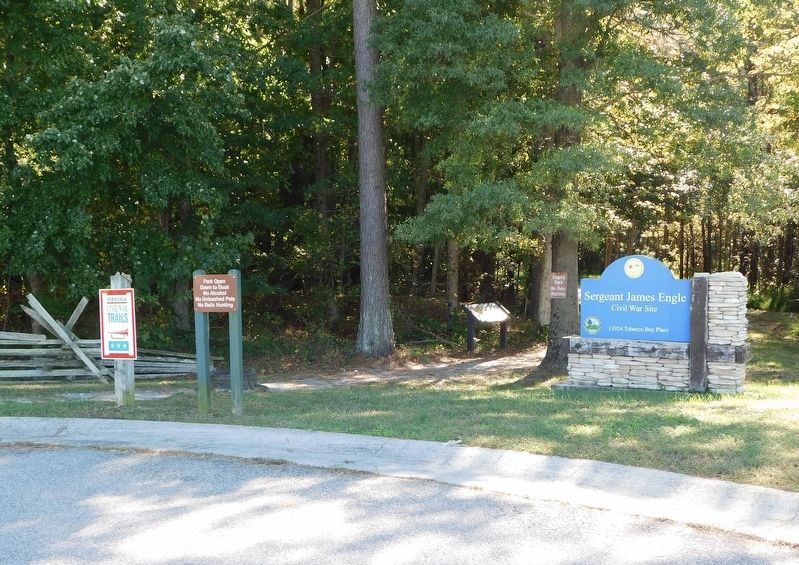
Photographed by Bradley Owen, October 19, 2021
2. Sgt. James Engle Marker
Marker can be seen to the left of the main park sign.
Howlett Line
Sgt. James Engle
Courtesy Ed and Fay Max
The Army version of the Medal of Honor.
Erected by Virginia Civil War Trails.
Topics and series. This historical marker is listed in this topic list: War, US Civil. In addition, it is included in the Virginia Civil War Trails series list. A significant historical date for this entry is May 18, 1864.
Location. 37° 20.051′ N, 77° 21.734′ W. Marker is near Chester, Virginia, in Chesterfield County. It is on Tobacco Bay Place south of Greyledge Boulevard, on the left when traveling south. Sergeant James Engle Park is at the end of the cul de sac on Tobacco Bay Place. The marker is at the beginning of the park walking trail. Touch for map. Marker is at or near this postal address: 13924 Tobacco Bay Place, Chester VA 23836, United States of America. Touch for directions.

Regionally, this marker is in the Piedmont, in Central Virginia, and in the Richmond Metropolitan Area. It is also in the American South, specifically in the Upper South, and on the Eastern Seaboard. Globally, it is in the North Atlantic Region, North America, the Western Hemisphere, the Western World,
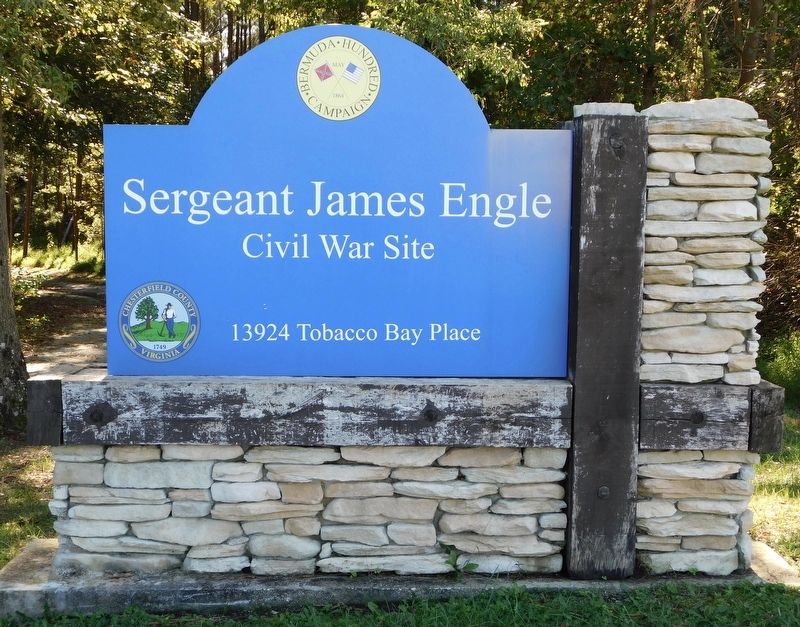
Photographed by Bradley Owen, October 19, 2021
3. Sgt. James Engle Civil War Site
Other nearby markers. At least 8 other markers are within walking distance of this marker: Fort Wead (about 700 feet away, measured in a direct line); a different marker also named Fort Wead (about 700 feet away); Actions in the East 1861-1863 (approx. ¾ mile away); Federal War Plans for 1864 (approx. ¾ mile away); The Bermuda Hundred Campaign Begins (approx. 0.9 miles away); Welcome to R. Garland Dodd Park at Point of Rocks (approx. 0.9 miles away); Point of Rocks (approx. 0.9 miles away); Confederate Leaders (approx. 0.9 miles away). Touch for a list and map of all markers in Chester.
Credits. This page was last revised on October 28, 2021. It was originally submitted on October 27, 2021, by Bradley Owen of Morgantown, West Virginia. This page has been viewed 601 times since then and 29 times this year. Photos: 1, 2, 3. submitted on October 27, 2021, by Bradley Owen of Morgantown, West Virginia. • Bernard Fisher was the editor who published this page.
