Near Amargosa Valley in Nye County, Nevada — The American Mountains (Southwest)
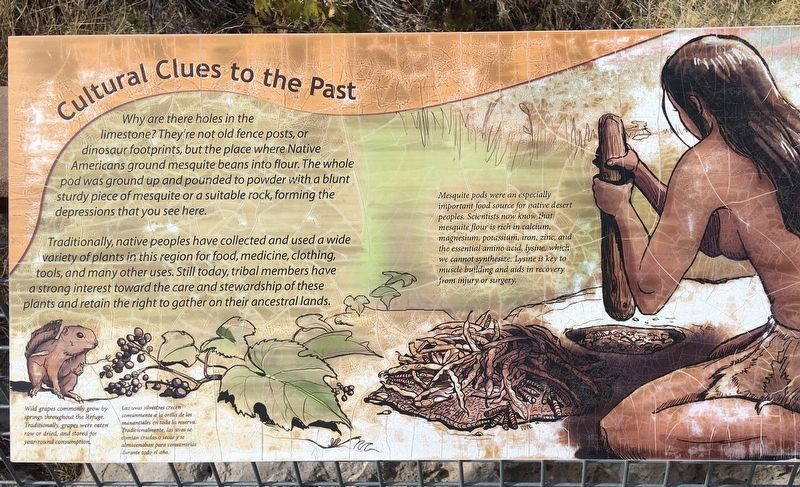
Cultural Clues to the Past
Ash Meadows National Wildlife Refuge
Photographed by Craig Baker, October 23, 2021
1. Cultural Clues to the Past Marker
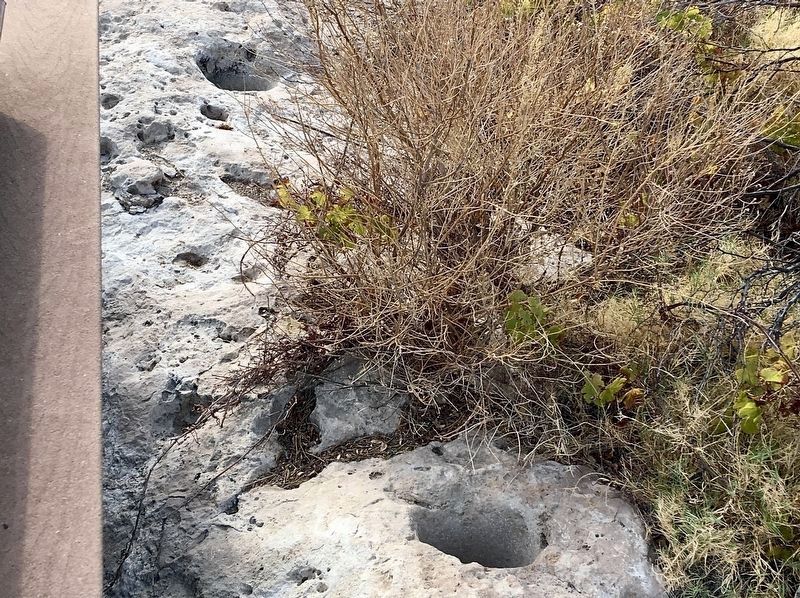
Why are there holes in the limestone? They're not old fence posts, or dinosaur footprints, but the place where Native Americans ground mesquite beans into flour. The whole pod was ground up and pounded to powder with a blunt sturdy piece of mesquite or a suitable rock, forming the depressions that you see here.
Traditionally, native peoples have collected and used a wide variety of plants in this region for food, medicine, clothing, tools, and many other uses. Still today, tribal members have a strong interest toward the care and stewardship of these plants and retain the right to gather on their ancestral lands.
Mesquite pods were an especially important food source for native desert peoples. Scientists now know that mesquite flour is rich in calcium, magnesium, potassium, iron, zinc, and the essential amino acid, lysine, which we cannot synthesize. Lysine is key to muscle building and aids in recovery from injury or surgery.
Wild grapes commonly grow by springs throughout the Refuge. Traditionally, grapes were eaten raw or dried, and stored for year-round consumption.
Topics.
this page online
Location. 36° 24.079′ N, 116° 16.367′ W. Marker is near Amargosa Valley, Nevada, in Nye County. It can be reached from Point of Rocks Road 1½ miles east of Spring/Ash Meadows Road. Located in Ash Meadows National Wildlife Refuge, at Point of Rocks, along a half-mile loop walk. Touch for map. Marker is in this post office area: Amargosa Valley NV 89020, United States of America. Touch for directions.

Regionally, this marker is in the Mojave Desert and in Central Nevada. It is also in the American Southwest and in the Mountain West. Globally, it is in North America, the Western Hemisphere, the Western World, and the Anglosphere. Historically, it finds itself in what was once New Spain and also Mexico’s Alta California.
Other nearby markers. At least 7 other markers are within 11 miles of this marker, measured as the crow flies: A Changing Landscape (approx. 0.2 miles away); Jack's Stone Cabin (approx. 5½ miles away); Jack Longstreet (approx.
Photographed by Craig Baker, October 23, 2021
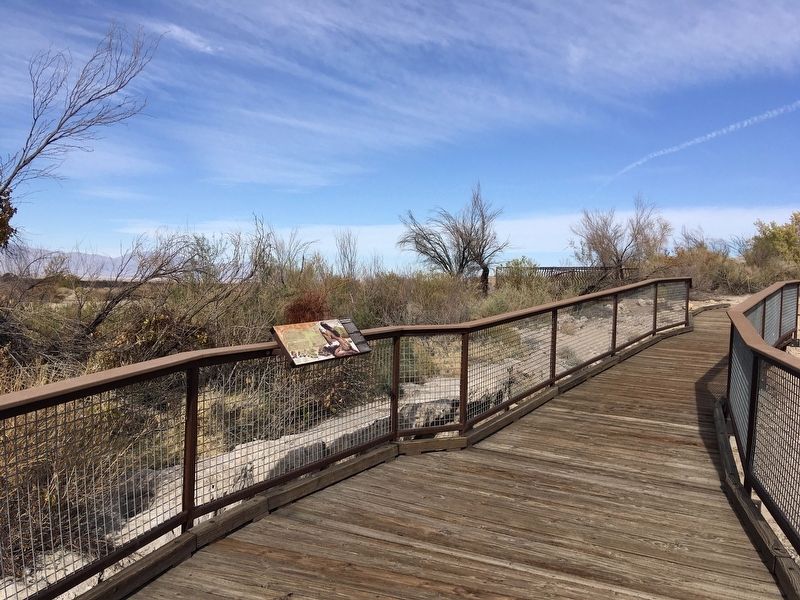
2. Cultural Clues to the Past Marker
Also see . . . Ash Meadows National Wildlife Refuge. (Submitted on October 28, 2021.)
Photographed by Craig Baker, October 23, 2021
3. Grinding Stone Depressions
Photographed by Craig Baker, October 23, 2021
4. Ash Meadows National Wildlife Refuge
Credits. This page was last revised on June 18, 2025. It was originally submitted on October 28, 2021, by Craig Baker of Sylmar, California. This page has been viewed 482 times since then and 34 times this year. Photos: 1, 2, 3, 4. submitted on October 28, 2021, by Craig Baker of Sylmar, California.
