North Newport News , Virginia — The American South (Mid-Atlantic)
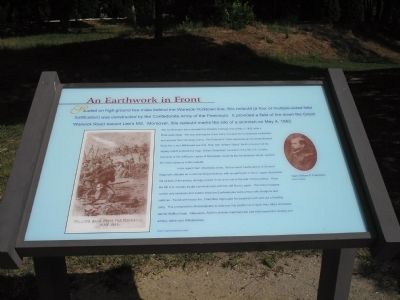
An Earthwork in Front
Photographed by Bill Coughlin, August 11, 2008
1. An Earthwork in Front Marker
The Confederates had evacuated the Warwick-Yorktown line on May 3, 1862, after a three-week siege. The next morning the Union Army occupied the Confederate earthworks and pursued their retreating enemy. The Federal IV Corps advanced up the Great Warwick Road from Lee’s Mill toward Lee Hall. Brig. Gen. William “Baldy” Smith’s division led the infantry march screened by Capt. William Chambliss’ squadron of the 5th U.S. Cavalry. Elements of the Jeff Davis Legion of Mississippi, covering the Confederate retreat, awaited the Union advance in this redoubt.
In his report Capt. Chambliss wrote, “At the recent headquarters of General Magruder, situated on a commanding eminence, with an earthwork in front, I again discovered the pickets of the enemy, strongly posted in the work and in the rear of the building.”
this page online
Topics. This historical marker is listed in this topic list: War, US Civil. A significant historical month for this entry is May 1862.
Location. This marker has been replaced by another marker nearby. It was located near 37° 11.984′ N, 76° 34.497′ W. Marker was in Newport News, Virginia. It was in North Newport News. It could be reached from Yorktown Road (Virginia Route 238), on the left when traveling north. Marker is located on the grounds of Lee Hall Mansion. Touch for map. Marker was in this post office area: Newport News VA 23603, United States of America. Touch for directions.

Regionally, this marker was on Virginia’s Peninsula, in Hampton
Photographed by Bill Coughlin, August 11, 2008
2. Marker at Lee's Hall
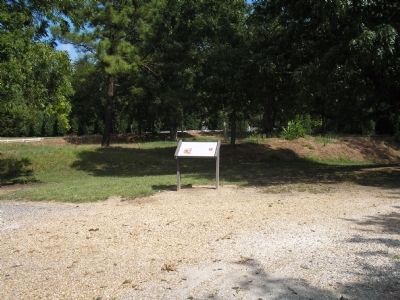
Earthworks can be seen behind the marker in this photo.
Other nearby markers. At least 8 other markers are within walking distance of this location: An Earthwork In Front (here, next to this marker); Largest and Most Valuable Estate in the County (within shouting distance of this marker); Lee Hall (within shouting distance of this marker); A Large Brick Kitchen (within shouting distance of this marker); Master and Slaves (about 300 feet away, measured in a direct line); Homestead by the Main Road (about 300 feet away); a different marker also named Lee Hall (about 600 feet away); Chessie System Caboose (approx. 0.4 miles away). Touch for a list and map of all markers in
Photographed by Bill Coughlin, August 11, 2008
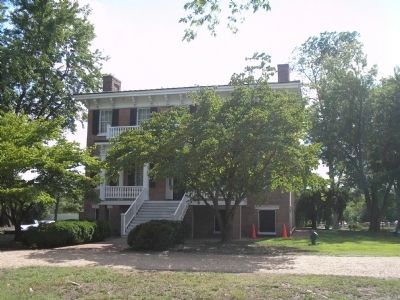
3. Lee Hall Mansion
Another marker is no longer nearby. Lee Hall (was about 400 feet away but has been replaced with another marker now near it).
More about this marker. The left side of the marker features a photograph of a sketch of Confederates “falling back from the Peninsula, May 1862.” Photo courtesy of the Virginia Historical Society. The right of the marker contains a photograph of Capt. William P. Chambliss, courtesy of USAMHI.
Also see . . . Lee Hall Mansion. (Submitted on February 28, 2009, by Bill Coughlin of Woodland Park, New Jersey.)
Photographed by Bill Coughlin, August 11, 2008
4. Earthworks at Lee Hall
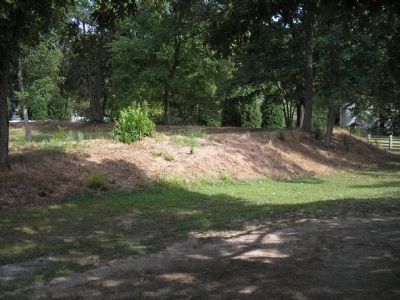
Well preserved Confederate earthworks are found just in front on the marker.
Credits. This page was last revised on June 10, 2025. It was originally submitted on February 28, 2009, by Bill Coughlin of Woodland Park, New Jersey. This page has been viewed 1,504 times since then and 22 times this year. Last updated on November 6, 2021, by Bradley Owen of Morgantown, West Virginia. Photos: 1, 2, 3, 4. submitted on February 28, 2009, by Bill Coughlin of Woodland Park, New Jersey. • Bernard Fisher was the editor who published this page.
