St. Marys in Auglaize County, Ohio — The American Midwest (Great Lakes)
Transportation
The Miami and Erie Canal

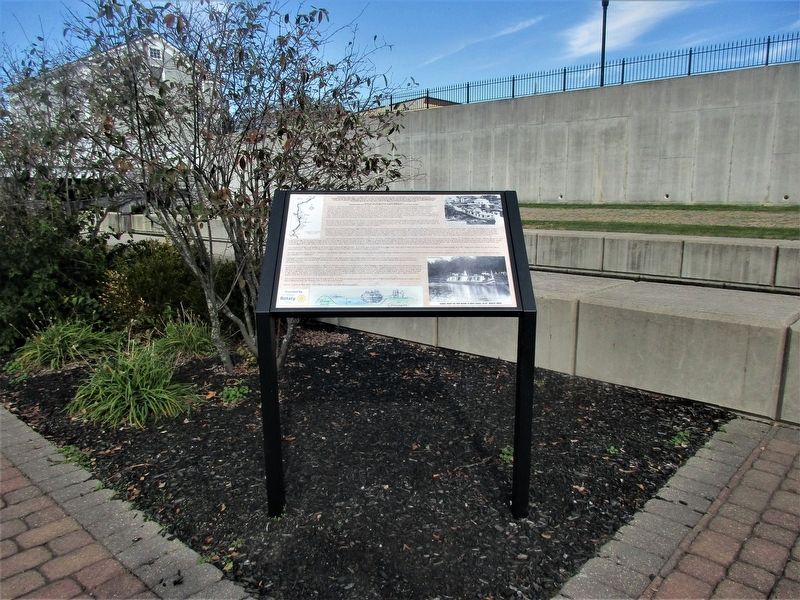
Photographed by Rev. Ronald Irick, November 8, 2021
1. Transportation Marker
“Transportation,” Murray seemed to be talking to himself, “transportation you gotta have. No use raisin’ a thousand bushels of wheat if you gotta carry it on your back two bushels at a time all the way to Dayton or Cincinnati to sell it. You know, man, that what makes Saint Marys such a good spot for us. We got the transportation now, and we’ll even be better when the canal is built. Imagine what it will be like, a man-made river fifty feet and straight as an arrow for miles, no rapids, no fallen trees, no zig-zagging around and an even flow of water all the time. Even going upstream, they say there’s hardly any difference. We’ve had the Saint Marys River and it’s been good travel much of the time, but it goes for miles to get a short distance and you can’t depend on even flow. It goes from flood to stale.”
Excerpt from “The Saint Marys Story,” by Frank B. Shuffelton, 1973,
illustrating dialogue about the coming canal that might have been spoken by Charles Murray, one of St. Marys’ founders.
As early as 1787, Thomas Jefferson suggested the idea of a man-made interior transportation route connecting the Ohio River
this page online
Many Irish and German immigrants were hired to construct the canal. Workers were typically paid 30 cents per day, sunrise to sunset, plus board and lodging. By comparison, city workers typically earned 75 cents a day on average. At the time,
Photographed by Rev. Ronald Irick, November 8, 2021
2. Transportation Marker
A major challenge in engineering the canal was solving the problem of how to supply water at the summit levels. Three man-made reservoirs, including, Grand Lake St. Marys, were created by damming rivers and swamps to retain water that would be directed through feeder canals to the main canal. Other structures located along the canal to facilitate transportation included 103 lift locks, 3 guard locks, and 19 aqueducts.
The completion of the canal opened up the East Coast markets to Ohio farmers. As a result, agricultural prices and wages rose. From 1826 to 1835, the cost of a barrel of flour rose from approximately $3 to $5. Cargo boats would carry up to 100 tons of merchandise each. The cost of moving a ton of freight declined from $125/ton overland to $25/ton via canal.
The canal also stimulated industry. Manufacturing facilities, especially mills, linseed oil refineries, machine shops, foundries,
Photographed by Rev. Ronald Irick, November 8, 2021
3. Transportation Marker
Passenger transportation was facilitated by the canal system as well. Special boats called packet boats could carry 40 to 60 passengers across the state for individual fares that were cheaper than taking the same trip on horseback. Leisure trips on the canal that often included fishing stops became popular during the Canal Era.
Shortly after construction was complete on the Miami and Erie Canal, railways expanded in Ohio, bringing a faster and more economical means of transporting goods to the state. Canal activity peaked in 1851, and in 1856 expenses exceded revenue for the first time. Despite competition from the railroads, the canal remained in operation both as a transportation route and as a generator of energy for industry until the early 1900’s. However, from March 23 through March 26, 1913 a significant rain event occurred that caused massive flooding throughout the state. This event remains the single largest weather disaster recorded in Ohio history. The floods

Photographed by Rev. Ronald Irick, November 8, 2021
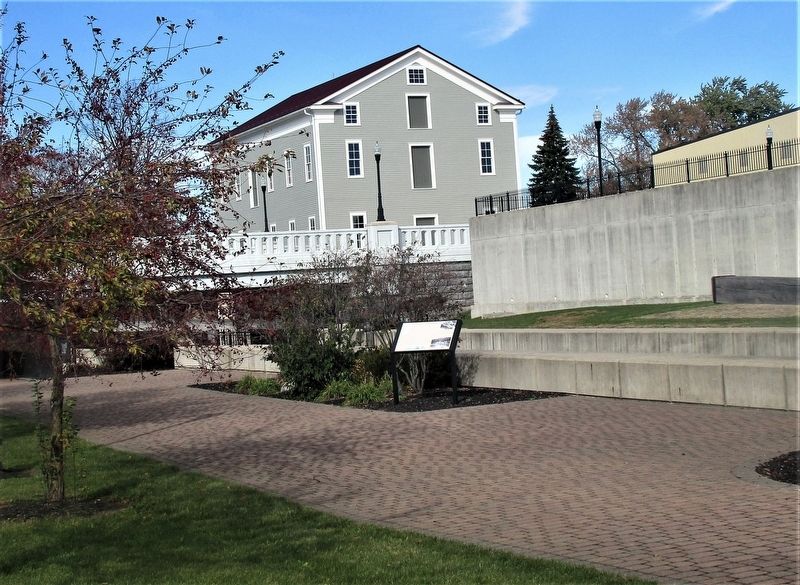
4. Photo taken from the Transportation Marker.
This section of the Miami and Erie Canal through the City of St. Marys remains intact as it was in the 1800’s. Follow the towpath north to see a replica canal boat in Memorial Park, the restored Lock 13, and the Canal Tumble.
Source: “Canals of Ohio, 1825- 1913” Marilyn G. Hood, The Ohio Historical Society
Erected by St. Marys Rotary Club.
Topics and series. This historical marker is listed in these topic lists: Industry & Commerce • Waterways & Vessels. In addition, it is included in the Rotary International series list.
Location. 40° 32.636′ N, 84° 23.283′ W. Marker is in St. Marys, Ohio, in Auglaize County. It is on Miami and Erie Towpath. Located on the old towpath of the Miami & Erie Canal, at Lock 13. Touch for map. Marker is at or near this postal address: 100 E High St, Saint Marys OH 45885, United States of America. Touch for directions.

Regionally, this marker is in the

Photographed by Rev. Ronald Irick, November 8, 2021
5. Photo taken from the Transportation Marker
Other nearby markers. At least 8 other markers are within walking distance of this marker: Lock 13 Rehabilitation Project (a few steps from this marker); Reservoir Mill, St. Marys (within shouting distance of this marker); 136 East Spring Street (within shouting distance of this marker); Memorial Park (within shouting distance of this marker); St. Marys Reservoir Mill (within shouting distance of this marker); The headwaters of the St. Marys River lie just southeast of the City of St. Marys. (within shouting distance of this marker); Miami and Erie Canal (about 300 feet away, measured in a direct line); The "Short Level" of the Miami and Erie Canal (about 300 feet away). Touch for a list and map of all markers in St. Marys.
More about this marker. The marker, for some reason, repeats portions
Photographed by Rev. Ronald Irick, November 8, 2021
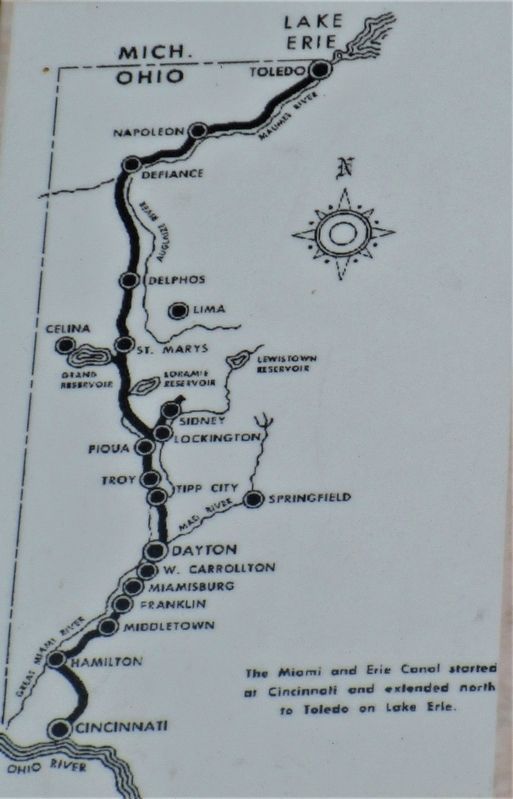
6. Canal map from the marker.
Note: the text reads- “Follow the towpath north to see a replica canal boat in Memorial Park”, the park and canal boat are both SOUTH of this marker.
Credits. This page was last revised on November 22, 2021. It was originally submitted on November 10, 2021, by Rev. Ronald Irick of West Liberty, Ohio. This page has been viewed 487 times since then and 14 times this year. Photos: 1, 2, 3, 4, 5, 6. submitted on November 10, 2021, by Rev. Ronald Irick of West Liberty, Ohio. • Mark Hilton was the editor who published this page.
