Brooklyn in St. Clair County, Illinois — The American Midwest (Great Lakes)
Freedom Village
in the C.A. 1829-1837
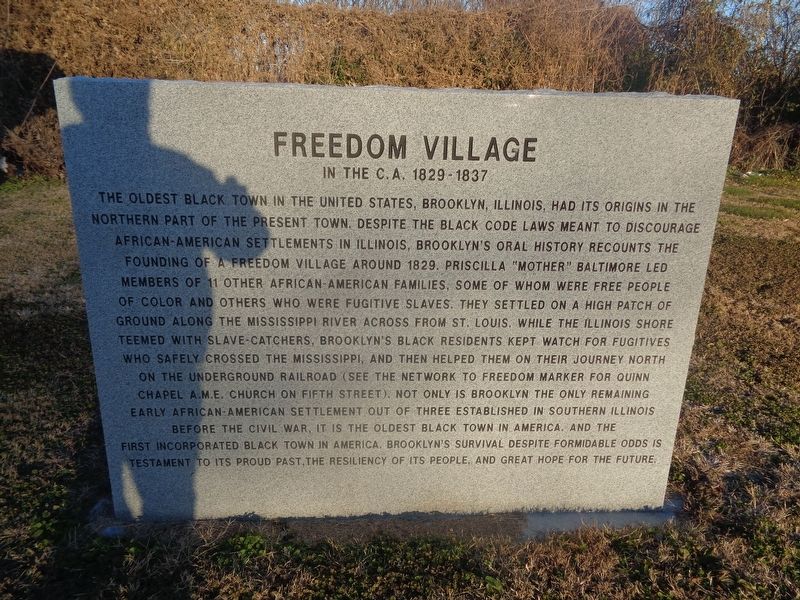
Photographed by Jason Voigt, November 25, 2021
1. Freedom Village Marker
this page online
Erected 2021 by Brooklyn Historical Society.
Topics. This historical marker is listed in these topic lists: Abolition & Underground RR • African Americans • Settlements & Settlers • Women. A significant historical year for this entry is 1829.
Location. 38° 39.533′ N, 90° 10.02′ W. Marker is in Brooklyn, Illinois, in St. Clair County. It is on North 5th Street north of Madison Street, on the right when traveling north. Marker is on the grounds of Quinn Chapel AME Church. Touch for map. Marker is at or near this postal address: 108 N 5th St, Lovejoy IL 62059, United States of America. Touch for directions.

Regionally, this marker is in Greater St. Louis. It is also in the American Midwest, in the Lewis & Clark Corridor, in the Corn Belt, and in the Great River Road Region. Globally, it is in North America, the Western Hemisphere, the Western World, and the Anglosphere. Historically, it finds itself in what was once the Viceroyalty of New France, the territory of the Mississippian Culture, and the Northwest Territory.
Other nearby markers. At
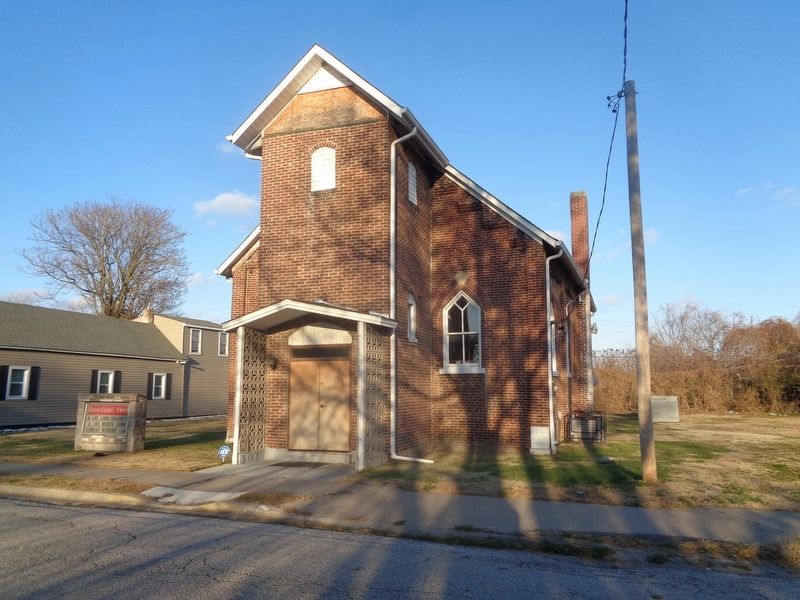
Photographed by Jason Voigt, November 25, 2021
2. Freedom Village Marker
Marker is on the grounds of Quinn Chapel AME Church (partly obscured by the telephone pole)
Other markers no longer nearby. Mary Meachum Freedom Crossing (was approx. 1.8 miles away in Missouri but has been confirmed missing); Coast Guard Rest Stop (was approx. 1.8 miles away in Missouri but has been replaced with another marker now near it).
Also see . . . Brooklyn, Illinois on Wikipedia. For many years, it was challenged as the oldest black town in the United States, mostly to the towns of Fort Mose and Eatonville, both in Florida. Brooklyn was originally an interracial community with white abolitionists helping black residents settle the town. However, tensions between both races came about during the early 20th century while industrialization was at its peak in Brooklyn, as well as neighboring communities such as Granite City and East St. Louis. The last half of the 20th century brought much decay and struggle with those cities, especially Brooklyn, as it has dealt with population loss and crime in recent years. (Submitted on November 25, 2021, by Jason Voigt of Glen Carbon, Illinois.)
Credits. This page was last revised on November 25, 2021. It was originally submitted on November 25, 2021, by Jason Voigt of Glen Carbon, Illinois. This page has been viewed 921 times since then and 68 times this year. Photos: 1, 2. submitted on November 25, 2021, by Jason Voigt of Glen Carbon, Illinois.
