Helena in Lewis and Clark County, Montana — The American West (Mountains)
Livestock Building
Montana State Capitol Campus Historic District
Photographed by Barry Swackhamer, July 15, 2021
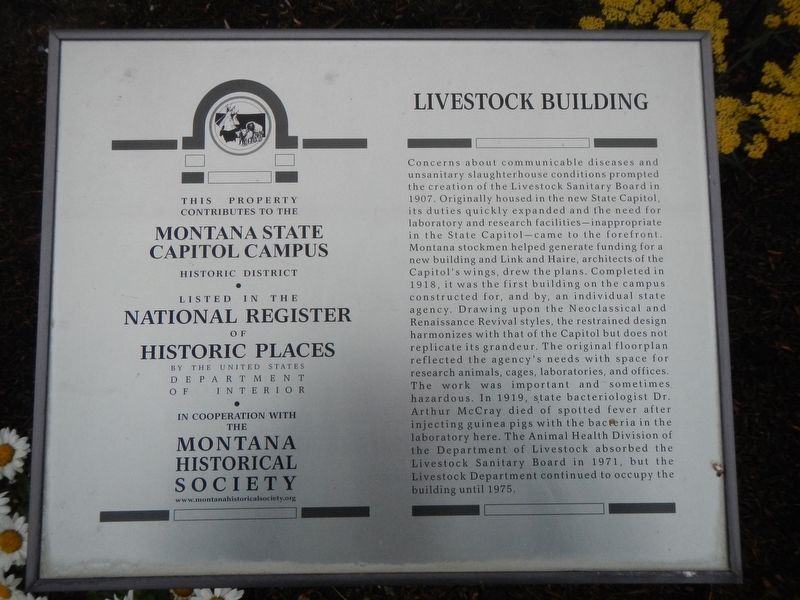
1. Livestock Building Marker
Inscription.
Concerns about communicable diseases and unsanitary slaughterhouse conditions prompted the creation of the Livestock Sanitary Board in 1907. Originally housed in the new State Capitol, its duties quickly expanded and the need for laboratory and research facilities—inappropriate in the State Capitol—came to the forefront. Montana stockmen helped generate funding for a new building and Link and Haire, architects of the Capitol’s wings, drew the plans. Completed in 1918, it was the first building on the campus constructed for, and by, an individual state agency. Drawing upon the Neoclassical and Renaissance Revival styles, the restrained design harmonizes with that of the Capitol but does not replicate its grandeur. The original floorplan reflected the agency’s needs with space for research animals, cages, laboratories, and offices. The work was important and sometimes hazardous. In 1919, state bacteriologist Dr. Arthur McCray died of spotted fever after injecting guinea pigs with the bacteria in the laboratory here. The Animal Health Division of the Department of Livestock absorbed the Livestock Sanitary Board in 1971, but
Click or scan to see this page online
the Livestock Department continued to occupy the building until 1975.
Location. 46° 35.111′ N, 112° 1.036′ W. Marker is in Helena, Montana, in Lewis and Clark County. It is on East Lockey Avenue near Roberts Street, on the right when traveling north. Touch for map. Marker is at or near this postal address: 1310 East Lockey Avenue, Helena MT 59601, United States of America. Touch for directions.
Regionally, this marker is in andspecifically entral Montana in Gold West Country. It is also in the American Mountain West and in the Lewis & Clark Corridor. Globally, it is in North America, the Rocky Mountains, the Western Hemisphere, the Western World, and the Anglosphere. Historically, it finds itself in what was once Rupert’s Land and also the Louisiana Purchase.
Other nearby markers. At least 8 other markers are within
Photographed by Barry Swackhamer, July 15, 2021
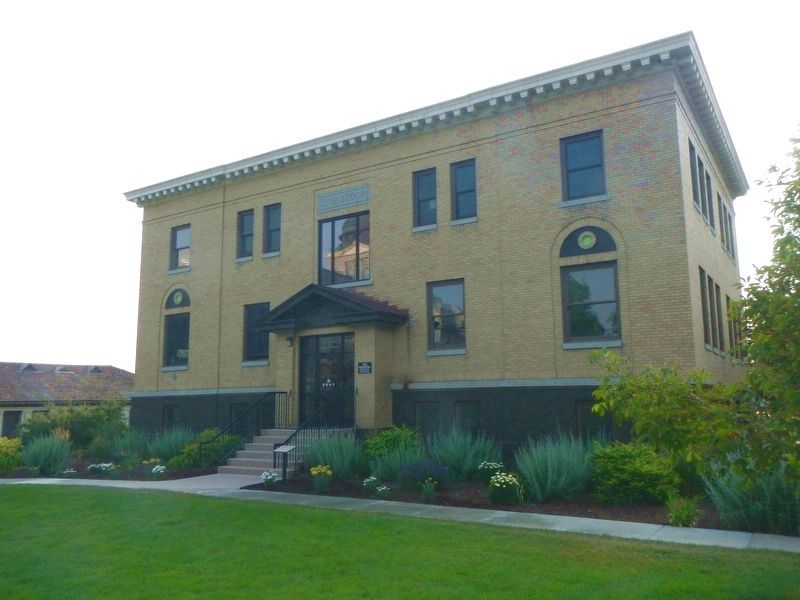
2. Livestock Building and Marker
The marker is on a stand at the building's entrance.
Credits. This page was last revised on November 26, 2021. It was originally submitted on November 26, 2021, by Barry Swackhamer of Brentwood, California. This page has been viewed 284 times since then and 35 times this year. Photos:1, 2. submitted on November 26, 2021, by Barry Swackhamer of Brentwood, California.