Pollock in Campbell County, South Dakota — The American Midwest (Upper Plains)
Lewis and Clark
⎯⎯⎯
Pollock, South Dakota
Photographed by Ruth VanSteenwyk, April 29, 2017
1. Lewis and Clark
Lewis and Clark
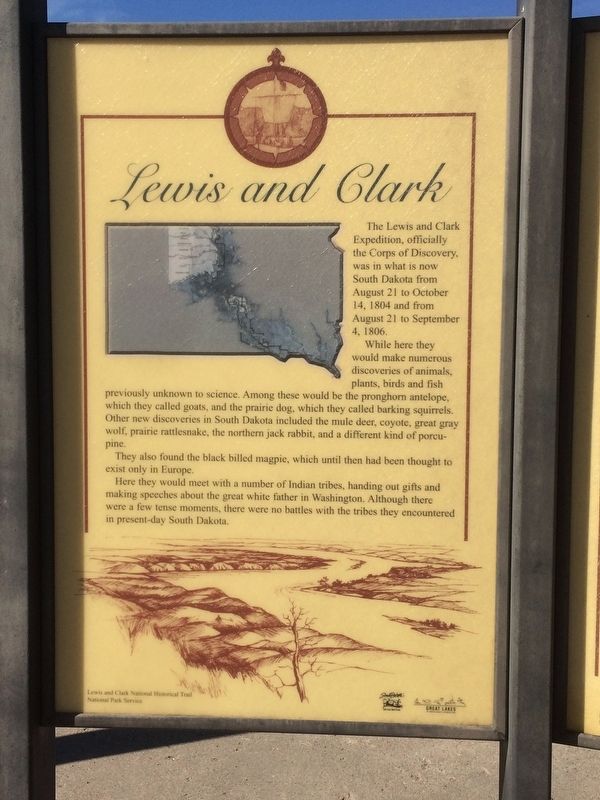
The Lewis and Clark Expedition, officially the Corps of Discovery, was in what is now South Dakota from August 21 to October 14, 1804 and from August 21 to September 4, 1806.
While here they would make numerous discoveries of animals, plants, birds and fish previously unknown to science. Among these would be the prong horn antelope, which they called goats, and the prairie dog, which they called barking squirrels. Other new discoveries in South Dakota included the mule deer, coyote, great gray wolf, prairie rattlesnake, the northern jack rabbit, and a different kind of porcupine.
They also found the black billed magpie, which until then had been thought to exist only in Europe.
Here they would meet with a number of Indian tribes, handing out gifts and making speeches about the great white father in Washington. Although there were a few tense moments, there were no battles with the tribes they encountered in present-day South Dakota.
Pollock
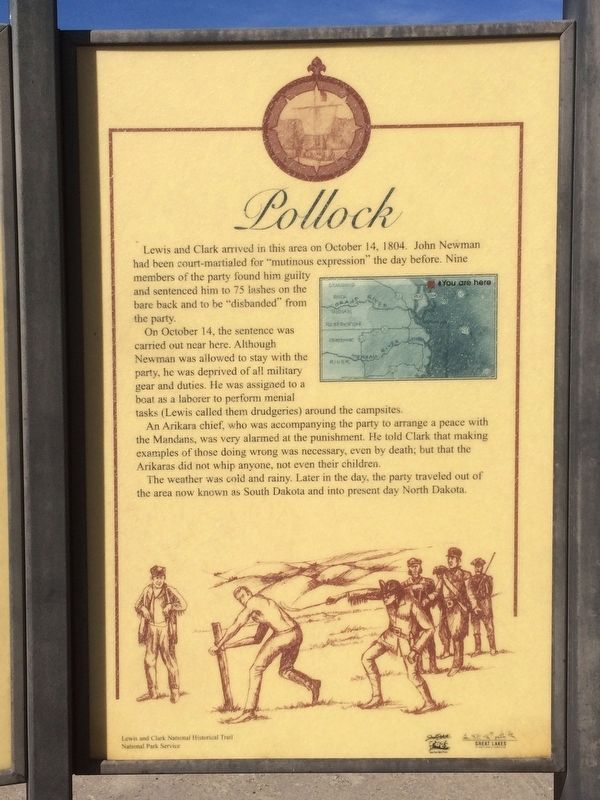
Lewis and Clark arrived in this area on October 14, 1804. John Newman had been court-martialed for "mutinous expression" the day before. Nine members
this page online
On October 14, the sentence was carried out near here. Although Newman was allowed to stay with the party, he was deprived of all military gear and duties. He was assigned to a boat as a laborer to perform menial tasks (Lewis called them drudgeries) around the campsites.
An Arikara chief, who was accompanying the party to arrange a peace with the Mandans, was very alarmed at the punishment. He told Clark that making examples of those doing wrong was necessary, even by death; but that the Arikaras did not whip anyone, not even their children.
The weather was cold and rainy. Later in the day, the party traveled out of the area now known as South Dakota and into present day North Dakota.
Erected by National Park Service, U.S. Department of the Interior.
Topics. This historical marker is listed in these topic lists: Exploration • Indigenous Peoples and Communities • Settlements & Settlers.
Location. 45° 53.964′ N, 100° 17.146′ W. Marker is in Pollock,
Photographed by Ruth VanSteenwyk, April 29, 2017
2. Pollock, South Dakota Marker

Regionally, this marker is in the Standing Rock Sioux Tribe and in East River. It is also in the American Lewis & Clark Corridor, on the prairies, and on the Northern Plains. Globally, it is in North America, the Western Hemisphere, the Western World, and the Anglosphere. Historically, it finds itself in what was once Rupert’s Land and also the Louisiana Purchase.
Other nearby markers. At least 4 other markers are within 2 miles of this marker, measured as the crow flies: Pollock, South Dakota Settlers / National Bicentennial Wagon Train (about 500 feet away, measured in a direct line); Old Pollock / Lot Distribution in New Pollock / Lake Pocasse (approx. one mile away); Lewis and Clark and the Legend of Stone Idol Creek/Lewis and Clark Expedition Meet The Arikara (approx. one mile away); Flint Store and Post Office (approx. 1.8 miles away).
Photographed by Ruth VanSteenwyk, April 29, 2017
3. Lewis and Clark/Pollock, South Dakota Marker
Credits. This page was last revised on December 26, 2024. It was originally submitted on January 1, 2018, by Ruth VanSteenwyk of Aberdeen, South Dakota. This page has been viewed 603 times since then and 40 times this year. Last updated on November 29, 2021, by Ruth VanSteenwyk of Aberdeen, South Dakota. Photos: 1, 2, 3. submitted on January 1, 2018, by Ruth VanSteenwyk of Aberdeen, South Dakota. • J. Makali Bruton was the editor who published this page.
