Gulf Shores in Baldwin County, Alabama — The American South (East South Central)
The Overland Campaign
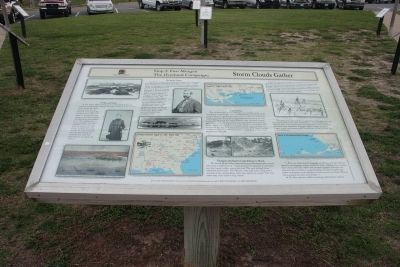
Storm Clouds Gather
| — | Civil War Trail, Battle for Mobile Bay | — |
Photographed by Timothy Carr, June 19, 2013
1. The Overland Campaign Marker
To Wait and Watch
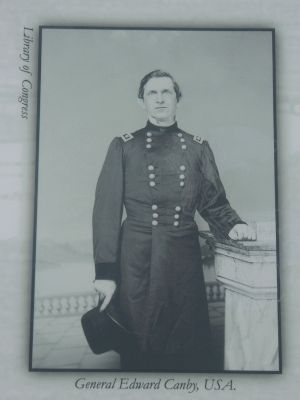
In late August 1864 the Federals controlled Mobile Bay but could not attack Mobile. Admiral Farragut could not reach the city even with his light draft vessels, because the channels in the upper Bay had been obstructed. Nor was U.S. General Edward Canby’s force big enough to take Mobile by an overland route. The soldiers that would otherwise have been available to him were tied down in other places. All Canby could do was make occasional demonstrations from the Bay to keep the Confederates, who were preparing for an attack, off balance.
The Armies Gather
Conditions changed after the decisive defeat of C.S. General John Bell Hood at Nashville in December. In the winter of 1865 U.S. General Ulysses S. Grant ordered Canby to capture Mobile, Selma, and Montgomery and sent him reinforcements. By March Canby had 45,000 men on the Gulf Coast. Most of his army gathered at Dauphin Island and Pensacola, but at least 8,000 men belonging to Granger’s XII Corps camped on Mobile Point. The Confederates, expecting an attack, reinforced Mobile. C.S. General Dabney Maury, Mobile’s commander, 3,000 infantrymen
this page online
Canby Moves
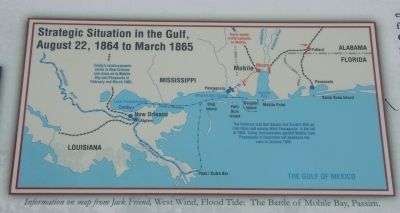
The fortifications around Mobile were considered the most formidable in the South. Canby avoided them, marching up the eastern shore of the Bay. He also sent U.S. General Frederick Steele north from Pensacola to attack the railroad at Pollard, feint toward Montgomery, and attack Blakeley from the north. Canby, delayed for weeks by unusually heavy rains, finally moved out on March 17. U.S. General James Veatch’s Division of Granger’s XIII Corps, which had camped on Dauphin Island, took transports to Navy Cove that day. U.S. General A. J. Smith’s XVI Corps boarded transports on March 19 and sailed to Fish River. Steele Left Pensacola on the 20th.
Granger’s and Steele’s Corps Prepare to March
On March 16 the order came down from Headquarters to pack four days’ cooked rations--three quarters of a pound of salt meat per day, bread, coffee, sugar, and salt. The men carried these rations in haversacks. The officers could take only “'dog tents,’ instead of the commodious tents they had been using.”
Photographed by Timothy Carr, June 19, 2013
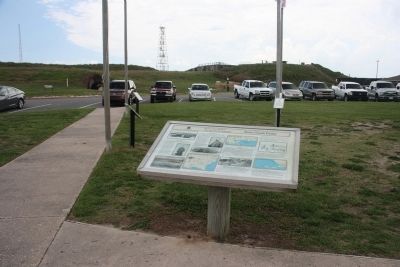
2. The Overland Campaign Marker
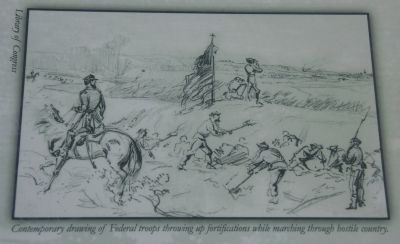
Canby also directed the liberal use of spade and pick to fortify each day’s encampment and cautioned his generals to protect their flanks and the intervals between each unit. Benton’s division of Granger’s Corps, led by Colonel Henry Bertram’s brigade, marched from Fort Morgan by the Fort Morgan and Blakeley Telegraph Road at 5:30 a.m. They carried 150 rounds of ammunition per man, five batteries of field guns, and supply wagons.
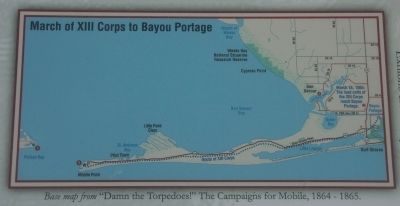
The going was easy until they reached Bayou Portage, because the men marched over a firm road built on a natural shell bank. Steele’s men, on the other hand, who began their march from Fort Barrancas near Pensacola, struggled against supply problems, boggy roads, and entrenched Confederate cavalry all the way to Fort Blakeley.
“…They are reducing the baggage of officers and men. We are allowed one baggage wagon instead of three. Officers have to leave their camp and mess chests and company papers. The men are allowed only one shift of underclothing, one pair of pants, one jacket and blouse, and a blanket or overcoat, but not both. What is left is packed in
Photographed by Timothy Carr, June 19, 2013
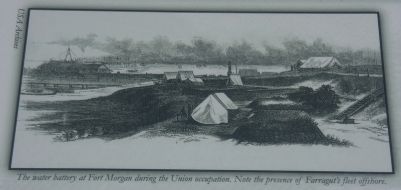
3. Top Left Image:
The water battery at Fort Morgan during the Union occupation. Note the presence of Farragut's fleet offshore. (USA Archives)
H. W. Hart, private soldier marching with Steele’s column
Erected by Mobile Bay Convention and Visitors Bureau. (Marker Number Stop 2 Fort Morgan).
Topics. This historical marker is listed in these topic lists: Forts and Castles • War, US Civil. A significant historical year for this entry is 1864.
Location. 30° 13.771′ N, 88° 1.347′ W. Marker is in Gulf Shores, Alabama, in Baldwin County. It is on Fort Morgan Road (State Road 180) 1.7 miles west of Dune Drive, on the left when traveling west. Located on the grounds of Fort Morgan State Historic Park in front of Fort Morgan Museum. Touch for map. Marker is at or near this postal address: 51 AL-180 West, Gulf Shores AL 36542, United States of America. Touch for directions.

Regionally, this marker is on the Gulf Coast and in the Mobile Bay area. It is also in the American South, specifically in the Deep South, and on the Gulf Coast. Globally, it is in North America, a Gulf of Mexico state, the Western Hemisphere, the Western World, and the Anglosphere. Historically, it finds itself in what was once New Spain, the Viceroyalty of New France, the
Photographed by Timothy Carr, June 19, 2013
4. Left Center Image: General Edward Canby, U.S.A. (Library of Congress)
Other nearby markers. At least 8 other markers are within walking distance of this marker: Colors of Significance: Historic Flags of Mobile Point (a few steps from this marker); 6.4” (100 pounder) Parrott Rifle / 7” Brooke Rifle (within shouting distance of this marker); U.S. Model 1918M1 155mm Gun and Model 1918A1 Carriage (within shouting distance of this marker); Lafayette’s Tour (within shouting distance of this marker); 32 Pounder Sea Coast Defense Gun (about 300 feet away, measured in a direct line); Noble Leslie DeVotie (about 300 feet away); Battery Schenck (1899-1923) (about 300 feet away); Second Battle of Fort Bowyer (about 300 feet away). Touch for a list and map of all markers in Gulf Shores.
Also see . . . Civil War Trail, Battle For Mobile Bay. (Submitted on November 2, 2013, by Timothy Carr of Birmingham, Alabama.)
Photographed by Timothy Carr, June 19, 2013
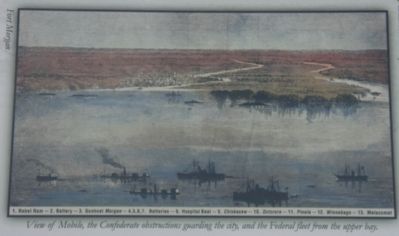
5. Bottom Left Image:
View of Mobile, the Confederate obstructions guarding the city, and the Federal fleet from the the upper bay. (Fort Morgan)
Photographed by Timothy Carr, June 19, 2013
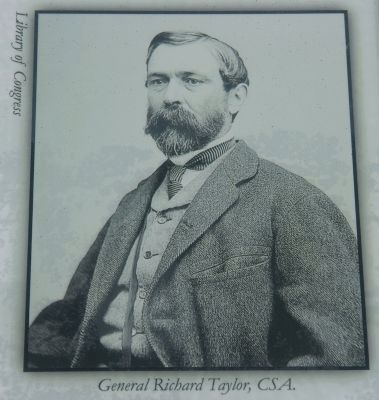
6. Center Left Top Image: General Richard Taylor, CSA. (Library of Congress)
Photographed by Timothy Carr, June 19, 2013
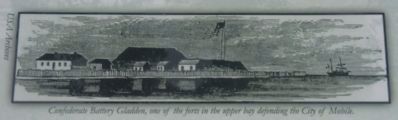
7. Center Left Middle Image:
Confederate Battery Gladden, one of the forts in the upper bay defending the City of Mobile. (USA Archives)
Photographed by Timothy Carr, June 19, 2013
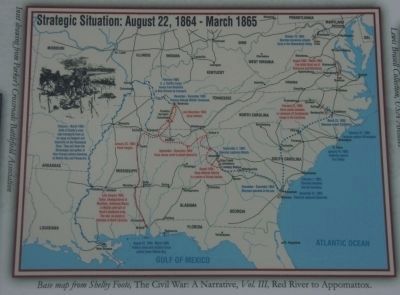
8. Center Left Bottom Image:
Base map from Shelby Foote, The Civil War: A Narrative, Vol. III, Red River to Appomattox. (Inset drawing from Parker's Crossroads Battlefield Association)
Photographed by Timothy Carr, June 19, 2013
9. Center Right Top Image:
Information on map from Jack Friend, Wes Wind, Flood Tide: The Battle of Mobile Bay, Passim.
Photographed by Timothy Carr, June 19, 2013
10. Center Right Bottom Image:
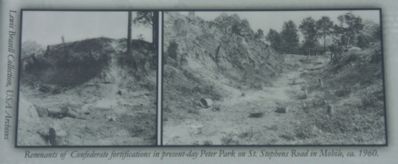
Remnants of Confederate fortifications in present-day Peter Park on Ste. Stephens Road in Mobile, ca. 1960. (Lewis Brasell Collection, USA Archives)
Photographed by Timothy Carr, June 22, 2013
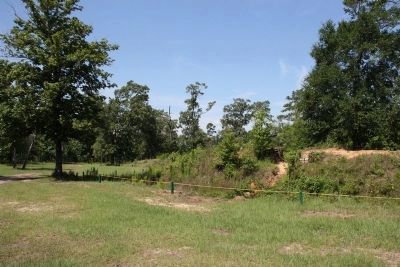
11. Confederate breastworks at Fort Blakely located on the Tensaw River northeast of Mobile.
Photographed by Timothy Carr, June 22, 2013
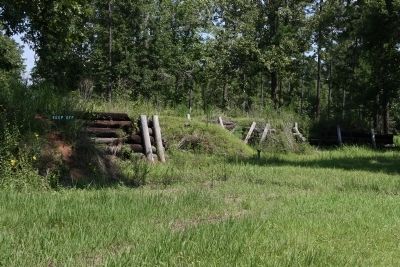
12. Union breastworks at Fort Blakely located on the Tensaw River northeast of Mobile.
Photographed by Timothy Carr, June 19, 2013
13. Top Right Image:
Contemporary drawing of Federal troops throwing up fortifications while marching through hostile country. (Library of Congress)
Photographed by Timothy Carr, June 19, 2013
14. Bottom Right Image:
Base map from "Damn the Torpedoes!" The Campaigns for Mobile, 1864 - 1865.
Credits. This page was last revised on December 3, 2021. It was originally submitted on November 2, 2013, by Timothy Carr of Birmingham, Alabama. This page has been viewed 1,931 times since then and 58 times this year. Last updated on December 2, 2021, by Carl Gordon Moore Jr. of North East, Maryland. Photos: 1, 2, 3, 4, 5, 6, 7, 8, 9, 10, 11, 12, 13, 14. submitted on November 2, 2013, by Timothy Carr of Birmingham, Alabama. • Mark Hilton was the editor who published this page.
