Leonardtown in St. Mary's County, Maryland — The American Northeast (Mid-Atlantic)
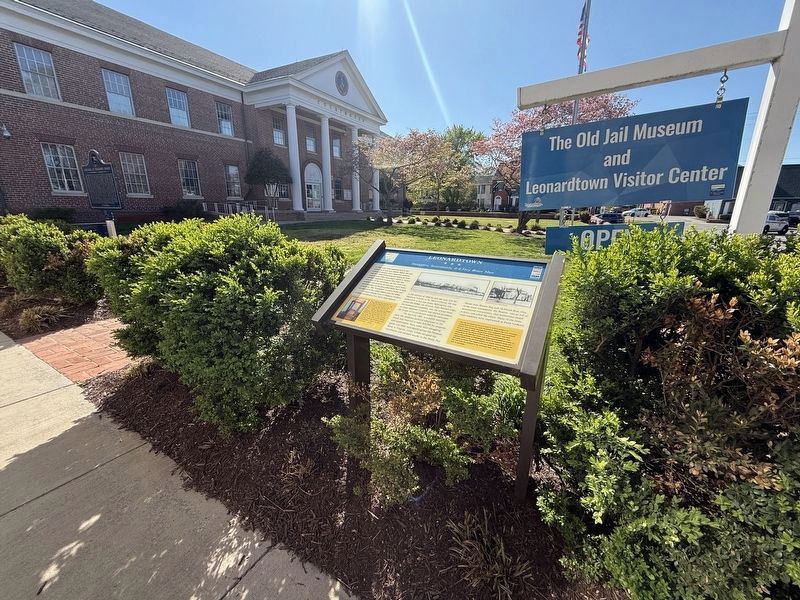
Leonardtown
Smugglers, Secessionists, & a Very Brave Man

Photographed by Sean C Bath, November 28, 2021
1. Leonardtown Marker
In 1860, male voters gathered here at the courthouse to cast their ballots. Before the mid-nineteenth century, voice voting was common, with each voter announcing his choices in front of one and all. Then came paper tickets or ballots colorfully marked as to party. Men here cast their votes in the courthouse, the site of all civic meetings and elections, by selecting a party ballot and dropping it in the glass-sided ballot box in sight of everyone. The "Australian" or secret ballot was not adopted in the United States until the 1890s.
William Charles Love, a Chaptico resident, is today considered a very brave man because in the election of 1860 he cast the only vote for Abraham Lincoln in St. Mary's County. He was ambushed on his way home, fighting his way across the bridge out of town. John Breckenridge, the secessionist candidate, was the winner here, so when Abraham Lincoln was elected president, the people of Leonardtown called for secession.
On April 23, 1861, in a public meeting here, the residents declared allegiance to the South and resolved to raise $10,000 for weapons and ammunition. Soon, some were smuggling
this page online
(sidebars)
This ballot box was used here in the 1858 and 1860 elections. In 1708, Leonardtown was laid out on the banks of Breton Bay, and the St. Mary's County court soon was moved here. In 1858, the Maryland State Legislature incorporated the town, still the only incorporated town in the county. On May 3, 1858, 46 white men (out of 164 white and 35 African American residents) elected five town commissioners. - Courtesy St. Mary's County Historical Society
The Old Jail behind you was built in 1876 to replace an antebellum jail on the same foundation. Before the war, freedom seekers who escaped bondage but were captured were confined here. In August 1860, a Black man named Alonzo, who had escaped from the estate of H.G.S. Key, of Leonardtown, was jailed here. He had fled north and concealed himself in a cave to await safe passage to Philadelphia. When he hailed a boat, the captain asked to see his free papers, to which Alonzo replied he left them at home. The captain did not believe that Alonzo was the free man he claimed to be, arrested him, and returned him to bondage.
Erected by Maryland
Topics and series. This historical marker is listed in these topic lists: Government & Politics • War, US Civil. In addition, it is included in the Maryland Civil War Trails series list. A significant historical date for this entry is April 23, 1861.
Location. 38° 17.373′ N, 76° 38.159′ W. Marker is in Leonardtown, Maryland, in St. Mary's County. It is on Court House Drive east of Washington Street (Maryland Route 326), on the right when traveling east. Located in front of the Old Jail Museum. Touch for map. Marker is at or near this postal address: 41625 Court House Dr, Leonardtown MD 20650, United States of America. Touch for directions.

Regionally, this marker is in Southern Maryland. It is also in the American South, specifically in the Upper South, in the Mid-Atlantic, in the Tidewater, in the Chesapeake Bay Region, and on the Eastern Seaboard. Globally, it is in the North Atlantic Region, North America, the Western Hemisphere, the Western World, and the Anglosphere. Historically, it finds itself in what was once one of the original Thirteen Colonies and also the Antebellum South.
Other nearby markers. At least 8 other markers are within walking distance of this marker: Lynching in America / Lynching of Benjamin Hance (here, next to this marker); This Cannon (here, next to this marker); The Great House (a few steps from this marker); War in the Chesapeake (about 300 feet away, measured in a direct line); A Town Spared (about 300 feet away); "O! say can you see…" (about 300 feet away); Veterans Memorial (about 400 feet away); World War I Monument -- Leonardtown (about 500 feet away). Touch for a list and map of all markers in Leonardtown.
Another marker is no longer nearby. Leonardtown (has been replaced with this marker).
Related marker. Click here for another marker that is related to this marker. Old Marker At This Location also titled "Leonardtown".
Credits. This page was last revised on April 11, 2026. It was originally submitted on December 3, 2021, by Sean C Bath of Silver Spring, Maryland. This page has been viewed 477 times since then and 60 times this year. Photos: 1. submitted on December 3, 2021, by Sean C Bath of Silver Spring, Maryland. 2. submitted on April 11, 2026, by Devry Becker Jones of Washington, District of Columbia. • Bernard Fisher was the editor who published this page.
