Pátzcuaro, Michoacán, Mexico — The Pacific Coast (and Central Highlands)
First Panamerican Indigenous Congress and Theatre Inauguration
Photographed by J. Makali Bruton, October 2, 2021
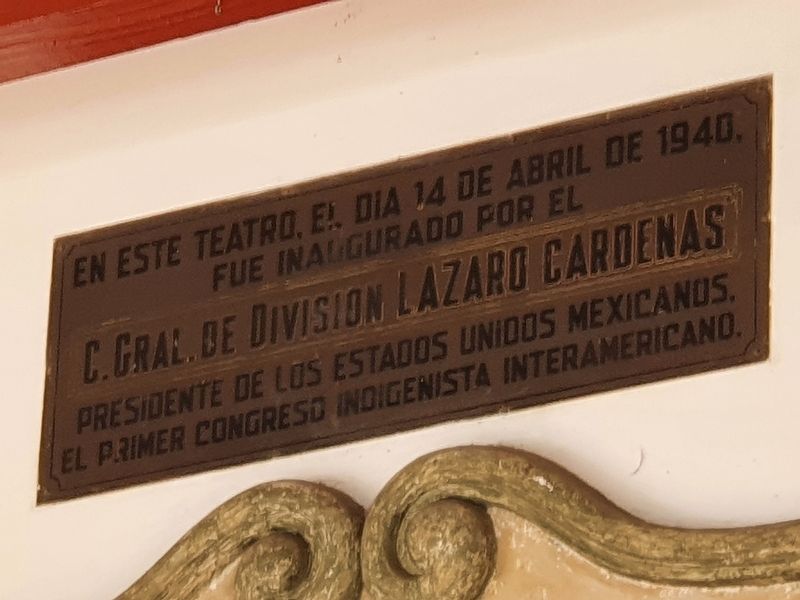
1. First Panamerican Indigenous Congress and Theatre Inauguration Marker

Presidente de los Estados Unidos Mexicanos,
El Primer Congreso Indigenista Interamericano
This theater, on April 14, 1940, was inaugurated by the Division General Lázaro Cárdenas
President of the United Mexican States,
The First Panamerican Indigenous Congress
Erected 1940.
Topics. This historical marker is listed in these topic lists: Entertainment • Indigenous Peoples and Communities. A significant historical date for this entry is April 14, 1940.
Location. 19° 30.999′ N, 101° 36.517′ W. Marker is in Pátzcuaro, Michoacán. It is on Padre Lloreda just west of Portal de Lerdo, on the right when traveling west. Touch for map. Marker is in this post office area: Pátzcuaro MIC 61600, Mexico. Touch for directions.

Regionally, this marker is in Western Mexico, in the Bajío, and on the Pacific Coast. Globally, it is in North America, specifically in Mesoamerica, on the Ring of Fire, on the Pacific Rim, and in the Western Hemisphere. Historically, it finds itself in what was once New Spain, a
this page online
Other nearby markers. At least 8 other markers are within walking distance of this marker: Gertrudis Bocanegra Public Library (here, next to this marker); Gertrudis Bocanegra de Lazo de la Vega (within shouting distance of this marker); Basilica de la Salud (approx. 0.2 kilometers away); Basílica de Nuestra Señora de la Salud (approx. 0.3 kilometers away); Palacio Huitzimengari / Casa de las Artesanías (approx. 0.3 kilometers away); City Hall / Plaza Vasco de Quiroga (approx. 0.3 kilometers away); Don Vasco de Quiroga and La Virgen de la Salud (approx. 0.3 kilometers away); Basilica de María Inmaculada de la Salud (approx. 0.3 kilometers away). Touch for a list and map of all markers in Pátzcuaro.
Additional commentary.
1. Notes on the First Panamerican Indigenous Congress
Beginning with its 1911 Revolution, Mexico was a leader in Indigenismo, a movement of Latin American elites advocating a dominant social and political role for Indians in countries where they were a majority of the population. The government of Lázaro Cárdenas (1934-1940) introduced policies to bring Indigenous populations

Photographed by J. Makali Bruton, October 2, 2021
2. First Panamerican Indigenous Congress and Theatre Inauguration Marker
The marker is hard to see in the corredor of the Emperor Caltzontzin Theatre.
Barbara Brookes, Alison Holland, eds., Rethinking the Racial Moment: Essays on the Colonial Encounter (London: Cambridge Scholars Publishing, 2011).
— Submitted April 19, 2022, by J. Makali Bruton of Washington, District of Columbia.
Credits. This page was last revised on April 4, 2025. It was originally submitted on December 9, 2021, by J. Makali Bruton of Washington, District of Columbia. This page has been viewed 237 times since then and 21 times this year. Photos: 1, 2. submitted on December 9, 2021, by J. Makali Bruton of Washington, District of Columbia.
