Near Greenwood in Kootenay Boundary, British Columbia — Canada’s West Coast (North America)
Copper Street

B.C. Ministry of Transportation and Infrastructure via Flickr (CC BY-NC-ND 2.0), November 15, 2016
1. Copper Street Marker
Caption: Greenwood's Copper Street in its heyday. Greenwood Museum photo
Erected by Province of British Columbia • Greenwood Museum.
Topics. This historical marker is listed in these topic lists: Industry & Commerce • Roads & Vehicles • Settlements & Settlers. A significant historical year for this entry is 1897.
Location. 49° 4.74′ N, 118° 41.082′ W. Marker is near Greenwood, British Columbia, in Kootenay Boundary. It is at the intersection of Smelter Viewpoint and Butte Avenue, on the right when traveling
this page online

Regionally, this marker is in the BC Interior and in the Kootenay Rockies. Globally, it is in North America, in the Rocky Mountains, on the Ring of Fire, on the Pacific Rim, in the Western Hemisphere, in the Western World, and in the Anglosphere. Historically, it finds itself in what was once a British colony.
Other nearby markers. At least 6 other markers are within 23 kilometers of this marker, measured as the crow flies: Greenwood Smelter (a few steps from this marker); Boundary Falls Smelter (approx. 4.6 kilometers away); Midway (approx. 10.6 kilometers away); Eholt (approx. 13.2 kilometers away); Ranald MacDonald (approx. 16.8 kilometers away in the U.S.); Chief Joseph Tonasket (approx. 21.8 kilometers away in the U.S.).
Another marker is no longer nearby. Kettle Valley Railroad (was approx. 10.5 kilometers away but has been replaced with another marker now near it).
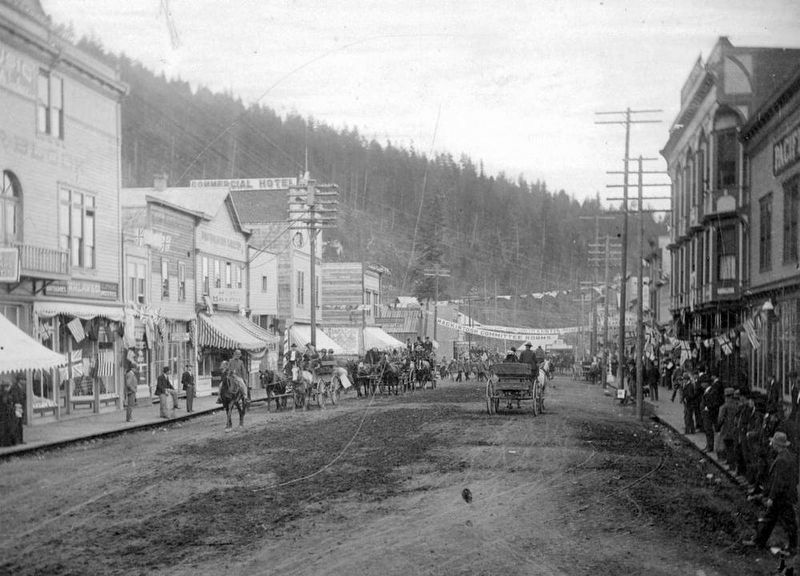
Unknown via British Columbia Archives B-00523_141 (Public domain), 1900
2. Copper Street
Greenwood's history dates to 1891, when gold, silver and copper were discovered in the area. Fortune seekers swarmed into the city, but the boom was short-lived: Copper prices sank after World War I and the city's population dwindled to just a few hundred. The ghost town briefly came back to life during World War II, when it was turned into an internment camp that held 1,200 Japanese-Canadians. The city now has about 650 residents.
Credits. This page was last revised on February 11, 2022. It was originally submitted on December 10, 2021, by Duane and Tracy Marsteller of Murfreesboro, Tennessee. This page has been viewed 314 times since then and 37 times this year. Photos: 1. submitted on December 10, 2021, by Duane and Tracy Marsteller of Murfreesboro, Tennessee. 2. submitted on December 12, 2021, by Duane and Tracy Marsteller of Murfreesboro, Tennessee.
Editor’s want-list for this marker. Wide shot of marker and surrounding area in context • Can you help?
