Near Ponca City in Kay County, Oklahoma — The American South (West South Central)
Native American Involvement …in the 101 Ranch
Photographed by James Hulse, September 10, 2021
1. Native American Involvement ...in the 101 Ranch Marker
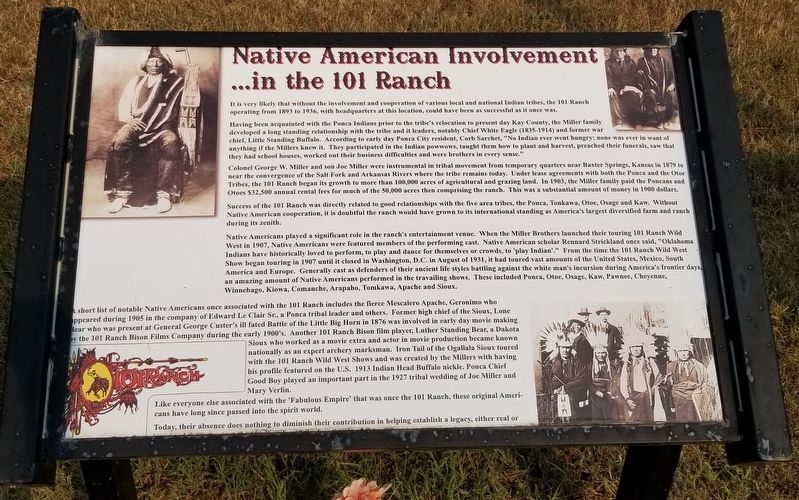
Having been acquainted with the Ponca Indians prior to the tribe's relocation to present day Kay County, the Miller family developed a long standing relationship with the tribe and it leaders, notably Chief White Eagle (1835-1914) and former war chief, Little Standing Buffalo. According to early day Ponca City resident, Corb Sarchet, "No Indian ever went hungry; none was ever in want of anything if the Millers knew it. They participated in the Indian powwows, taught them how to plant and harvest, preached their funerals, saw that they had school houses, worked out their business difficulties and were brothers in every sense."
Colonel George W. Miller and son Joe Miller were instrumental in tribal movement from temporary quarters near Baxter Springs, Kansas in 1879 to near the convergence of the Salt Fork and Arkansas Rivers where the tribe remains today. Under lease agreements with both
this page online
Success of the 101 Ranch was directly related to good relationships with the five area tribes, the Ponca, Tonkawa, Otoe, Osage and Kaw. Without Native American cooperation, it is doubtful the ranch would have grown to its international standing as America's largest diversified farm and ranch during its zenith.
Native Americans played a significant role in the ranch's entertainment venue. When the Miller Brothers launched their touring 101 Ranch Wild West in 1907, Native Americans were featured members of the performing cast. Native American scholar Rennard Strickland once said, "Oklahoma Indians have historically loved to perform, to play and dance for themselves or crowds, to 'play Indian'." From the time the 101 Ranch Wild West Show began touring in 1907 until it closed in Washington, D.C. in August of 1931, it had

Photographed by James Hulse, September 10, 2021
2. Native American Involvement ...in the 101 Ranch Marker
A short list of notable Native Americans once associated with the 101 Ranch includes the fierce Mescalero Apache, Geronimo who appeared during 1905 in the company of Edward Le Clair Sr., a Ponca tribal leader and others. Former high chief of the Sioux, Lone Bear who was present at General George Custer's ill fated Battle of the Little Big Horn in 1876 was involved in early day movie making by the 101 Ranch Bison Films Company during the early 1900's. Another 101 Ranch Bison film player, Luther Standing Bear, a Dakota Sioux who worked as a movie extra and actor in movie production became known nationally as an expert archery marksman. Iron Tail of the Ogallala Sioux toured with the 101 Ranch Wild West Shows and was created by the Millers with having his profile featured on the U.S. 1913 Indian Head Buffalo nickle. Ponca Chief Good Boy played an important part in the 1927 tribal wedding of Joe Miller and Mary Verlin.
Like everyone else associated with the 'Fabulous Empire' that was once the 101 Ranch, these original Americans have long since passed into the spirit world.
Today, their absence does nothing to diminish their contribution in helping establish a legacy, either real or...
Erected by 101 Ranch Old Timers Association.
Topics. This historical marker is listed in these topic lists: Animals • Entertainment • Indigenous Peoples and Communities • Industry & Commerce. A significant historical month for this entry is August 1931.
Location. 36° 36.772′ N,
Photographed by James Hulse, September 10, 2021
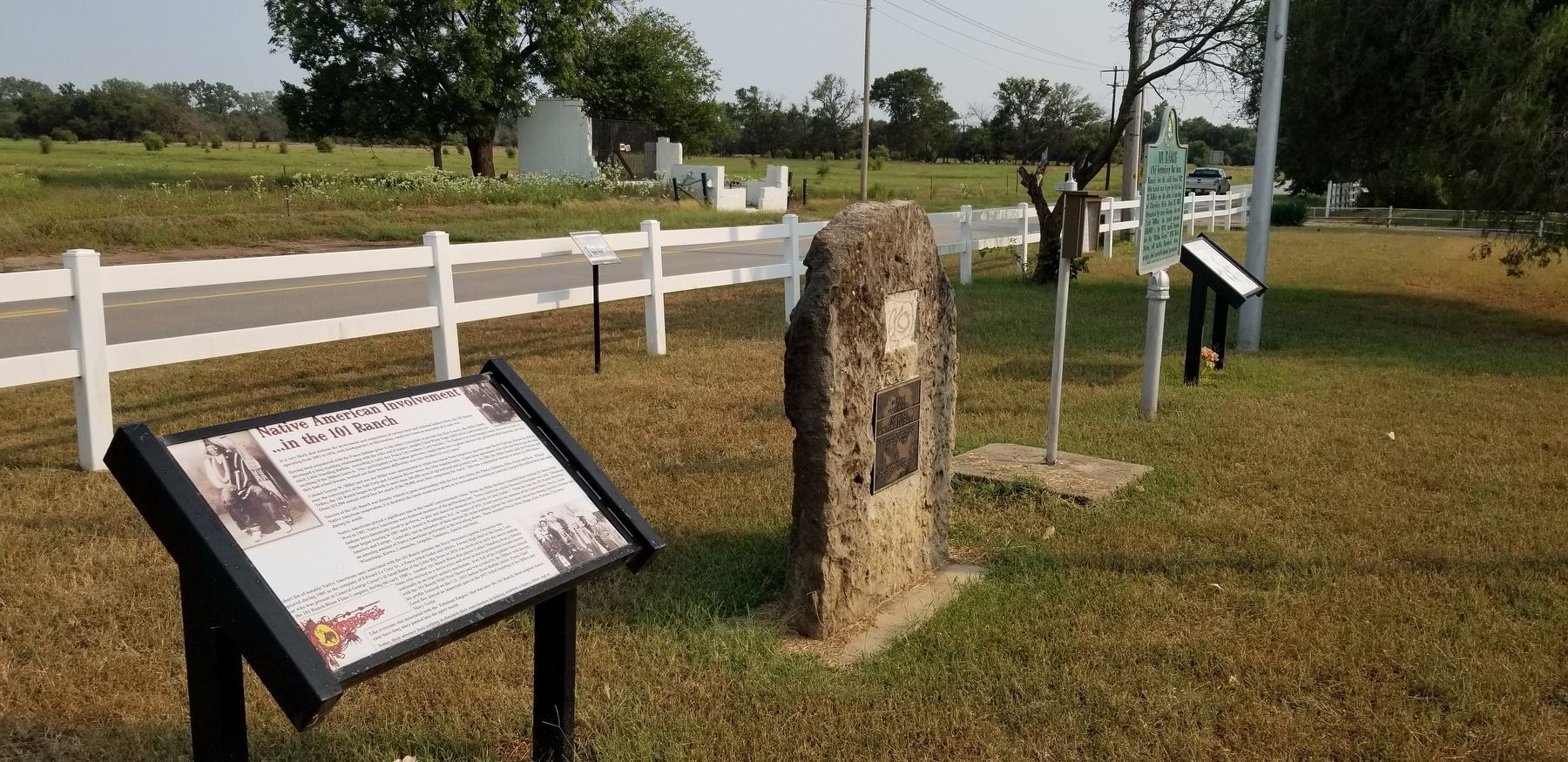
3. The Native American Involvement ...in the 101 Ranch Marker is the marker on the left of the others

Regionally, this marker is in Northwest Oklahoma — Red Carpet Country. It is also in the American South, specifically on the prairies, and on the Southern Plains. Globally, it is in North America, the Western Hemisphere, the Western World, and the Anglosphere. Historically, it finds itself in what was once the territory of the Mississippian Culture, the Louisiana Purchase, and Cherokee Outlet.
Other nearby markers. At least 8 other markers are within 6 miles of this marker, measured as the crow flies: 101 Ranch (here, next to this marker); "White House" (within shouting distance of this marker); A John Deer Rowe Plow Seed Planter (about 300 feet away, measured in a direct line); 101 Dairy Barn Vent from Dairy Barn (about 400 feet away); Two Old Potato Plows (about 400 feet away); "Indian Trail Marker" (approx. 3 miles away); a different marker also named 101 Ranch (approx. 3.2 miles away); Royal Air Force (RAF) Memorial (approx. 5.6 miles away). Touch for a list and map of all markers in Ponca City.
Credits. This page was last revised on December 31, 2024. It was originally submitted on December 13, 2021, by James Hulse of Medina, Texas. This page has been viewed 913 times since then and 88 times this year. Photos: 1, 2, 3. submitted on December 13, 2021, by James Hulse of Medina, Texas.
