Sandy Spring in Montgomery County, Maryland — The American Northeast (Mid-Atlantic)
Countee Cullen
⎯⎯⎯
The Odd Fellows Lodge
Sandy Spring African American Heritage Trail
| — | [Sandy Spring Slave Museum & African Art Gallery] | — |
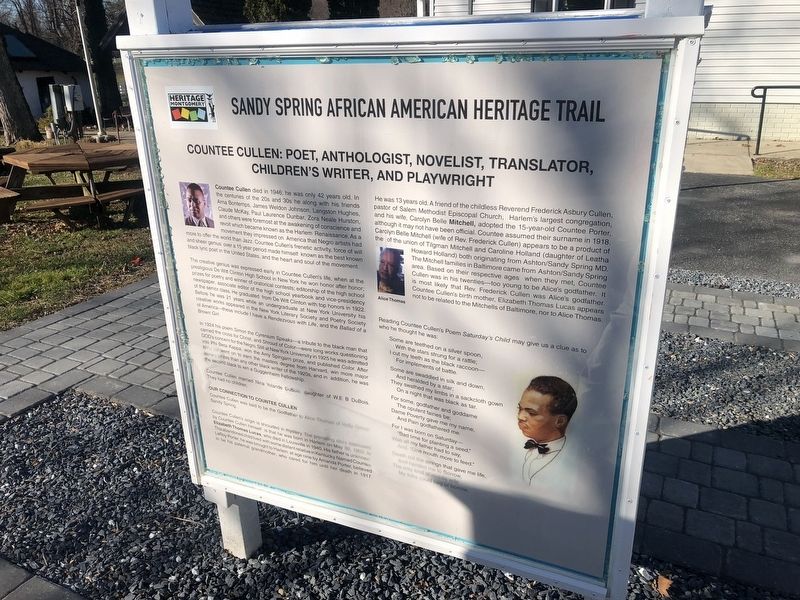
Countee Cullen: Poet, Anthropologist, Novelist, Translator, Children's Author, and Playwright
Countee Cullen died in 1946; he was only 42 years. In the centuries of the 20s and 30s he along with his friends Arna Bontemps, James Weldon Johnson, Langston Hughes, Claude McKay, Paul Laurence Dunbar, Zora Neale Hurston, and others were foremost at the awakening of conscience and revolt which became known as the Harlem Renaissance. As a movement they impressed on America that Negro artists had more to offer the world than Jazz. Countee Cullen's frenetic activity, force of will and sheer genius over a 15 year period made himself known as the best known black lyric poet in the United States, and the heart and the soul of the movement.
The creative genius was expressed early in Countee Cullen's life, when at the prestigious De Witt Clinton High School in New York he won honor after honor; prizes for poetry and winner of oratorical contests; editorship of the high school newspaper, associate editor of the high school yearbook and vice-presidency of the senior class. He graduated from De Witt Clinton with top honors in 1922.
this page online
In 1924 his poem Simon the Cyrenium Speaks—a tribute to the black man that carried the cross for Christ, and Shroud of Color—were long works questioning God's concern for the Negro. Still at New York University in 1925 he was admitted into Phi Beta Kappa, won the Amy Spingarn prize, and published Color. After NYU he went on to earn the masters degree from Harvard, win more major literary prizes than any other black writer of the 1920s, and in addition, he was the second black to win a Guggenheim Fellowship.
Countee Cullen married Nina Yolande DuBois, daughter of W.E B. DuBois. They had no children.
Our Connection to Countee Cullen
Countee Cullen's origin is shrouded in mystery. The prevailing story espoused by Countee Cullen himself is that he was born in Harlem on May 30, 1903, to Elizabeth Thomas Lucas, who died in Louisville in 1940. His father is unknown. This abandoned child lived with
Photographed by Devry Becker Jones (CC0), December 12, 2021
2. The Odd Fellows Lodge side of the marker
He was 13 years old. A friend of the childless Reverend Frederick Asbury Cullen, pastor of Salem Methodist Episcopal Church, Harlem's largest congregation and his wife, Carolyn Belle Mitchell, adopted the 15-year-old Countee Porter, although it may not have been official. Countee assumed their surname in 1918. Carolyn Belle Mitchell (wife of Rev. Frederick Cullen) appears to be a product of the of the union of Tilgman Mitchell and Caroline Holland (daughter of Leatha Howard Holland) both originating from Ashton/Sandy Spring MD. The Mitchell families in Baltimore came from Ashton/Sandy Spring area. Based on their respective ages when they met, Countee Cullen was in his twenties—too young to be Alice's godfather. It is most likely that Rev. Frederick Cullen was Alice's godfather. Countee Cullen's birth mother, Elizabeth Thomas Lucas appears to not be related to the Mitchells of Baltimore, nor to Alice Thomas.
Reading Countee Cullen's

Some are teethed on a silver spoon,
With the stars strung for a rattle;
I cut my teeth as the black raccoon—
For implements of battle.
Some are swaddled in silk and down,
And heralded by a star;
They swathed my limbs in a sackcloth gown
On a night that was black as tar.
For some, godfather and goddame
The opulent fairies be;
Dame Poverty gave me my name,
And Pain godfathered me.
For I was born on Saturday—
"Bad time for planting a seed,"
Was all my father had to say,
And, "One mouth more to feed."
Death cut the strings that gave me life,
And handed me to Sorrow,
The only kind of middle wife
My folks could beg or borrow.
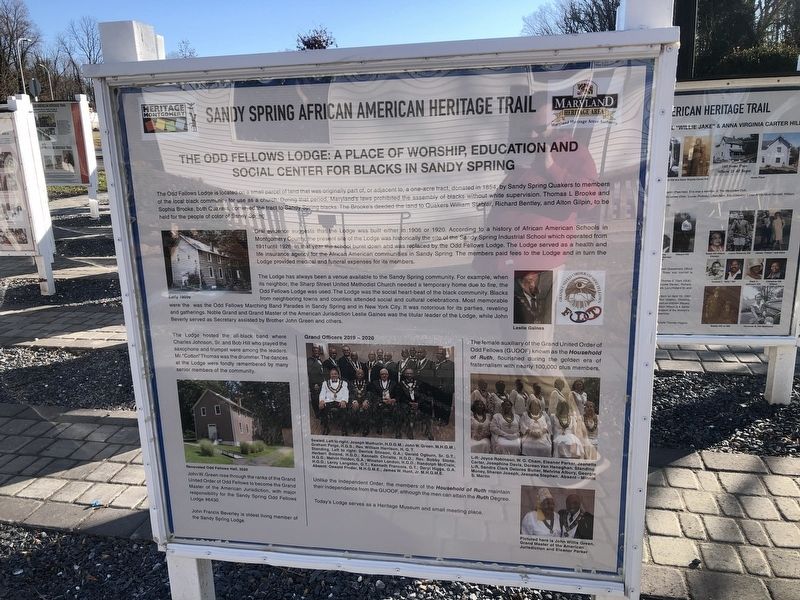
The Odd Fellows Lodge: A Place of Worship, Education and Social Center for Blacks in Sandy Spring
The Odd Fellows Lodge is located on a small parcel of land that was originally part of, or adjacent to, a one-acre tract, donated in 1854, by Sandy Spring Quakers to members of the local black community for use as a church. During that period, Maryland's laws prohibited the assembly of blacks without white supervision.

Photographed by Devry Becker Jones (CC0), December 12, 2021
4. The Odd Fellows Lodge side of the marker
Oral evidence suggests that the Lodge was built either in 1906 or 1920. According to a history of African American Schools in Montgomery County, the present site of the Lodge was historically the site of the Sandy Spring Industrial School which operated form 1911 until 1926. In that year the school burnt down and was replaced by the Odd Fellows Lodge. The Lodge served as a health and life insurance agency for the African American communities in Sandy Spring. The members paid fees to the Lodge and in turn the Lodge provided medical and funeral expenses for its members.
The Lodge has always been a venue available to the Sandy Spring community. For example, when its neighbor, the Sharp Street United Methodist Church needed a temporary home due to fire, the Odd Fellows Lodge was used. The Lodge was the social heart-beat of the black community. Blacks from neighboring towns and counties attended social

Photographed by Allen C. Browne, November 29, 2015
5. Countee Cullen
1925 portrait by Winold Reiss in the National Portrait Gallery.
The lodge hosted the all-black band where Charles Johnson, Sr. and Bob Hill who played the saxophone and trumpet were among the leaders. Mr. "Cotton" Thomas was the drummer. The dances at the Lodge were fondly remembered by many senior members of the members of the community.
John W. Green rose through the ranks of the Grand United Order of Odd Fellows to become the Grand Master of the American Jurisdiction, with major responsibility for the Sandy Spring Odd Fellows Lodge #6430.
John Francis is the oldest living member of the Sandy Spring Lodge.
The female auxiliary of the Grand United Order of Odd Fellows (GUOOF) known as the Household of Ruth, flourished during the golden era of fraternalism with nearly 100,000 plus members.
Unlike the Independent Order, the members of the Household of Ruth maintain their independence from the GUOOF, although the men can attain the Ruth Degree.
Today's Lodge serves as a Heritage Museum and small meeting place.
Erected 2020 by Sandy Spring Slave Museum & African Art Gallery.
Topics and series. This historical marker is listed in these topic lists: African Americans • Anthropology & Archaeology • Arts, Letters, Music • Entertainment. In addition, it is included in the Quakerism series list. A significant historical year for this entry is 1854.
Location. 39° 9.581′ N, 77° 1.978′ W. Marker is in Sandy Spring, Maryland, in Montgomery County. It is on Brooke Road 0.1 miles west of Chandlee Mill Road, on the right when traveling west. Touch for map. Marker is at or near this postal address: 18524 Brooke Rd, Sandy Spring MD 20860, United States of America. Touch for directions.

Regionally, this marker is in the Washington Metropolitan Area. It is also in the American Mid-Atlantic. Globally, it is in North America, the Western Hemisphere, the Western World, and the Anglosphere. Historically, it finds itself in what was once one of the original Thirteen Colonies and also the Antebellum South.
Other nearby markers. At least 8 other markers are within walking distance of this marker: Martha Howard and John H. Murphy Alliance / Mutual Memorial Cemetery (here, next to this marker); Profiles of the Richard Perry Budd and Williams Families in Sandy Spring (here, next to this marker); Harridays and Carrolls / Carolyn Snowden (here, next to this marker); Tribute to Robert H. "Bob" Hill / Sharp Street United Methodist Church (here, next to this marker); Leatha Howard Holland Webster / William Howard Hill & Anna Virginia Carter Hill (here, next to this marker); The Powell-Matthews-Cook and Brooks Families in Sandy Spring / Spencerville (here, next to this marker); Historic Sites Allegedly Connected to the Underground Railroad / Mamma Annie Matthews (here, next to this marker); Eliza Howard and Descendants / Remembering the Bells, Hopkins, Harriday Families (here, next to this marker). Touch for a list and map of all markers in Sandy Spring.
Additional commentary.
1. About Countee Cullen
Some historians believe that Countee Cullen was gay, bisexual, same-gender loving or questioning, although there is not a consensus on this. He was married twice to women, although it is believed that he had affairs while he was married or unmarried.
— Submitted December 16, 2021, by Devry Becker Jones of Washington, District of Columbia.
Additional keywords. LGBT, LGBTQ, 🏳️🌈, Harlem Renaissance, "New Negro Renaissance"
Credits. This page was last revised on October 26, 2022. It was originally submitted on December 16, 2021, by Devry Becker Jones of Washington, District of Columbia. This page has been viewed 770 times since then and 27 times this year. Photos: 1, 2, 3, 4. submitted on December 16, 2021, by Devry Becker Jones of Washington, District of Columbia. 5. submitted on October 19, 2022, by Allen C. Browne of Silver Spring, Maryland.
