Sandy Spring in Montgomery County, Maryland — The American Northeast (Mid-Atlantic)
Tribute to Robert H. "Bob" Hill
⎯⎯⎯
Sharp Street United Methodist Church
Sandy Spring African American Heritage Trail
| — | [Sandy Spring Slave Museum & African Art Gallery] | — |

Photographed by Devry Becker Jones (CC0), December 12, 2021
1. Tribute to Robert H. "Bob" Hill side of the marker
Tribute to Robert H. "Bob" Hill: Entrepreneur, Master Builder, and Community Leader
Robert H. Hill was born on a farm in Sandy Spring in 1904. His parent, Samuel T. and Mary Hill, were prosperous and raised not only 16 children, but hogs, cattle, corn, wheat, hay, and all manner of vegetables which were regularly driven to the District of Columbia markets. Farming was not Bob Hill's first choice.
Bob Hill says he always knew about building things. His carpentry skills were honed at Sharp Street Colored Schools by teaching principal A.D. Owens, one of the school's four teachers. He learned his home building skills by working with older Sandy Spring carpenters on construction jobs.
Hill spent the next fifty years building more than 250 homes, churches, a brick funeral home, and other structures. He became known locally as a "custom" or "master" builder, forming Sandy Spring Construction Co. in the 1940's. Over the years, Hill developed a constituency, building for young families, wealthy socialites, and national figures such as Ralph Bunche, all over Maryland and in Washington. Sandy Spring Construction Co. prospered
this page online
Robert "Bob" Hill was a prominent businessman and active community leader, often referring to himself as the "Mayor" of Sandy Spring. He participated in activities and played in the Odd Fellows musical bands. His passion was baseball. He supported the activities of the Sandy Spring All Stars baseball team, and Negro League quality baseball players who played in Olney, in a field in his name.
The Sharp Street United Methodist Church: Heart and Soul of the Sandy Spring African American Heritage Area
The Sharp Street United Methodist Church
"Founded in 1822, Sharp Street United Methodist Church is the oldest African-American church in Montgomery County, Maryland. Sharp Street Church has served as a beacon of hope and freedom in the village of Sandy Spring for nearly two centuries. Since its founding, the church has maintained a vitalpresence in the community and has evolved into a vibrant place of worship and educational, social and cultural institution serving African Americans in Montgomery County ans surrounding counties."Photographed by Devry Becker Jones (CC0), December 12, 20212. Sharp Street United Methodist Church side of the marker
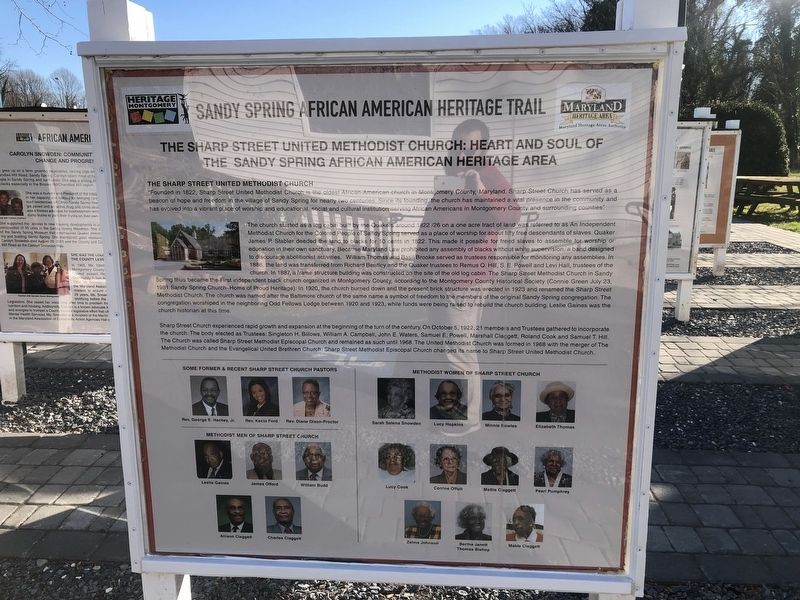
The church started as a log cabin built by the Quakers around 1822 /26 on a one acre tract of land was referred to as An Independent Methodist Church for the Colored People of Sandy Spring served as a place of worship for about fifty free descendants of slaves. Quaker James P. Stabler deeded the land to blacks for 10 cents in 1822 This made it possible for freed slaves to assemble for worship or education in their own sanctuary. Because Maryland Law prohibited any assembly of any blacks without white supervision, a band designed to discourage abolitionist activities. William Thomas and Basil Brooke served as trustees responsible for monitoring any assemblies. In 1886, the land was transferred from Richard Bentley and the Quaker trustees to Remus Q. Hill, S.E. Powell and Levi Hall, trustees of the church. In 1887, a frame structure building was constructed on the site of the old log cabin. The Sharp Street in Sandy Spring thus became the
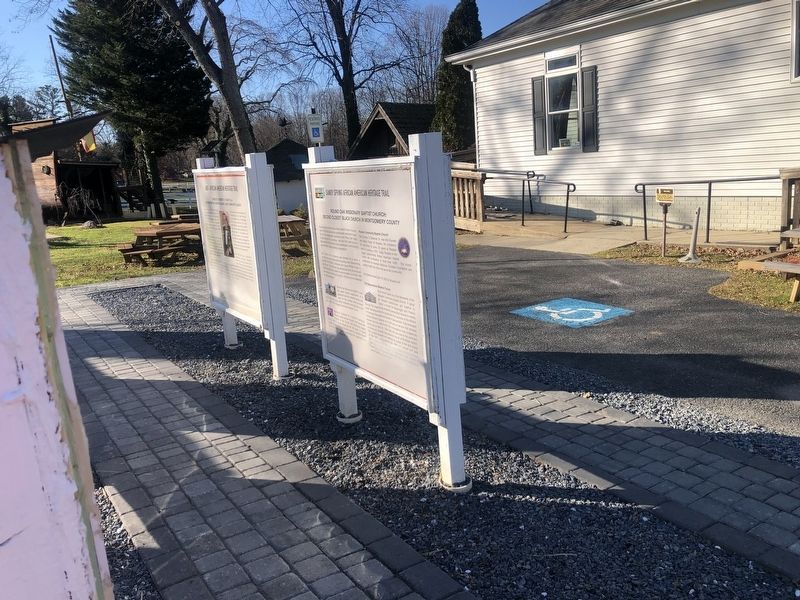
Photographed by Devry Becker Jones (CC0), December 12, 2021
3. Tribute to Robert H. "Bob" Hill side of the marker
Sharp Street Church experienced rapid growth and expansion at the beginning of the turn of the century. On October 5, 1922, 21 members and Trustees gathered to incorporate the church. The body elected as Trustees: Singleton H. Billows, William A. Campbell, John E. Waters, Samuel E. Powell, Marshall Claggett, Roland Cook and Samuel T. Hill. The Church was called Sharp Street Methodist Episcopal Church and remained as such until 1968. The United Methodist Church was formed in 1968
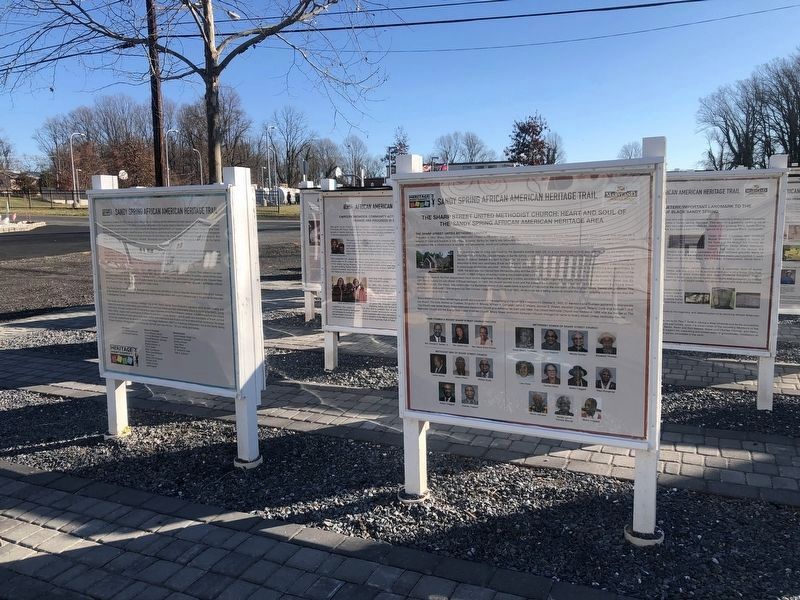
Photographed by Devry Becker Jones (CC0), December 12, 2021
4. Sharp Street United Methodist Church side of the marker
Erected 2020 by Sandy Spring Slave Museum & African Art Gallery.
Topics and series. This historical marker is listed in these topic lists: African Americans • Agriculture • Education • Industry & Commerce • Religion & Religious Structures. In addition, it is included in the Quakerism series list. A significant historical year for this entry is 1904.
Location. 39° 9.583′ N, 77° 1.977′ W. Marker is in Sandy Spring, Maryland, in Montgomery County. It is on Brooke Road 0.1 miles west of Chandlee Mill Road, on the right when traveling west. Touch for map. Marker is at or near this postal address: 18524 Brooke Rd, Sandy Spring MD 20860, United States of America. Touch for directions.

Regionally, this marker is in the Washington Metropolitan Area. It is also in the American Mid-Atlantic. Globally, it is in North America, the Western Hemisphere, the Western World, and the Anglosphere. Historically, it finds itself in what was once one of the original Thirteen Colonies and also the Antebellum South.
Other nearby markers. At least 8 other markers are within walking distance of this marker: Round Oak Missionary Baptist Church / Sandy Spring African American Heritage Trail (here, next to this marker); Countee Cullen / The Odd Fellows Lodge (here, next to this marker); Martha Howard and John H. Murphy Alliance / Mutual Memorial Cemetery (here, next to this marker); Profiles of the Richard Perry Budd and Williams Families in Sandy Spring (here, next to this marker); Harridays and Carrolls / Carolyn Snowden (here, next to this marker); Leatha Howard Holland Webster / William Howard Hill & Anna Virginia Carter Hill (here, next to this marker); The Powell-Matthews-Cook and Brooks Families in Sandy Spring / Spencerville (here, next to this marker); Mysteries of the Hopkins House / Free Black Slaves Settled the Norbeck Community (a few steps from this marker). Touch for a list and map of all markers in Sandy Spring.
Credits. This page was last revised on March 9, 2023. It was originally submitted on December 16, 2021, by Devry Becker Jones of Washington, District of Columbia. This page has been viewed 1,335 times since then and 109 times this year. Photos: 1, 2, 3, 4. submitted on December 16, 2021, by Devry Becker Jones of Washington, District of Columbia.
