Historic District in St. Augustine in St. Johns County, Florida — The American South (South Atlantic)
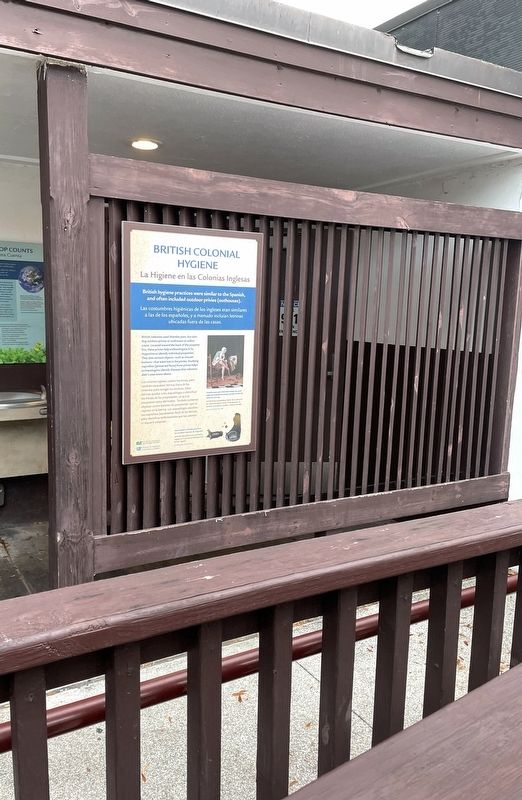
British Colonial Hygiene
La Higiene en las Colonias Inglesas

Photographed by Brandon D Cross, December 15, 2021
1. British Colonial Hygiene Marker
Las costumebres higiénicas de los ingleses eran similares a las de los españoles, y a menudo incluían letrinas ubicadas funeral de las casas.
British colonists used chamber pots, but also dug outdoor privies or outhouses to collect waste. Located toward the back of the property line, these privies help archeologists in St. Augustine to identify individual properties. They also contain objects - such as trouser buttons - that were lost in the privies. Studying coprolites (preserved feces) from privies helps archeologists identify diseases that colonists didn’t even know about.
Los colonos ingleses usaban bacinicas, pero tambi&eacurate;n excavaban letrinas fuera de las viviendas para rocoger los residuos. Estes letrinas ayudan a los arqueólogos a identificar los límites de las propiedades, ya que se encuentran cerca del lindero. También excavaban letrinas fuera de las viviendas para recogerlos residuos. Estes letrinas ayudan a los arqueólogos a identificar los límites de las propiedades, ya que se encuentran cerca
this page online
(Caption)
Woman at her Toilet, Jan Steen, 1663
Chamber pots were often kept indoors for use at night and emptied into privies, gardens or even the street the next day.
Las bacinicas se guardaban dentro de la casa para ser usadas durante la noche. Al día siguiente, se vaciaban en la letrina, el jardín o hasta en la calle.
Items found in a British privy from the Ximenez-Fatio site, St. Augustine
Artículos descubiertos en una letrina ingleses en el yacimiento Ximenez-Fatio en San Agustín.
Florida Museum of Natural History
Erected by Florida Museum of Natural History and Historic St. Augustine, University of Florida.
Topics. This historical marker is listed in these topic lists: Colonial Era • Settlements & Settlers.
Location. 29° 53.796′ N, 81° 18.803′ W. Marker is in St. Augustine, Florida, in St. Johns County. It
Photographed by Brandon D Cross, December 15, 2021
2. British Colonial Hygiene Marker

Regionally, this marker is in First Coast and in Greater Jacksonville. It is also in the American South and on the Eastern Seaboard. Globally, it is in the North Atlantic Region, North America, a Gulf of Mexico state, the Western Hemisphere, the Western World, and the Anglosphere. Historically, it finds itself in what was once New Spain, the territory of the Mississippian Culture, one of the Confederate States of America, and the Antebellum South.
Other nearby markers. At least 8 other markers are within walking distance of this marker: Every Drop Counts (here, next to this marker); La Florida's El Camino Real (here, next to this marker); Spanish Colonial Hygiene (a few steps from this marker); Florencia House (a few steps from this marker); Salcedo House (a few steps from this marker); Triay House (a few steps from this marker); The Minorcan Heritage (a few steps from this marker); De Hita-González Houses (a few steps from this marker). Touch for a list and map of all markers in St. Augustine.
Credits. This page was last revised on December 18, 2021. It was originally submitted on December 17, 2021, by Brandon D Cross of Flagler Beach, Florida. This page has been viewed 329 times since then and 22 times this year. Photos: 1, 2. submitted on December 17, 2021, by Brandon D Cross of Flagler Beach, Florida. • Bernard Fisher was the editor who published this page.
