
Historic District in St. Augustine in St. Johns County, Florida — The American South (South Atlantic)
Coontie
Zamia pumila or Zamia floridans

Photographed by Cosmos Mariner, December 16, 2021
1. Coontie Marker
200 Million Years in the Making
Coontie is a low and palm-like or fern-like plant that grows throughout Florida and the Caribbean. Coontie is a member of the Phylum cycadacaea. At roughly 200 million years old, this is one of the older plant phyla in Florida, and is sometimes called a 'living fossil'. Looking at this plant, you may notice that it seems a bit more primitive than other plants you might see in the Park.
Coontie is often found in well-drained shallow sandy soil and is commonly found on coastal middens and shell mounds. The name Coontie comes to English most directly from the Seminole language. The original Seminole meaning was 'white root' or 'flour root'. When the Seminole Indians moved into Florida in the mid-18th century, they found the remnant Timucua and Calusa populations extracting flour from Zamia, and quickly added it to their potpourri of wild plant foods.
a.k.a. Florida Arrowroot — But Use Caution
With a subterranean stem that is rich in starch, Coontie has a historically widespread use as a food among Florida Indian peoples. The plant must be carefully processed to remove toxins that are naturally
this page online
Around 1825, early settlers in the Fort Lauderdale area learned the Seminole's technique of removing the toxin cycasin from the Coontie to produce starch. By the 1880s, several mills were in business in Miami. During WWI, one mill was processing as much as 18 tons of coontie daily for military purchase. The starch content was said to range from 20% in winter to a low of 8% in summer. By 1911, the starch was known as "Florida Arrowroot." The Food and Drug Administration banned the practice of Coontie starch making in 1925, because of the chance that improper procedures could result in unintentional poisoning. The last commercial Coontie starch factory in Florida was destroyed by the 1926 Miami Hurricane.
The Atala Hairstreak Butterfly Returns
Coontie is critically
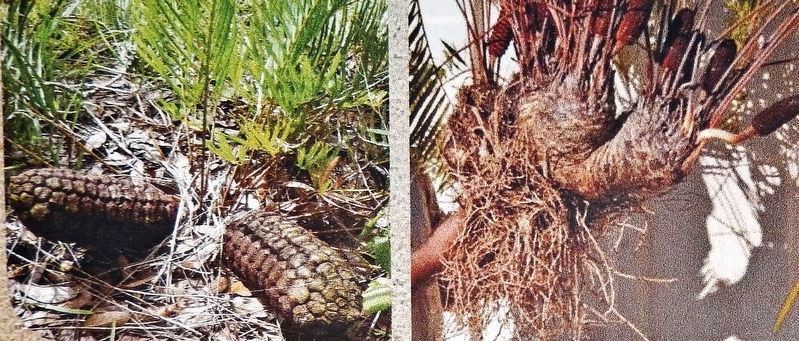
2. Marker detail: Coontie Seed Cones & Roots
Coontie is widely used as an ornamental throughout south Florida. As a result of this, the Atala Hairstreak Butterfly has returned from the edge of extinction.
(left) Coontie seed cones can look very similar to ears of corn. The similarity ends there.
(right) The starchy roots of the Coontie can be processed into a light-yellow starch from which doughs and breads can be made.
This butterfly, thought to be extinct until recently, is dependent for its survival on the Zamia genus. As Coontie plants were harvested in the millions for starch making, the butterfly had no food source and died out in large areas. With the return of the Coontie plant as a common landscaping shrub, the butterfly has made a return.
At the larval stage, the Eumaeus atala caterpillar exclusively eats the leaves of the coontie. A half dozen caterpillars can completely strip a Coontie bare and so a large coontie population is needed to sustain the Eumaeus atala population. The butterfly is boldly colored, with black wings, cyan spots, and a bright orange abdomen.
Topics. This historical marker is listed in these topic lists: Animals • Indigenous Peoples and Communities • Industry & Commerce • War, World I.
Location. 29° 54.393′ N, 81° 18.929′ W. Marker is in St. Augustine, Florida, in St. Johns County. It is in the Historic District. It can be reached from Williams Street east of Magnolia Avenue.

Photographed by Cosmos Mariner, December 16, 2021
3. Coontie Marker

Regionally, this marker is in First Coast and in Greater Jacksonville. It is also in the American South and on the Eastern Seaboard. Globally, it is in the North Atlantic Region, North America, a Gulf of Mexico state, the Western Hemisphere, the Western World, and the Anglosphere. Historically, it finds itself in what was once New Spain, the territory of the Mississippian Culture, one of the Confederate States of America, and the Antebellum South.
Other nearby markers. At least 8 other markers are within walking distance of this marker: Ancient Civilization Uncovered! (a few steps from this marker); Prickly Pear Cactus (a few steps from this marker); Sweetgum (a few steps from this marker); Galberry (a few steps from this marker); Mandarin Orange (a few steps from this marker); Cassia (a few steps from this marker); Yaupon Holly (a few steps from this marker); The Timucuan Way Of Life (a few steps from this marker). Touch for a list and map of all markers in St. Augustine.
Related markers. Click here for a list of markers that are related to this marker. Ponce de León's Fountain of Youth Archaeological Park
Also see . . .
1. Zamia pumila. Wikipedia entry:
This plant is poisonous, producing a toxin called cycasin that affects the gastrointestinal tract and nervous system. The toxin can however be removed by careful leaching, and the roots and half-buried stems were used by the Taíno people for their yield of a starch. The plant is also fed upon by various insects, including the Atala butterfly (Eumaeus atala), which sequesters the toxin inside its body for use in its own defense.(Submitted on December 28, 2021, by Cosmos Mariner of Cape Canaveral, Florida.)
2. Atala hairstreak. University of Florida Featured Creatures website entry (Submitted on January 3, 2023, by Larry Gertner of New York, New York.)
Credits. This page was last revised on January 3, 2023. It was originally submitted on December 28, 2021, by Cosmos Mariner of Cape Canaveral, Florida. This page has been viewed 1,863 times since then and 70 times this year. Photos: 1, 2, 3. submitted on December 28, 2021, by Cosmos Mariner of Cape Canaveral, Florida.
