
Douglas (Bronzeville) in Chicago in Cook County, Illinois — The American Midwest (Great Lakes)
State Street
Photographed by Andrew Ruppenstein, August 27, 2021
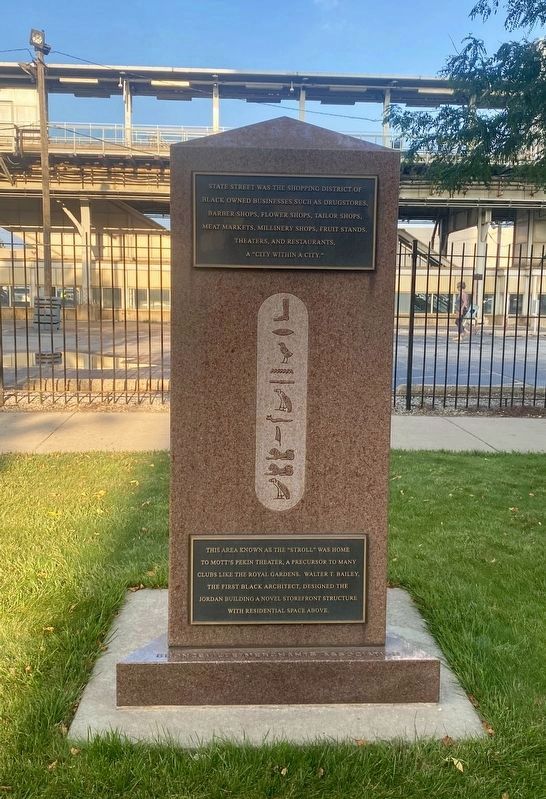
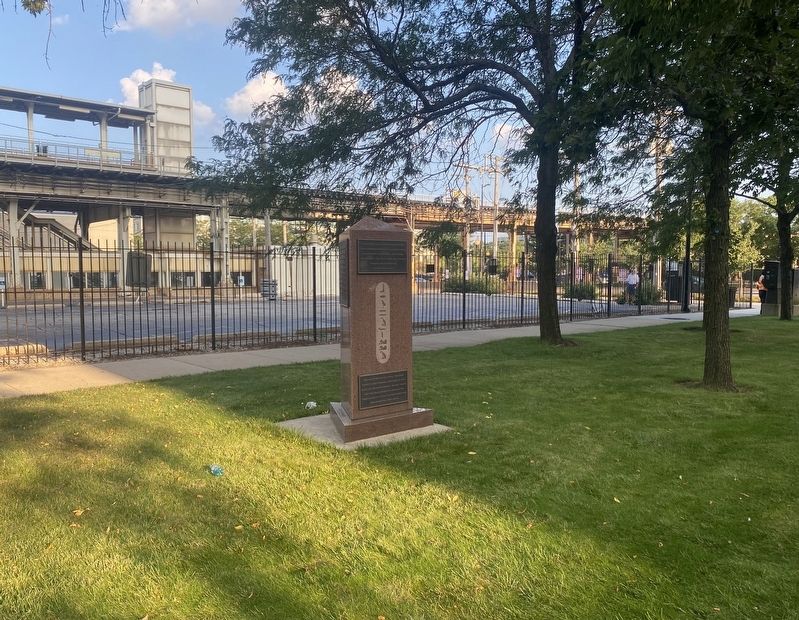
1. State Street Marker - obelisk with panels 1a and 1b
State Street was the shopping district of Black owned businesses such as drugstores, barber shops, flower shops, tailor shops, meat markets, millinery shops, fruit stands, theaters, and restaurants, a “city within a city."
This area known as the "Stroll” was home to Mott's Pekin Theater, a precursor to many clubs like the Royal Gardens. Walter T. Bailey, the first Black architect, designed the Jordan Building a novel storefront structure with residential space above.
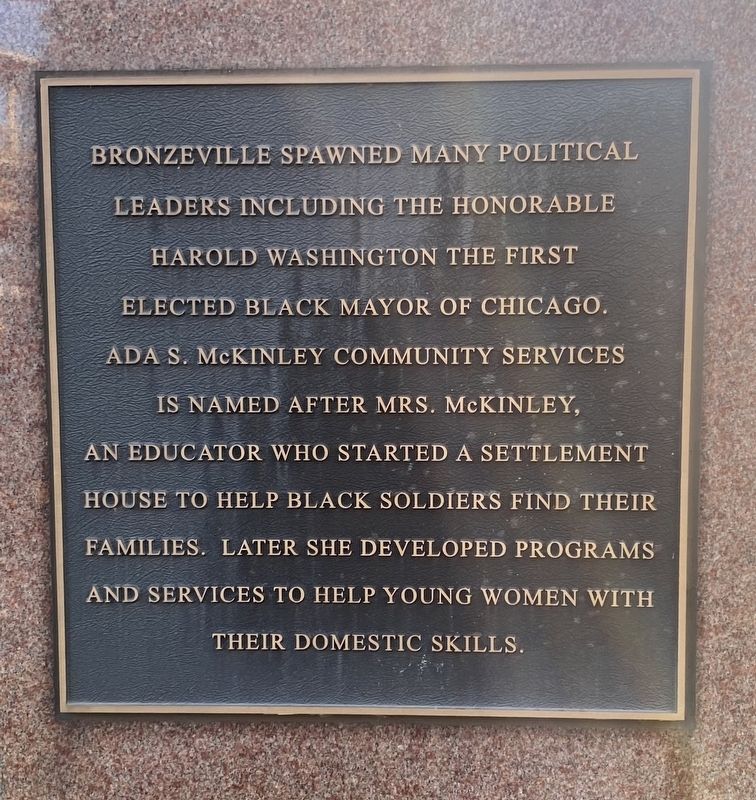
Bronzeville spawned many political leaders including the Honorable Harold Washington the first elected Black mayor of Chicago. Ada S. McKinley Community Services is named after Mrs. McKinley, an educator who started a settlement house to help Black soldiers find their families. later she developed programs and services to help young women with their domestic skills.
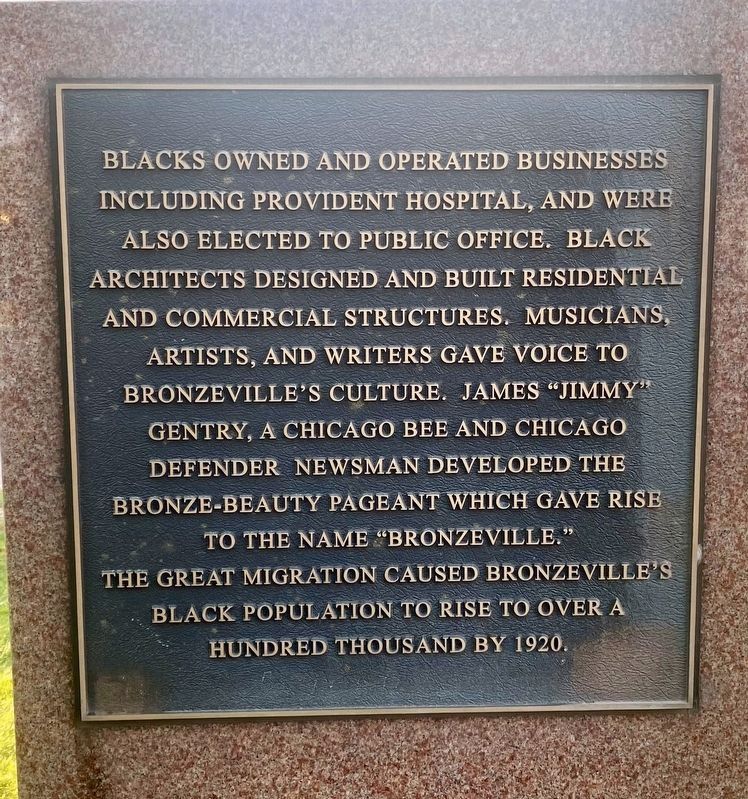
Blacks owned and operated businesses including Provident Hospital, and were also elected to public office. Black architects designed and built commercial and residential structures. Musicians, artists and writers gave voice to Bronzeville's culture. James "Jimmy" Gentry, a Chicago Bee and Chicago Defender newsman developed the Bronze-Beauty Pageant which gave rise to the name "Bronzeville." The Great Migration caused Bronzeville's population to rise to over a hundred thousand by 1920.
Erected by Bronzeville Merchants Association.
Topics. This historical marker is listed in these topic lists: African Americans • Charity & Public Work • Industry & Commerce • Roads & Vehicles. A significant historical year for this entry is 1920.
Location. 41° 49.891′ N, 87° 37.579′ W. Marker is in Chicago, Illinois, in Cook County. It is in Douglas (Bronzeville). It is at the intersection of South State Street and East 35th Street, on the right on South State
this page online

Regionally, this marker is in the American Midwest and on the Great Lakes. Globally, it is in North America, the Western Hemisphere, the Western World, and the Anglosphere. Historically, it finds itself in what was once the Viceroyalty of New France, the territory of the Mississippian Culture, and the Northwest Territory.
Other nearby markers. At least 8 other markers are within walking distance of this marker: Welcome to Bronzeville (within shouting distance of this marker); William J. Otterson (within shouting distance of this marker); John Walter Humphrey (within shouting distance of this marker); Edward Lee (within shouting distance of this marker); Joseph Sanford (within shouting distance of this marker); Hymes Taylor (within shouting distance of this marker); Chicago Race Riot of 1919 (within shouting distance of this marker); a different marker also named Welcome to Bronzeville (within shouting distance of this marker). Touch for a list and map of all markers in Chicago.
Also see . . . Bronzeville: The Black Metropolis.
Photographed by Andrew Ruppenstein, August 27, 2021
2. State Street Marker - Panel 2
"From the 1920s through the 1950s, Chicago's South Side was the center for African-American culture and business. Known as "Bronzeville," the neighborhood was surprisingly small, but at its peak more than 300,000 lived in the narrow, seven-mile strip.(Submitted on December 29, 2021.)
Chicago's black population stretched along 22nd to 63rd streets between State Street and Cottage Grove. But the pulsing energy of Bronzeville was located at the crowded corners of 35th and State Street and 47th Street and South Parkway Boulevard (later renamed Martin Luther King, Jr. Drive). At those intersections, people came to see and be seen, shop, conduct business, dine and dance, and experience this bustling black metropolis. The crowds reflected the diverse mix of people living in the black belt: young and old, poor and prosperous, professionals and laborers."
Photographed by Andrew Ruppenstein, August 27, 2021
3. State Street Marker - Panel 3
Photographed by Andrew Ruppenstein, August 27, 2021
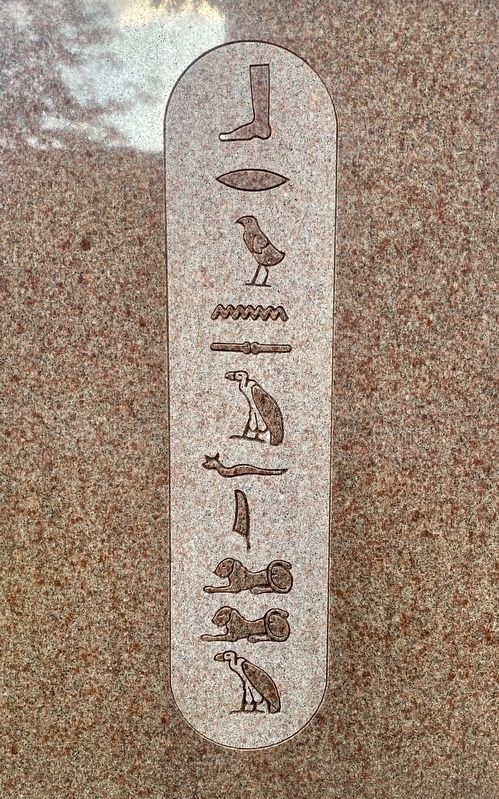
4. State Street Marker - cartouche
On the face of obelisk is a cartouche with "Bronzeville" spelled out in the Egpytian hieroglyph alphabet. (𓃀 = B, 𓂋 = R, 𓅱 = O, etc.)
Photographed by Andrew Ruppenstein, August 27, 2021
5. State Street Marker - wider view
Credits. This page was last revised on January 30, 2023. It was originally submitted on December 28, 2021, by Andrew Ruppenstein of Lamorinda, California. This page has been viewed 823 times since then and 56 times this year. Photos: 1. submitted on December 28, 2021, by Andrew Ruppenstein of Lamorinda, California. 2, 3, 4, 5. submitted on December 29, 2021, by Andrew Ruppenstein of Lamorinda, California.
