Hardin in Big Horn County, Montana — The American West (Mountains)
Lee Building
Hardin Commercial Historic District
Photographed by Barry Swackhamer, July 19, 2021
1. Lee Building Marker
Inscription.
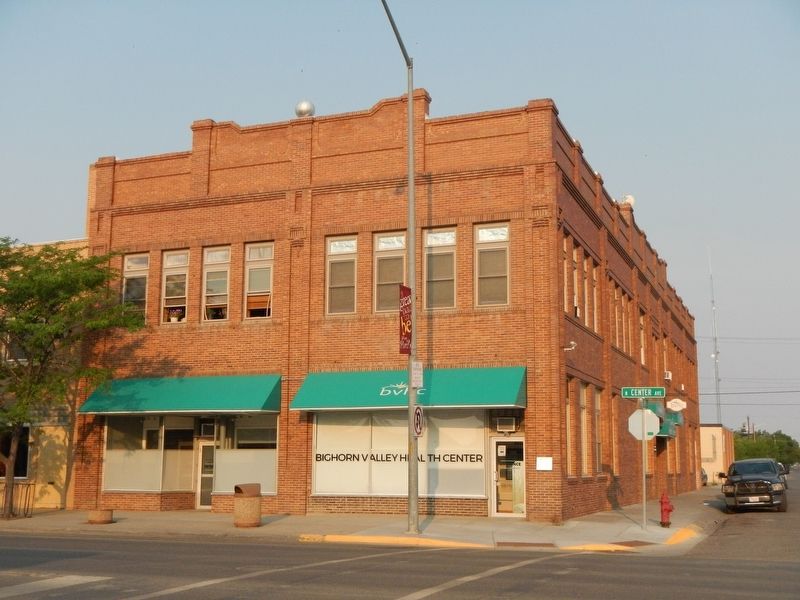
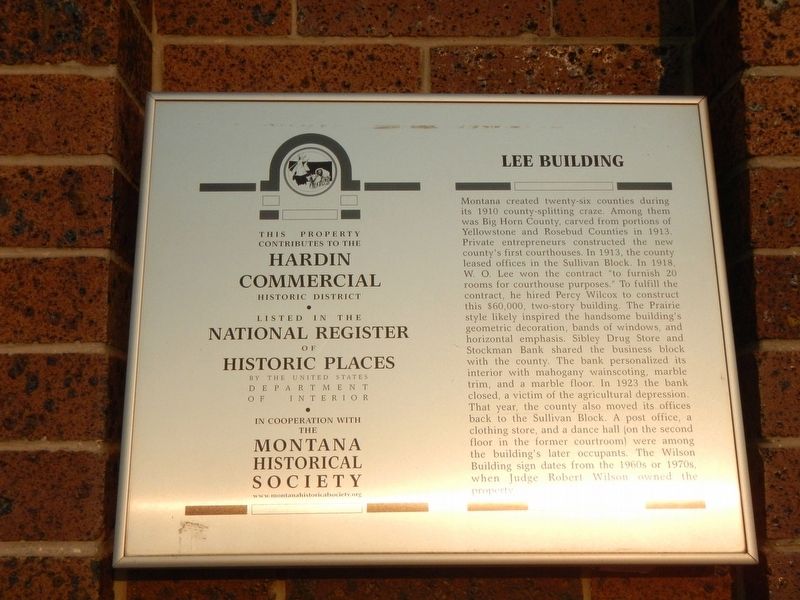
Lee Building. Hardin Commercial Historic District. Montana created twenty-six counties during its 1910 county-splitting craze. Among them was Big Horn County, carved from portions of Yellowstone and Rosebud Counties in 1913. Private entrepreneurs constructed the new countys first courthouses. In 1913, the county leased offices in the Sullivan Block. In 1918, W. O. Lee won the contract to furnish 20 rooms for courthouse purposes. To fulfill the contract, he hired Percy Wilcox to construct this $60,000, two-story building. The Prairie style likely inspired the handsome buildings geometric decoration, bands of windows, and horizontal emphasis. Sibley Drug Store and Stockman Bank shared the business block with the county. The bank personalized its interior with mahogany wainscoting, marble trim, and a marble floor. In 1923 the bank closed, a victim of the agricultural depression. That year, the county also moved its offices back to the Sullivan Block. A post office, a clothing store, and a dance hall (on the second floor in the former courtroom) were among the buildings later occupants. The Wilson Building sign dates from the 1960s or 1970s, when Judge Robert Wilson owned the property.
Montana created twenty-six counties during its 1910 county-splitting craze. Among them was Big Horn County, carved from portions of Yellowstone and Rosebud Counties in 1913. Private entrepreneurs constructed the new countys first courthouses. In 1913, the county leased offices in the Sullivan Block. In 1918, W. O. Lee won the contract to furnish 20 rooms for courthouse purposes. To fulfill the contract, he hired Percy Wilcox to construct this $60,000, two-story building. The Prairie style likely inspired the handsome buildings geometric decoration, bands of windows, and horizontal emphasis. Sibley Drug Store and Stockman Bank shared the business block with the county. The bank personalized its interior with mahogany wainscoting, marble trim, and a marble floor. In 1923 the bank closed, a victim of the agricultural depression. That year, the county also moved its offices back to the Sullivan Block. A post office, a clothing store, and a dance hall (on the second floor in the former courtroom) were among the buildings later occupants. The Wilson Building sign dates from the 1960s or 1970s, when Judge Robert Wilson owned the property.
Erected by Montana Historical Society.
Topics and series. This historical marker is listed in these topic lists: Architecture
Location. 45° 43.938′ N, 107° 36.401′ W. Marker is in Hardin, Montana, in Big Horn County. It is on West 4th Street near North Central Avenue, on the left when traveling west. Touch for map. Marker is at or near this postal address: 10 West 4th Street, Hardin MT 59034, United States of America. Touch for directions.

Regionally, this marker is in Montana’s and he Crow Nation, in Southeast Montana, in Custer Country. It is also in the American Mountain West, in the Lewis & Clark Corridor, on the prairies, on the Great Plains, and specifically on the Northern Plains. Globally, it is in North America, the Rocky Mountains, the Western Hemisphere, the Western World, and the Anglosphere. Historically, it finds itself in what was once Ruperts Land and also the Louisiana Purchase.
The marker is at the right corner of the building.
Credits. This page was last revised on December 4, 2024. It was originally submitted on January 1, 2022, by Barry Swackhamer of Brentwood, California. This page has been viewed 282 times since then and 14 times this year. Photos:1, 2. submitted on January 1, 2022, by Barry Swackhamer of Brentwood, California.