Near Hardin in Big Horn County, Montana — The American West (Mountains)
The Chicago, Burlington & Quincy Railroad
Photographed by Barry Swackhamer, July 19, 2021
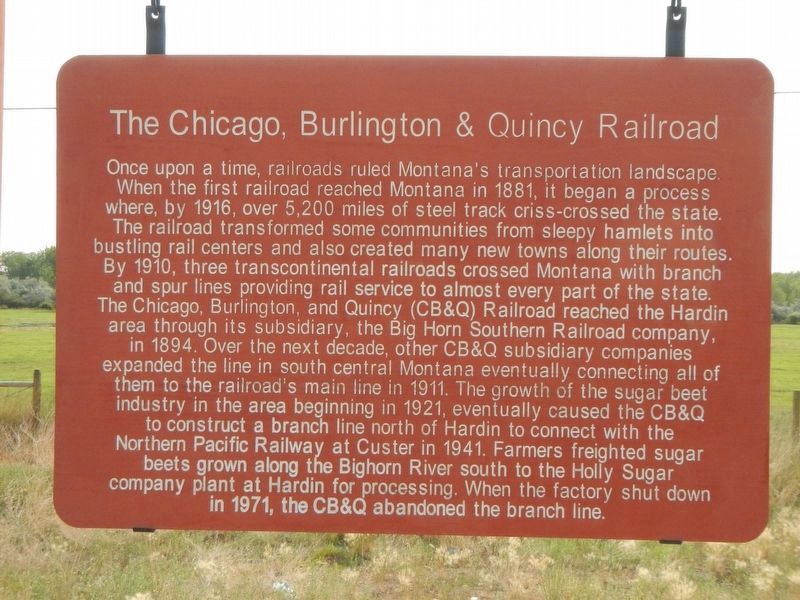
1. The Chicago, Burlington & Quincy Railroad Marker
Inscription.
Once upon a time, railroads ruled Montana's transportation landscape. When the first railroad reached Montana in 1881, it began a process where, by 1916, over 5,200 miles of steel track criss-crossed the state. The railroad transformed some communities from sleepy hamlets into bustling rail centers and also created many new towns along their routes. By 1910, three transcontinental railroads crossed Montana with branch and spur lines providing rail service to almost every part of the state. The Chicago, Burlington, and Quincy (CB&Q) reached Hardin area through its subsidiary, the Big Horn Southern Railroad company, in 1894. Over the next decade, other CB&Q subsidiary companies expanded the line in south central Montana eventually connecting all of them to the railroad's main line in 1911. The growth of the sugar beet industry in the area beginning in 1921, eventually caused the CB&Q to construct a branch line north of Hardin to connect with the Northern Pacific Railway at Custer in 1941. Farmers freighted sugar beets grown along the Bighorn River south to the Holly Sugar company plant at Hardin for processing. When the factory
Click or scan to see this page online
shut down in 1971, the CB&Q abandoned the branch line.
Location. 45° 49.1′ N, 107° 36.71′ W. Marker is near Hardin, Montana, in Big Horn County. It is on State Highway 47 at milepost 6 near 23, on the right when traveling north. Touch for map. Marker is in this post office area: Hardin MT 59034, United States of America. Touch for directions.
Regionally, this marker is in andspecifically he Crow Nation, in Southeast Montana, in Custer Country. It is also in the American Mountain West, in the Lewis & Clark Corridor, on the prairies, on the Great Plains, and specifically on the Northern Plains. Globally, it is in North America, the Rocky Mountains, the Western Hemisphere, the Western World, and the Anglosphere. Historically, it finds itself in what was once Rupert’s Land and also the Louisiana Purchase.
Other nearby markers. At least 8 other markers are within 6 miles of this marker,
Photographed by Barry Swackhamer, July 19, 2021
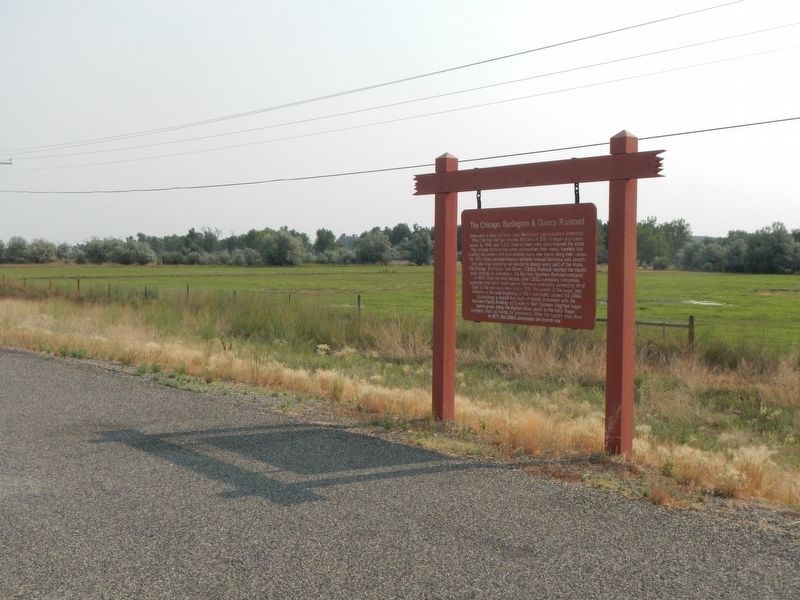
2. The Chicago, Burlington & Quincy Railroad Marker
Credits. This page was last revised on January 3, 2022. It was originally submitted on January 3, 2022, by Barry Swackhamer of Brentwood, California. This page has been viewed 579 times since then and 90 times this year. Photos:1, 2. submitted on January 3, 2022, by Barry Swackhamer of Brentwood, California.