
Metepec, Mexico State, Mexico — The Central Highlands (North America)
Church of San Juan Bautista
Toluca y sus alredores
Photographed by J. Makali Bruton, November 26, 2021
1. Church of San Juan Bautista Marker

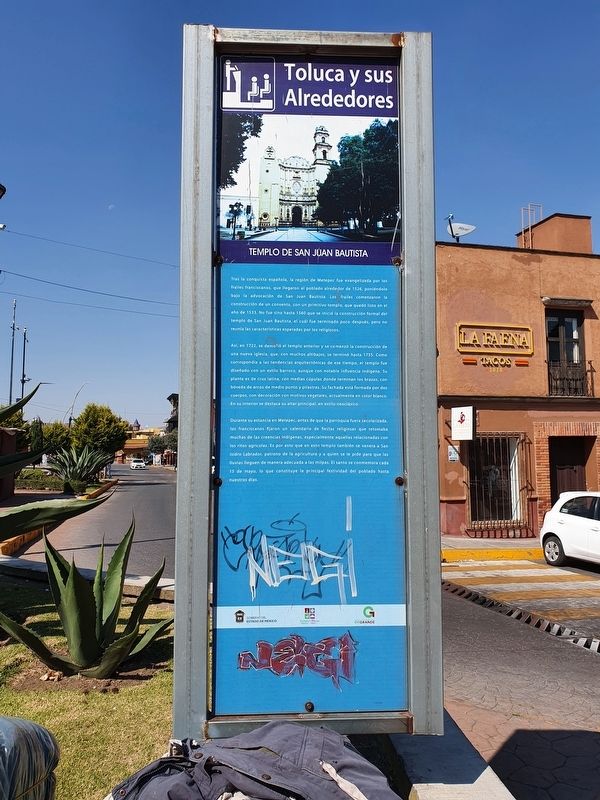
Tras la conquista española, la región de Metepec fue evangelizada por los frailes franciscanos, que llegaron al poblado alrededor de 1526, poniéndolo bajo la advocación de San Juan Bautista. Los frailes comenzaron la construcción de un convento, con un primitivo templo, que quedó listo en el año de 1533. No fue sino hasta 1560 que se inició la construcción formal del templo de San Juan Bautista, el cuál fue terminado poco después, pero no reunía las características esperadas por los religiosos.
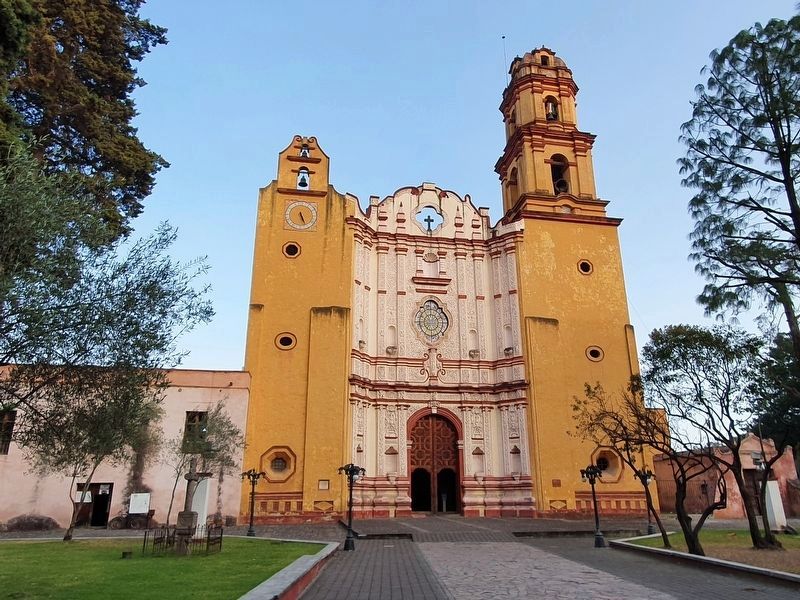
Así, en 1722, se demolió el templo anterior y se comenzó la construcción de una nueva iglesia, que, con muchos altibajos, se terminó hasta 1755. Como correspondía a las tendencias arquitectónicas de ese tiempo, el templo fue diseñado con un estilo barroco, aunque con notable influencia indígena. Su planta es de cruz latina, con medias cúpulas donde terminan los brazos, con bóveda de arcos de medio punto y pilastras. Su fachada está formada por dos cuerpos, con decoración con motivos vegetales, actualmente en color blanco. En su interior se destaca su altar principal, en estilo neoclásico.
this page online
Durante su estancia en Metepec, antes de que la parroquia fuera secularizada, los franciscanos fijaron un calendario de fiestas religiosas que retomaba muchas de las creencias indígenas, especialmente aquellas relacionadas con los ritos agrícolas. Es por esto que en este templo también se venera a San Isidro Labrador, patrono de la agricultura y a quien se le pide para que las lluvias lleguen de manera adecuada a las milpas. El santo se conmemora cada 15 de mayo, lo que constituye la principal festividad del poblado hasta nuestros días.
Church of San Juan Bautista
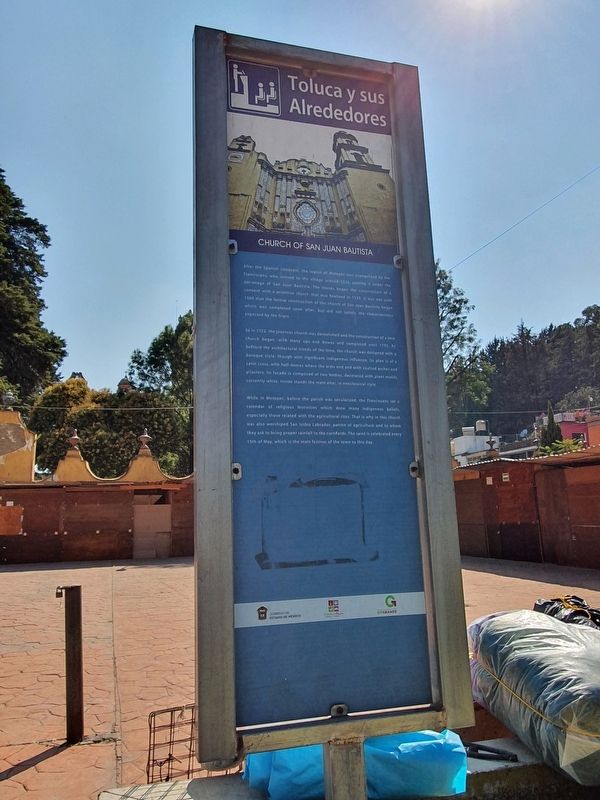
After the Spanish conquest the region of Metepec was evangelized by the Franciscans, who arrived to the village around 1526, putting it under the patronage of San Juan Bautista. The monks began the construction of a convent with a primitive church that was finalized in 1533. It was not until 1560 that the formal construction of the church of San Juan Bautista began which was completed soon after, but did not satisfy the characteristics expected by the friars.
So in 1722, the previous church was demolished and the construction of a new church began with
Photographed by J. Makali Bruton, November 26, 2021
2. Church of San Juan Bautista Marker English text
While in Metepec, before the parish was secularized, the Franciscans set a calendar of religious festivities which drew many indigenous beliefs, especially those related with the agricultural rites. That is why in this church was also worshiped San Isidro Labrador, patron of agriculture and to whom they ask to bring proper rainfall to the cornfields. The saint is celebrated every 15th of May, which is the main festival of the town to this day.
Erected by Gobierno del Estado de México.
Topics. This historical marker is listed in these topic lists: Colonial Era • Religion & Religious Structures. A significant historical year for this entry is 1526.
Location. 19° 15.059′ N, 99° 36.275′ W. Marker is in Metepec,
Photographed by J. Makali Bruton, November 26, 2021
3. Church of San Juan Bautista Marker

Regionally, this marker is in Central Mexico and specifically in Mexico City Metropolitan Area. Globally, it is in North America, specifically in Mesoamerica, on the Ring of Fire, and in the Western Hemisphere. Historically, it finds itself in what was once New Spain, a Spanish colony, and the Aztec Empire.
Other nearby markers. At least 8 other markers are within walking distance of this marker: Tree of the Bicentennial of National Independence (a few steps from this marker); St. John the Baptist Church (within shouting distance of this marker); Hill of the Magueyes (within shouting distance of this marker); The Chapel of the Virgin of Sorrows (about 90 meters away, measured in a direct line); a different marker also named Hill of the Magueyes (about 90 meters away); Former Franciscan Convent of San Juan Bautista de Metepec (about 120 meters away); El Paseo de la Agricultura (about 120 meters away);
Photographed by J. Makali Bruton, November 26, 2021
4. The nearby Church of San Juan Bautista
Credits. This page was last revised on January 9, 2022. It was originally submitted on January 9, 2022, by J. Makali Bruton of Washington, District of Columbia. This page has been viewed 272 times since then and 50 times this year. Photos: 1, 2, 3, 4. submitted on January 9, 2022, by J. Makali Bruton of Washington, District of Columbia.
