Near Cherokee in Swain County, North Carolina — The American South (South Atlantic)
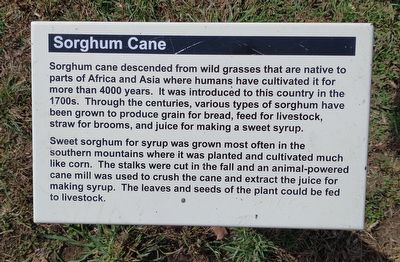
Sorghum Cane
Photographed by Tom Bosse, November 6, 2021
1. Sorghum Cane Marker
Sweet sorghum for syrup was grown most often in the southern mountains where it was planted and cultivated much like corn. the stalks were cut in the fall and an animal-powered cane mill was used to crush the cane and extract the juice for making syrup. The leaves and seeds of the plant could be fed to livestock.
Erected by Great Smoky Mountains National Park.
Topics. This historical marker is listed in these topic lists: Agriculture • Settlements & Settlers.
Location. 35° 30.729′ N, 83° 18.257′ W. Marker is near Cherokee, North Carolina, in Swain County. It can be reached from Newfound Gap Road (U.S. 441) 0.7 miles north of Blue Ridge Parkway, on the right when traveling north. Marker is located at the Mountain
this page online

Regionally, this marker is in the Mountains and specifically in the Great Smoky Mountains. It is also in the American South, specifically in the Upper South, in Appalachia, and specifically in Southern Appalachia. Globally, it is in North America, the Western Hemisphere, the Western World, and the Anglosphere. Historically, it finds itself in what was once the original Cherokee Nation, the territory of the Mississippian Culture, one of the original Thirteen Colonies, one of the Confederate States of America, and the Antebellum South.
Other nearby markers. At least 8 other markers are within walking distance of this marker: Broomcorn (here, next to this marker); Sorghum Mill and Furnace (a few steps from this marker); Corn Cribs (within shouting distance of this marker); Springhouse (within shouting distance of this marker); Blacksmith Shop (within shouting distance of this marker); Hogs
Photographed by Tom Bosse, November 6, 2021
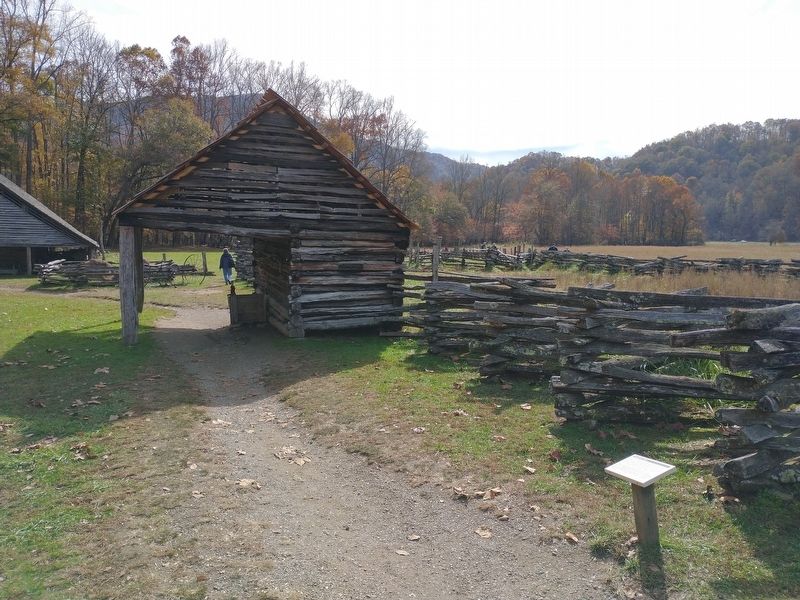
2. Sorghum Cane Marker
Also see . . . Oconaluftee Mountain Farm Museum and Mingus Mill. My Smoky Mountain Guide website entry (Submitted on July 18, 2024, by Larry Gertner of New York, New York.)
Credits. This page was last revised on July 18, 2024. It was originally submitted on January 17, 2022, by Tom Bosse of Jefferson City, Tennessee. This page has been viewed 277 times since then and 21 times this year. Photos: 1, 2. submitted on January 17, 2022, by Tom Bosse of Jefferson City, Tennessee. • Bernard Fisher was the editor who published this page.
