Princeton in Gibson County, Indiana — The American Midwest (Great Lakes)
Coal Mining
1874 — Present
Photographed by Cosmos Mariner, August 23, 2021
1. Coal Mining Marker
Inscription.
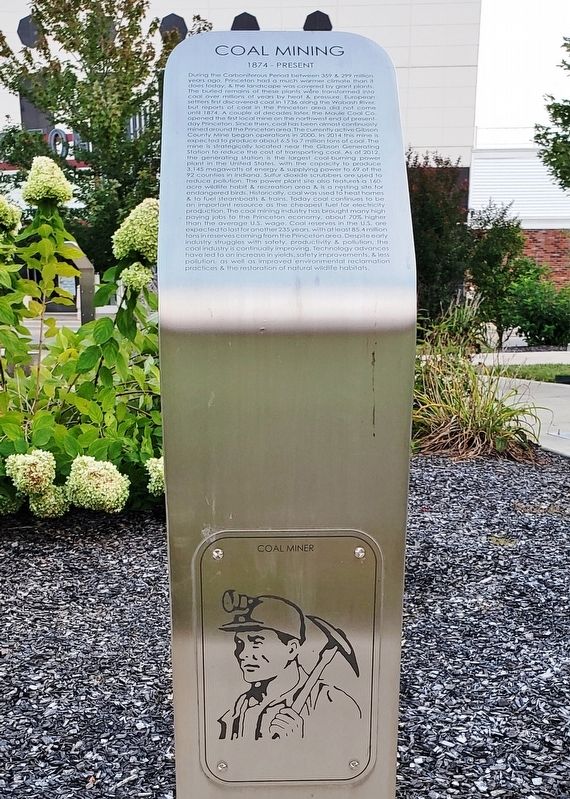
During the Carboniferous Period between 359 & 299 million years ago, Princeton had a much warmer climate than it does today, & the landscape was covered by giant plants. The buried remains of these plants were transformed into coal over millions of years by heat & pressure. European settlers first discovered coal in 1736 along the Wabash River, but reports of coal in the Princeton area did not come until 1874. A couple of decades later, the Maule Coal Co. opened the first local mine on the northwest end of present-day Princeton. Since then, coal has been almost continuously mined around the Princeton area. The currently active Gibson County Mine began operations in 2000. In 2014 this mine is expected to produce about 6.5 to 7 million tons of coal. The mine is strategically located near the Gibson Generating Station to reduce the cost of transporting coal. As of 2012, the generating station is the largest coal-burning power plant in the United States, with the capacity to produce 3,145 megawatts of energy & supplying power to 69 of the 92 counties in Indiana. Sulfur dioxide scrubbers are used to reduce pollution. The power
Click or scan to see this page online
plant site also features a 160-acre wildlife habitat & recreation area & is a nesting site for endangered birds. Historically, coal was used to heat homes & to fuel steamboats & trains. Today coal continues to be an important resource as the cheapest fuel for electricity production. The coal mining industry has brought many high paying jobs to the Princeton economy, about 70% higher than the average U.S. wage. Coal reserves in the U.S. are expected to last for another 235 years, with at least 85.4 million tons in reserves coming from the Princeton area. Despite early industry struggles with safety, productivity & pollution, the coal industry is continually improving. Technology advances have led to an increase in yields, safety improvements, & less pollution, as well as improved environmental reclamation practices & the restoration of natural wildlife habitats.
Location. 38° 21.333′ N, 87° 34.22′ W. Marker is in Princeton, Indiana, in Gibson County. It
Photographed by Cosmos Mariner, August 23, 2021
2. Coal Mining Marker
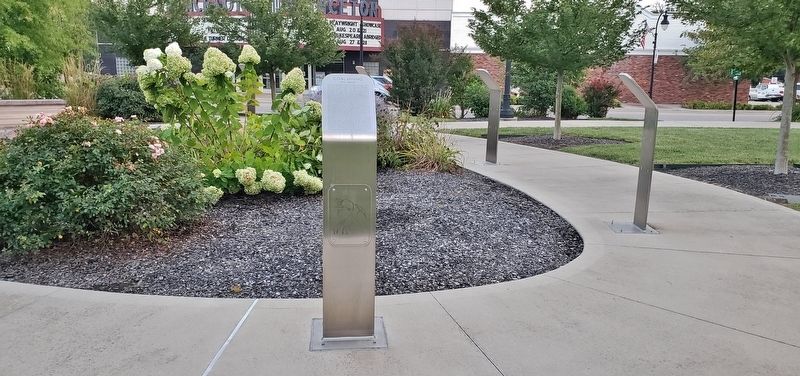
is at the intersection of West Broadway Street (Indiana Route 65) and North West Street, on the left when traveling east on West Broadway Street. Marker is located in the heritage plaza at the southeast corner of Downtown Princeton Park. Touch for map. Marker is at or near this postal address: 300 West Broadway Street, Princeton IN 47670, United States of America. Touch for directions.
Regionally, this marker is in Indiana’s Tri-State Region, in Southern Indiana, and in the Wabash Valley. It is also in the American Midwest and in the Corn Belt. Globally, it is in North America, the Western Hemisphere, the Western World, and the Anglosphere. Historically, it finds itself in what was once the territory of the Mississippian Culture and also the Northwest Territory.
Other nearby markers. At least 8 other markers are within walking distance of this marker: Railroads (here, next to this marker); Industry (here, next to this marker); Prince Town (here, next to this marker); Lyles Station (here, next to this marker); Agriculture (a few steps from this marker); Tri-State Tornado (a few steps from this marker); Early Settlers
The Gibson Generating Station is a large coal power plant located in Montgomery Township, Indiana near the Wabash River. The coal power plant has an average power production capacity of 3,345 megawatts making it the second largest coal power plant in the United States. Construction of the original Gibson Generating Station was completed in 1972 with five units. The power station has a large human-made lake on the site named Gibson Lake which is used for cooling the plant.
(Submitted on January 18, 2022, by Cosmos Mariner of Cape Canaveral, Florida.)
Credits. This page was last revised on January 20, 2022. It was originally submitted on January 17, 2022, by Cosmos Mariner of Cape Canaveral, Florida. This page has been viewed 283 times since then and 44 times this year. Photos:1, 2, 3. submitted on January 18, 2022, by Cosmos Mariner of Cape Canaveral, Florida.