Mid City North in Baton Rouge in East Baton Rouge Parish, Louisiana — The American South (West South Central)
A National Cemetery System

Photographed by Craig Doda, December 24, 2018
1. A National Cemetery System Marker
Civil War Dead
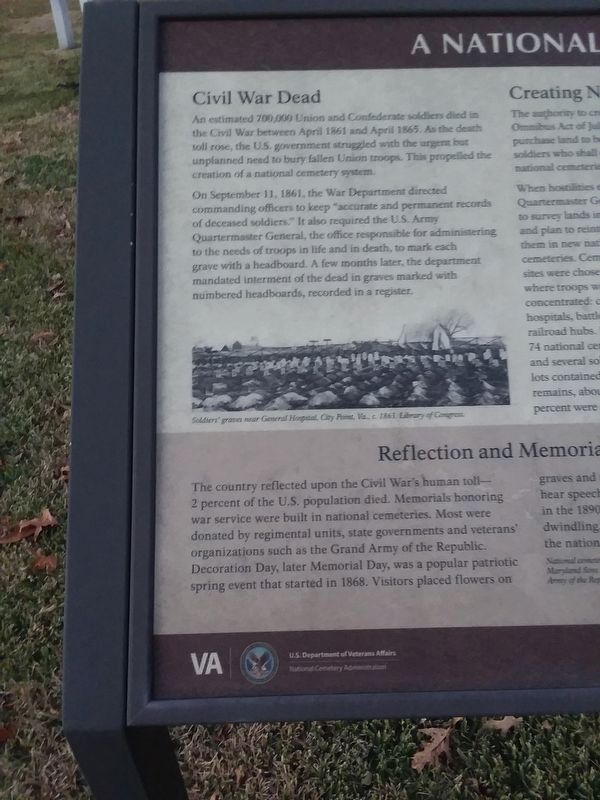
An estimated 700,000 Union and Confederate soldiers died in the Civil War between April 1861 and April 1865. As the death toll rose, the US. government struggled with the urge but unplanned need to bury fallen Union troops. This propelled the creation of a national cemetery system.
On September 11, 1861, the War Department directed commanding officers to keep "accurate and permanent records of deceased soldiers.” It also required the US. Army Quartermaster General, the office responsible for administering to the needs of troops in life and in death, to mark each grave with a headboard. A few months later, the department mandated interment of the dead in graves marked with numbered headboards, recorded in a register.
Creating National Cemeteries
The authority to create military burial grounds came in an Omnibus Act of July 17, 1862, It directed the president to purchase land to be used as "a national cemetery for the soldiers who shall die in the service of the country.” Fourteen national cemeteries were established by 1862.
When hostilities ended, a grim task began. In October
this page online
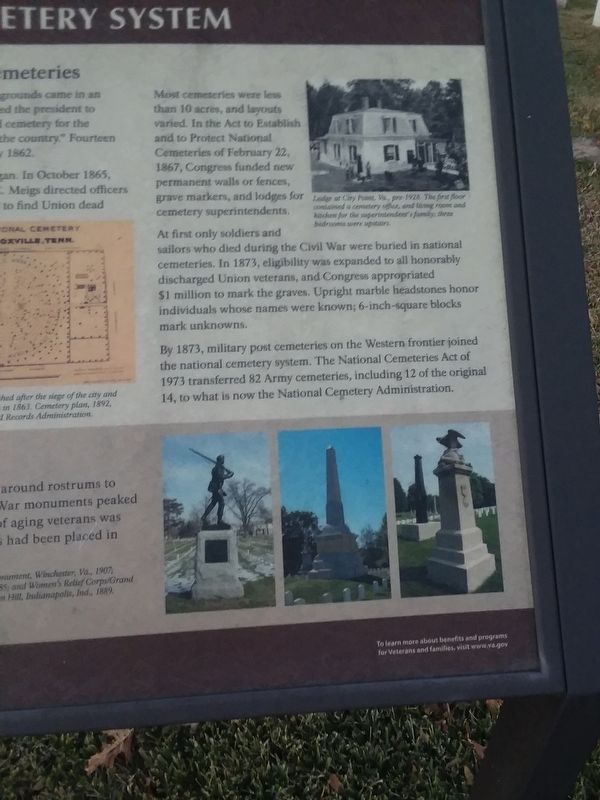
Most cemeteries were less than 10 acres, and layouts varied. In the Act to Establish and to Protect National Cemeteries of February 22, 1867, Congress funded new permanent walls or fences, grave markers, and lodges for cemetery superintendents.
At first only soldiers and sailors who died during the Civil War were buried in national cemeteries. In 1873, eligibility was expanded to all honorably discharged Union veterans, and Congress appropriated $1 million to mark the graves. Upright marble headstones honor individuals whose names were known; 6-inch-square blocks mark unknowns.
By 1873, military post cemeteries on the Western frontier joined the national cemetery system. The National Cemeteries Act of 1973

Photographed by Craig Doda, December 24, 2018
2. A National Cemetery System Marker
Reflection and Materialization
The country reflected upon the Civil War's human toll- 2 percent of the U.S. population died. Memorials honoring war service were built in national cemeteries. Most were donated by regimental units, state governments and veterans' organizations such as the Grand Army of the Republic. Decoration Day, later Memorial Day, was a popular patriotic spring event that started in 1868. Visitors placed flowers on graves and monuments, and gathered around rostrums to hear speeches. Construction of Civil War monuments peaked in the 1890s. By 1920, as the number of aging veterans was dwindling, more than 120 monuments had been placed in the national cemeteries.
Topics. This historical marker is listed in this topic list: Cemeteries & Burial Sites. A significant historical date for this entry is February 22, 1867.
Location. 30° 26.963′ N, 91° 10.143′ W. Marker is in Baton Rouge, Louisiana, in East Baton Rouge Parish. It is in Mid City North. It is on North 19th Street, on the right when traveling north.
Photographed by Craig Doda, December 24, 2018
3. A National Cemetery System Marker

Regionally, this marker is in Louisiana’s Florida Parishes. It is also in the American South, specifically in the Deep South, and in the Great River Road Region. Globally, it is in North America, a Gulf of Mexico state, the Western Hemisphere, the Western World, and the Anglosphere. Historically, it finds itself in what was once New Spain, the territory of the Mississippian Culture, the Louisiana Purchase, one of the Confederate States of America, and the Antebellum South.
Other nearby markers. At least 8 other markers are within walking distance of this marker: National Cemetery (a few steps from this marker); Genl. Philemon Thomas (a few steps from this marker); Massachusetts Memorial (within shouting distance of this marker); Yellow Fever Memorial (about 400 feet away, measured in a direct line); Baton Rouge National Cemetery (about 500 feet away); Magnolia Cemetery (about 500 feet away); Civil War Battle of Baton Rouge

Photographed by Craig Doda, December 24, 2018
4. A National Cemetery System Marker
Photographed by Craig Doda, December 24, 2018
5. A National Cemetery System Marker
Credits. This page was last revised on February 12, 2023. It was originally submitted on January 29, 2022, by Craig Doda of Napoleon, Ohio. This page has been viewed 414 times since then and 18 times this year. Photos: 1, 2, 3, 4, 5. submitted on January 29, 2022, by Craig Doda of Napoleon, Ohio. • Mark Hilton was the editor who published this page.
Editor’s want-list for this marker. Clear photo of marker in focus. • Can you help?
