Society Hill in Philadelphia in Philadelphia County, Pennsylvania — The American Northeast (Mid-Atlantic)
Physick House
321 South Fourth Street
| — | Open to visitors | — |
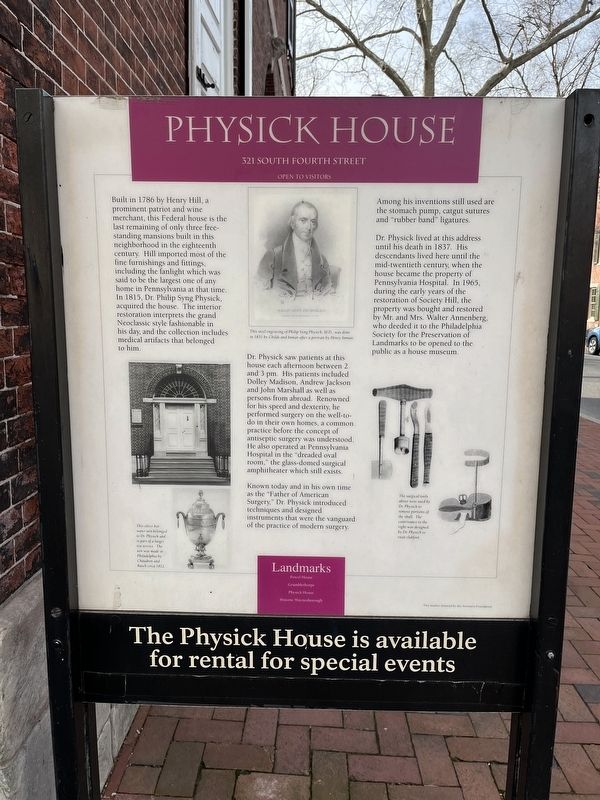
Built in 1786 by Henry Hill, a prominent patriot and wine merchant, this Federal house is the last remaining of only three free-standing mansions built in this neighborhood in the eighteenth century. Hill imported most of the fine furnishings and fittings, including the fanlight which was said to be the largest one of any home in Pennsylvania at that time. In 1815, Dr. Philip Syng Physick, acquired the house. The interior restoration interprets the grand Neoclassic style fashionable in his day, and the collection includes medical artifacts that belonged to him.
Dr. Physick saw patients at this house each afternoon between 2 and 3 pm. His patients included Dolley Madison, Andrew Jackson and John Marshall as well as persons from abroad. Renowned for his speed and dexterity, he performed surgery on the well-to-do in their own homes, a common practice before the concept of antiseptic surgery was understood. He also operated at Pennsylvania Hospital in the "dreaded oval room," the glass-domed surgical amphitheater which still exists.
Known today and in his own time as the "Father of American Surgery." Dr. Physick introduced
this page online
Among his inventions still used are the stomach pump, catgut sutures and "rubber band" ligatures.
Dr. Physick lived at this address until his death in 1837. His descendants lived here until the mid-twentieth century, when the house became the property of Pennsylvania Hospital. In 1965, during the early years of the restoration of Society Hill, the property was bought and restored by Mr. and Mrs. Walter Annenberg, who deeded it to the Philadelphia Society for the Preservation of Landmarks to be opened to the public as a house museum.
[Captions:]
This steel engraving of Philip Syng Physick, M.D., was done in 1831 by Childs and Inman after a portrait of Henry Inman.
This silver hotwater urn belonged to Dr. Physick and is part of a larger tea service. The urn was made in Philadelphia by Chaudron and Rasch circa 1812.
The surgical tools above were used by Dr. Physick to remove portions of the skull. The contrivance to the right was designed by Dr. Physick to treat clubfoot.
Erected by The Arronson Foundation.
Topics and series.
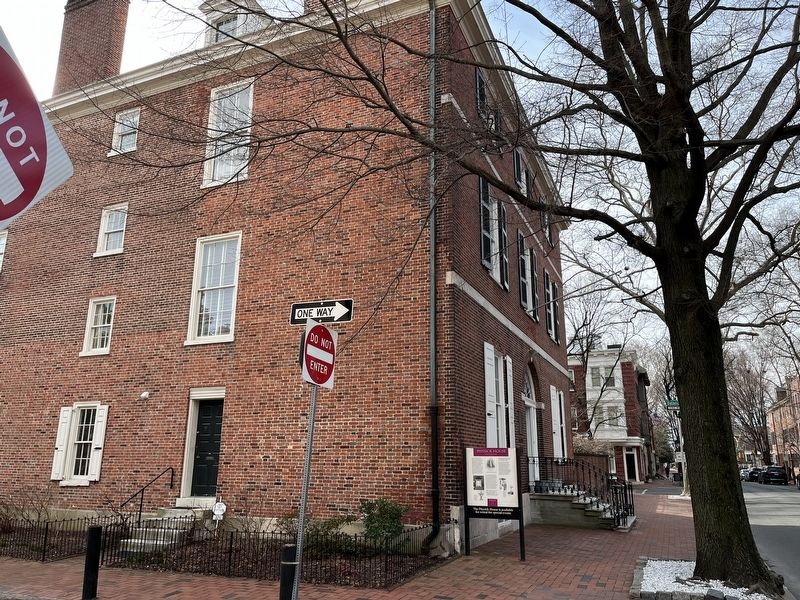
Location. 39° 56.665′ N, 75° 8.91′ W. Marker is in Philadelphia, Pennsylvania, in Philadelphia County. It is in Society Hill. It is at the intersection of South 4th Street and Cypress Street, on the left when traveling south on South 4th Street. Touch for map. Marker is at or near this postal address: 321 S 4th St, Philadelphia PA 19106, United States of America. Touch for directions.

Regionally, this marker is in Southeast Pennsylvania. It is also in the American Northeast and in the Mid-Atlantic. Globally, it is in North America, the Western Hemisphere, the Western World, and the Anglosphere. Historically, it finds itself in what was once the Haudenosaunee (Iroquois) Confederacy, New Netherland, and one of the original Thirteen Colonies.
Other nearby markers. At least 8 other markers are within walking distance of this marker: Philip Syng Physick (here, next to this marker); Thomas Neval (within shouting distance of this marker); Baruch S. Blumberg (within shouting distance of this marker); Charles E. Peterson (1906 - 2004) / Edmund N. Bacon (about 300 feet away, measured in a direct line); Here lieth the body of Samuel McCutchon… (about 400 feet away); Daniel McKaraher (about 400 feet away); In 1835… (about 400 feet away); Old Pine Street Presbyterian Church Historic Graveyard (about 400 feet away). Touch for a list and map of all markers in Philadelphia.
Credits. This page was last revised on February 2, 2023. It was originally submitted on March 2, 2022, by Devry Becker Jones of Washington, District of Columbia. This page has been viewed 269 times since then and 21 times this year. Photos: 1, 2. submitted on March 2, 2022, by Devry Becker Jones of Washington, District of Columbia.
