Goderich in Huron County, Ontario — Central Canada (North America)
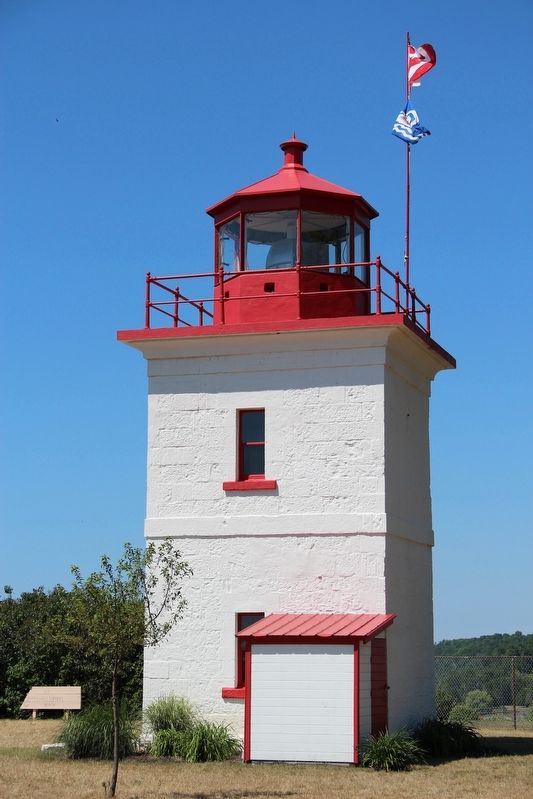
Goderich Lighthouse
Goderich Marine Heritage Walkway
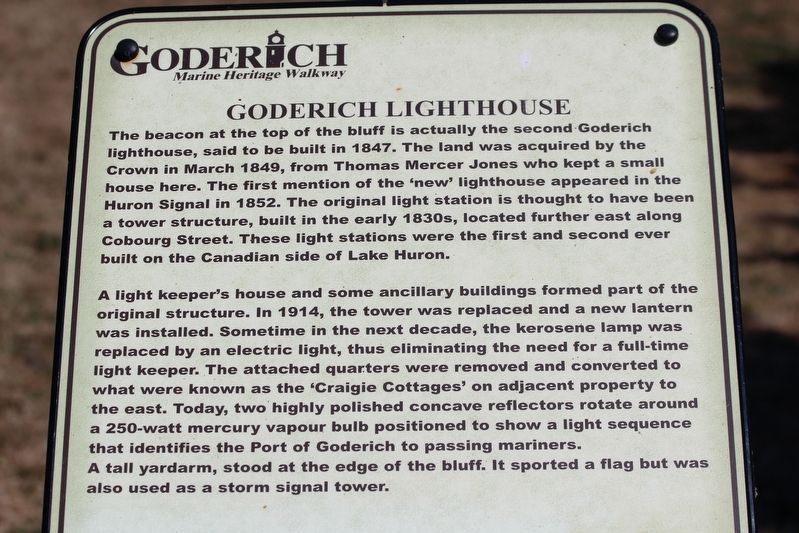
A light keeper's house and some ancillary buildings formed part of the original structure. In 1914, the tower was replaced and a new lantern was installed. Sometime in the next decade, the kerosene lamp was replaced by an electric light, thus eliminating the need for a full-time light keeper. The attached quarters were removed and converted to what were known as the 'Craigie Cottages' on adjacent property to the east. Today, two highly polished concave reflectors rotate around a 250-watt mercury vapour bulb positioned to show a light sequence that identifies the Port of Goderich to passing mariners. A tall
this page online
Topics and series. This historical marker is listed in these topic lists: Communications • Waterways & Vessels. In addition, it is included in the Lighthouses series list. A significant historical month for this entry is March 1849.
Location. 43° 44.5′ N, 81° 43.471′ W. Marker is in Goderich, Ontario, in Huron County. It is on Cobourg Street just south of Lighthouse Street, on the right when traveling south. Touch for map. Marker is at or near this postal address: 280 Cobourg St, Goderich ON N7A 2J2, Canada. Touch for directions.

Regionally, this marker is in the Huron-Perth-Waterloo-Wellington Area and in Southwestern Ontario. It is also in Central Canada. Globally, it is in North America, on the Great Lakes, in the Western Hemisphere, in the Western World, and in the Anglosphere. Historically, it finds itself in what was once a British colony, the Viceroyalty of New France, the Haudenosaunee (Iroquois) Confederacy, and Rupert’s Land.
Other nearby markers. At least 8 other markers are within walking distance of this
Credits. This page was last revised on March 16, 2022. It was originally submitted on March 3, 2022, by Duane and Tracy Marsteller of Murfreesboro, Tennessee. This page has been viewed 473 times since then and 69 times this year. Photos: 1. submitted on March 3, 2022, by Duane and Tracy Marsteller of Murfreesboro, Tennessee. 2. submitted on March 16, 2022, by Duane and Tracy Marsteller of Murfreesboro, Tennessee.
Editor’s want-list for this marker. Wide shot of marker and surrounding area in context. • Can you help?
