Fort Myer in Arlington in Arlington County, Virginia — The American South (Mid-Atlantic)
Arlington House, 1864
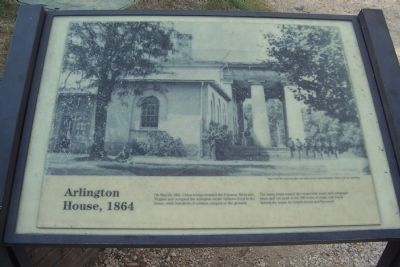
Photographed by Richard E. Miller, August 24, 2008
1. Arlington House, 1864 Marker
Erected by National Park Service, U.S. Department of the Interior.
Topics and series. This historical marker is listed in these topic lists: Landmarks • Notable Buildings • War, US Civil. In addition, it is included in the National Cemeteries series list. A significant historical date for this entry is May 24, 1861.
Location. Marker has been reported missing. It was located near 38° 52.847′ N, 77° 4.352′ W. Marker was in Arlington, Virginia, in Arlington County. It was in Fort Myer. It could be reached from Lee Drive. "Arlington House" (a.k.a. the Custis-Lee Mansion and/or the Robert E. Lee Memorial) is within the National Cemetery, on a hilltop accessible by pedestrian and tour buses, about 0.15
this page online

Regionally, this marker was in the Washington Metropolitan Area and in Northern Virginia. It was also in the American South, specifically in the Upper South, in the Mid-Atlantic, and on the Eastern Seaboard. Globally, it was in the North Atlantic Region, North America, the Western Hemisphere, the Western World, and the Anglosphere. Historically, it found itself in what was once the territory of the Mississippian Culture, one of the original Thirteen Colonies, one of the Confederate States of America, and the Antebellum South.
Other nearby markers. At least 8 other markers are within walking distance of this location: Garden to Graves (a few steps from this marker); Kingdom of my childhood (a few steps from this marker); Trophy of War (a few steps from this marker); A Place of Division and Reunification (a few steps from this marker); The Gray Family (within shouting distance of this marker); Platforms of Power (within shouting distance
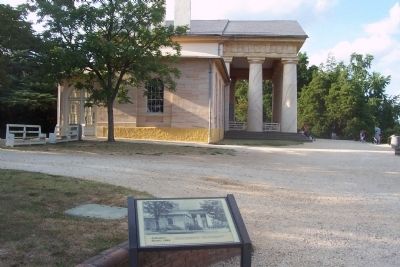
Photographed by Richard E. Miller, August 14, 2008
2. Arlington House, 1864 Marker
Other markers no longer nearby. The Flower Garden (was a few steps from this marker but has been replaced with another marker now near it); The Kingdom of My Childhood (was within shouting distance of this marker but has been replaced with another marker now near it); Selina Gray (was within shouting distance of this marker but has been replaced with another marker now near it); Guardian of a Nation's Heritage (was within shouting distance of this marker but has been permanently removed).
Also see . . . Arlington House, The Robert E. Lee Memorial. National Park Service (Submitted on December 10, 2013.)
Additional keywords. Custis-Lee Mansion; Horatio G. Wright; Arlington National Cemetery.
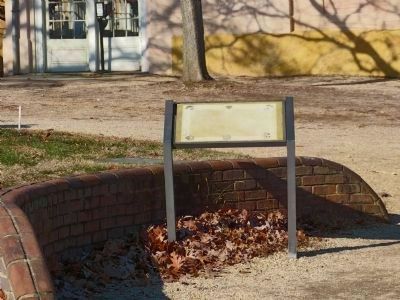
Photographed by Allen C. Browne, November 29, 2013
3. Arlington House, 1864 Marker
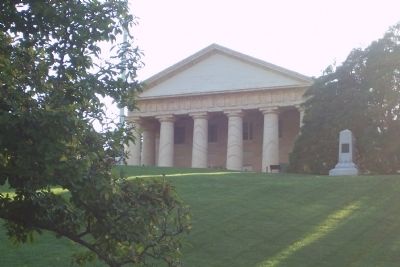
Photographed by Richard E. Miller, August 30, 2008
4. Arlington House, seen from near President John F. Kennedy's gravesite below
Note the prominent monument to Brevet Maj. Gen. Horatio G. Wright at the crest of the hill, in front of the trees to the right. During the Civil War, General Wright was a key leader within the Army of the Potomac, ending the war as a Corps commander. General Wright served as Army Chief of Engineers after his Civil War service, overseeing the completion of the Washington Monument. Accordingly, he was buried at Arlington House with its view of that monument (then the tallest structure in the world) in mind.
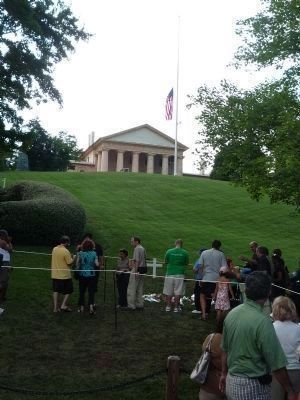
Photographed by Richard E. Miller, August 30, 2009
5. Arlington House, viewed from near Senator Edward Kennedy's gravesite.
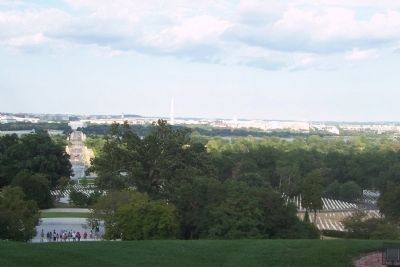
Photographed by Richard E. Miller, 8.24.08
6. View from Arlington House toward the Washington Monument, President Kennedy's gravesite, lower left.
Credits. This page was last revised on February 1, 2023. It was originally submitted on September 1, 2008, by Richard E. Miller of Oxon Hill, Maryland. This page has been viewed 2,048 times since then and 38 times this year. Last updated on March 22, 2022, by Connor Olson of Menomonee Falls, Wisconsin. Photos: 1, 2. submitted on September 1, 2008, by Richard E. Miller of Oxon Hill, Maryland. 3. submitted on December 12, 2013, by Allen C. Browne of Silver Spring, Maryland. 4. submitted on September 1, 2008, by Richard E. Miller of Oxon Hill, Maryland. 5. submitted on September 1, 2009, by Richard E. Miller of Oxon Hill, Maryland. 6. submitted on September 1, 2008, by Richard E. Miller of Oxon Hill, Maryland. • J. Makali Bruton was the editor who published this page.
