Seminary Hill in Alexandria, Virginia — The American South (Mid-Atlantic)
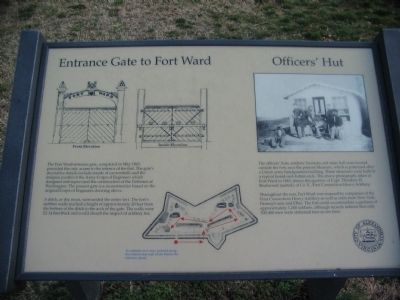
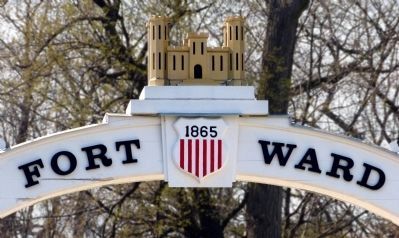
Entrance Gate to Fort Ward
⎯⎯⎯
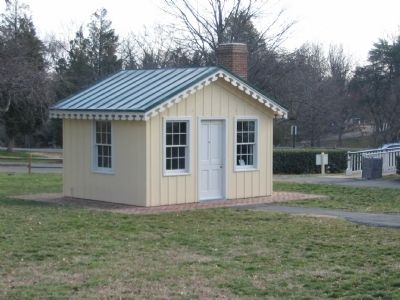
Officers' Hut
Photographed by Craig Swain, March 1, 2008
1. Entrance Gate to Fort Ward Marker
A ditch, or dry moat, surrounded the entire fort. The fort's earthen walls reached a height of approximately 20 feet from the bottom of the ditch to the arch of the gate. The walls were 12-14 feet thick and could absorb the impact of artillery fire.
The officers' huts, soldiers' barracks and mess hall were located outside the fort, near the present Museum, which is patterned after a Union army headquarters building. These structures were built in a typical board-and-batten style. The above photograph, taken at Fort Ward in 1863, shows the quarters of Capt. Theodore H. Rockwood (seated), of Co. E., First Connecticut Heavy Artillery.
Throughout the war, Fort Ward was manned by companies of the First Connecticut Heavy Artillery as well as
this page online
Erected by City of Alexandria.
Topics and series. This historical marker is listed in these topic lists: Forts and Castles • War, US Civil. In addition, it is included in the Defenses of Washington, and the Virginia, The City of Alexandria series lists. A significant historical month for this entry is May 1865.
Location. This marker has been replaced by another marker nearby. It was located near 38° 49.759′ N, 77° 6.141′ W. Marker was in Alexandria, Virginia. It was in Seminary Hill. It was on West Braddock Road, on the right when traveling east. Located in Fort Ward Historic Site. Touch for map. Marker was at or near this postal address: 4301 West Braddock Road, Alexandria VA 22304, United States of America. Touch for directions.

Regionally, this marker was in the Washington Metropolitan Area and in Northern Virginia. It was also in the American South, specifically in the Upper South, in the Mid-Atlantic, and on the Eastern Seaboard.
Photographed by Craig Swain, March 1, 2008
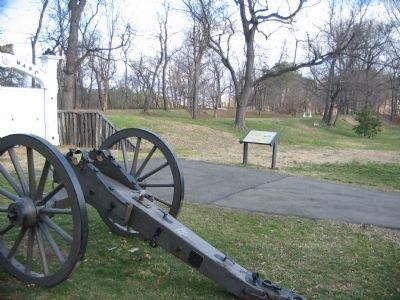
2. Fort Entrance Wayside
Other nearby markers. At least 8 other markers are within walking distance of this location: Entrance Gate to Fort Ward (a few steps from this marker); Fort Ward (within shouting distance of this marker); Welcome to Historic Fort Ward Park (within shouting distance of this marker); African Americans and the Civil War (within shouting distance of this marker); Bombproof (within shouting distance of this marker); "The Fort" and "Seminary" Community (about 300 feet away, measured in a direct line); From Fort to Community (about 300 feet away); Southwest Bastion (about 300 feet away). Touch for a list and map of all markers in Alexandria.
Other markers no longer nearby. Fort Ward (was within shouting distance of this marker but has been permanently removed); a different marker also named Bombproof (was
Photographed by Allen C. Browne, April 13, 2014
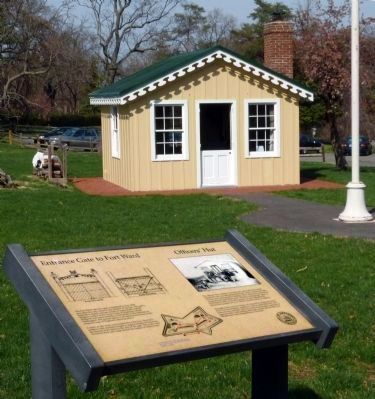
3. Entrance Gate to Fort Ward Marker
& Officers' Hut
& Officers' Hut
More about this marker. Above the left side text are front and inside elevations of the original fort entrance gate. On the right is a wartime photograph of the officers' hut. An engineering plan of the fort is captioned, To continue your tour, proceed along the exterior rear wall of the Fort to the stairway ahead. The tour route is indicated with red arrows on the fort plan.
Related marker. Click here for another marker that is related to this marker. This marker has been replaced with the linked marker.
Also see . . . Fort Ward Historic Site. (Submitted on May 8, 2008, by Craig Swain of Leesburg, Virginia.)
Photographed by Craig Swain, March 1, 2008
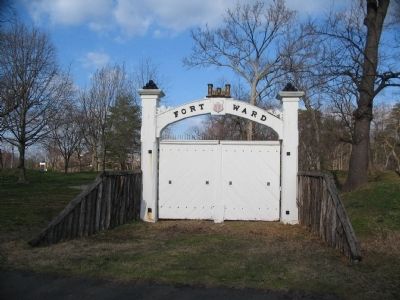
4. Reconstruction of the Front Entrance
Photographed by Craig Swain, March 1, 2008
5. Officers' Hut Reconstruction
Photographed by Allen C. Browne, April 13, 2014
6. Fort Ward Entrance Gate
Credits. This page was last revised on April 26, 2025. It was originally submitted on May 8, 2008, by Craig Swain of Leesburg, Virginia. This page has been viewed 2,886 times since then and 21 times this year. Last updated on March 26, 2022, by Connor Olson of Menomonee Falls, Wisconsin. Photos: 1, 2. submitted on May 8, 2008, by Craig Swain of Leesburg, Virginia. 3. submitted on April 16, 2014, by Allen C. Browne of Silver Spring, Maryland. 4, 5. submitted on May 8, 2008, by Craig Swain of Leesburg, Virginia. 6. submitted on April 16, 2014, by Allen C. Browne of Silver Spring, Maryland. • J. Makali Bruton was the editor who published this page.
