Araby View near Frederick in Frederick County, Maryland — The American Northeast (Mid-Atlantic)
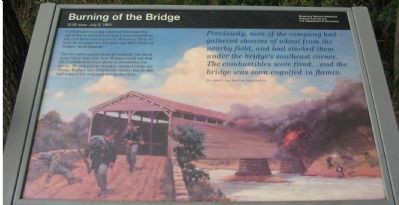
Burning of the Bridge
12:00 noon July 9, 1864
| — | Monocacy National Battlefield | — |
Photographed by Craig Swain, September 9, 2007
1. Burning of the Bridge Marker
Confederates wearing captured blue uniforms had killed or wounded several Union skirmishers who had been sent across the Monocacy River to hold the Georgetown Turnpike and B&O Railroad bridges "at all hazards."
The two sides traded shots all morning, but about noon Union Maj. Gen. Lew Wallace could see that the Confederates were about to overwhelm his troops. He ordered the wooden covered bridge set ablaze. Wallace had delayed the enemy, but he also had trapped his own men across the river.
Previously, men of the company had gathered sheaves of wheat from the nearby field, and had stacked them under the bridge's southeast corner. The combustibles were fired ...and the bridge was soon engulfed in flames.
Pvt. Alfred S. Roe, New York Heavy Artillery
Erected by National Park Service, U.S. Department of the Interior.
Topics. This historical marker is listed in this topic list: War, US Civil. A significant historical date for this entry is July 9, 1864.
Location. This marker has been replaced by another marker nearby. It was located near 39° 22.154′ N, 77° 23.293′ W. Marker was near Frederick, Maryland, in Frederick County.
this page online

Regionally, this marker was in the Washington Metropolitan Area and in Central Maryland. It was also in the American Mid-Atlantic. Globally, it was in North America, the Western Hemisphere, the Western World, and the Anglosphere. Historically, it found itself in what was once one of the original Thirteen Colonies and also the Antebellum South.
Other nearby markers. At least 8 other markers are within walking distance of this location: Burning the Bridge (within shouting distance of this marker); Desperate Escape (within shouting distance of this marker); CPL Kirk J Bosselmann (about 800 feet away); Retreat (about 800 feet away); Monocacy Battlefield
Photographed by Craig Swain, September 9, 2007
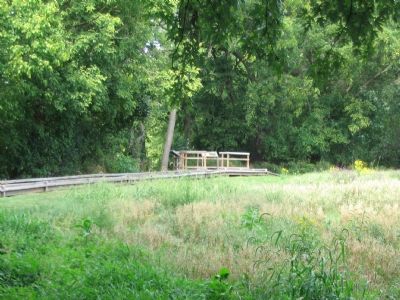
2. Trail Stop Overlooking the River
Other markers no longer nearby. Fleeing for Their Lives (was a few steps from this marker but has been replaced with another marker now near it); Monocacy National Battlefield (was about 700 feet away, measured in a direct line but has been replaced with another marker now near it); a different marker also named Monocacy National Battlefield (was about 700 feet away but has been replaced with another marker now near it); Gambrill Mill (was about 700 feet away but has been replaced with another marker now near it); Bush Creek Crossing (was about 700 feet away but has been reported to have been replaced with another marker now near it); A Bold Plan (was approx. 0.2 miles away but has been replaced with another marker now near it); Gambrill House (was approx. 0.2 miles away but has been permanently removed).
More about this marker. A background painting depicts the burning of the Wooden
Photographed by Craig Swain, September 9, 2007
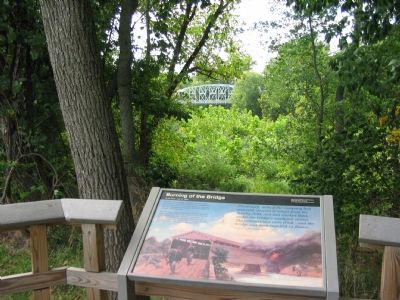
3. The Marker and the Modern Bridge
This photo was taken close to the anniversary of the battle (compared to the photo below of the bridge as seen in the winter).
Related markers. Click here for a list of markers that are related to this marker. This marker is among several describing the battle of Monocacy, to "tour" the battlefield using the related HMBd markers sites.
Also see . . . Battle of Monocacy. National Parks Service website entry (Submitted on November 2, 2007, by Craig Swain of Leesburg, Virginia.)
Photographed by Craig Swain, January 29, 2007
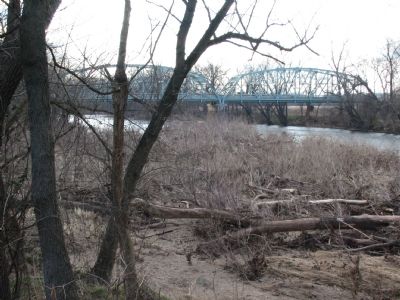
4. Present Day Urbana Pike Bridge
The modern truss bridge crosses the river near where the wooden bridge stood at the time of the battle.
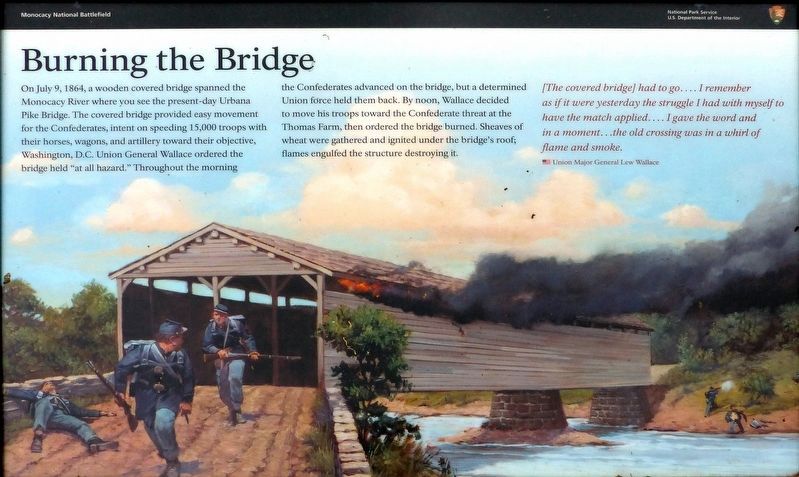
Photographed by Allen C. Browne, May 1, 2017
5. Burning the Bridge
The “Burning of the Bridge” marker has been replaced by this “Burning the Bridge” marker.
Click for more information.
Click for more information.
Credits. This page was last revised on June 28, 2024. It was originally submitted on November 2, 2007, by Craig Swain of Leesburg, Virginia. This page has been viewed 2,091 times since then and 48 times this year. Last updated on March 28, 2022, by Connor Olson of Menomonee Falls, Wisconsin. Photos: 1, 2, 3, 4. submitted on November 2, 2007, by Craig Swain of Leesburg, Virginia. 5. submitted on May 31, 2017, by Allen C. Browne of Silver Spring, Maryland. • Bernard Fisher was the editor who published this page.
