Axtell Park in Sioux Falls in Minnehaha County, South Dakota — The American Midwest (Upper Plains)
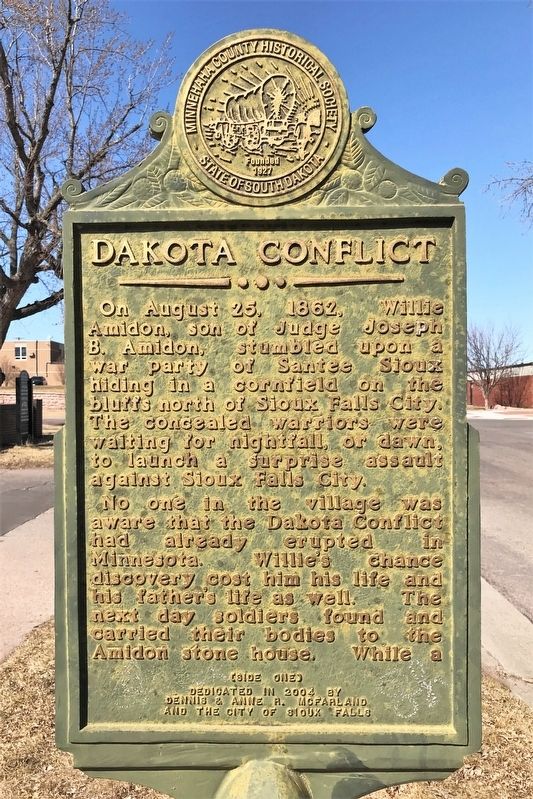
Dakota Conflict
March 26, 2022
1. Dakota Conflict Marker
No one in the village was aware that the Dakota Conflict had already erupted in Minnesota. Willie's chance discovery cost him his life and his father's life as well. The next day soldiers found and carried their bodies to the Amidon stone house. While a small number of soldiers remained to protect the settlers, "a scouting party was sent out with orders to ride until they had found and punished the murderers."
From vantage points near this location, mounted Sioux warriors suddenly appeared and began to fire down the bluff at the military camp in the village below. When the soldiers returned fire, the attackers "were repulsed . . . without loss of life on either side." This clash was the only Indian attack recorded against Sioux Falls City.
Erected 2004 by Dennis & Anne R. McFarland, the City of Sioux Falls, the Minnehaha County Historical Society, and Alissa Young.
Topics. This historical marker is listed in these topic lists: Settlements & Settlers • Wars, US Indian. A significant historical date for this entry is August 25, 1862.
Location. 43° 32.82′ N, 96° 43.971′ W. Marker is in Sioux Falls, South Dakota, in Minnehaha County. It is in Axtell Park. It is on South Spring Avenue south of West 9th Street, on the left when traveling north. Touch for map. Marker is at or near this postal address: 100 S Spring Ave, Sioux Falls SD 57104, United States of America. Touch for directions.

Regionally, this marker is in East River. It is also in the American Midwest, in the Lewis & Clark Corridor, in the Corn Belt, on the prairies,
this page online
Other nearby markers. At least 8 other markers are within walking distance of this marker: The Woman's Alliance (a few steps from this marker); Early Firefighting in Sioux Falls (about 500 feet away, measured in a direct line); The 1900 Campaign Whistlestop by Theodore Roosevelt (about 500 feet away); The People's Party National Convention (about 700 feet away); Prehistoric Prayer Rock (about 800 feet away); U.S. Senator R.F. Pettigrew (about 800 feet away); 215 N Duluth Avenue (approx. 0.2 miles away); Germania Hall (approx. 0.2 miles away). Touch for a list and map of all markers in Sioux Falls.
Another marker is no longer nearby. Prehistoric Prayer Rock (was about 800 feet away but has been reported to have been replaced with another marker now near it).

March 26, 2022
2. Dakota Conflict Marker

March 26, 2022
3. Dakota Conflict Marker, from the south
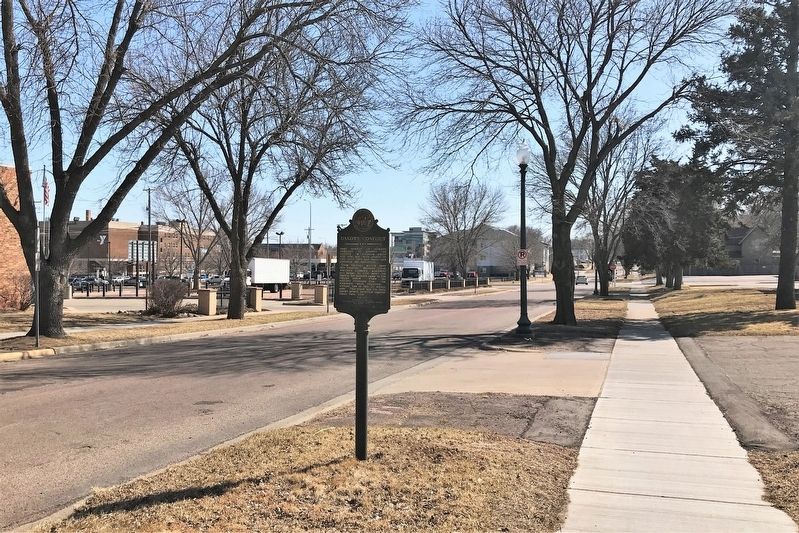
March 26, 2022
4. Dakota Conflict Marker, from the north
Credits. This page was last revised on February 16, 2023. It was originally submitted on March 31, 2022. This page has been viewed 325 times since then and 24 times this year. Photos: 1, 2, 3, 4. submitted on March 31, 2022.
