Petersburg, Virginia — The American South (Mid-Atlantic)
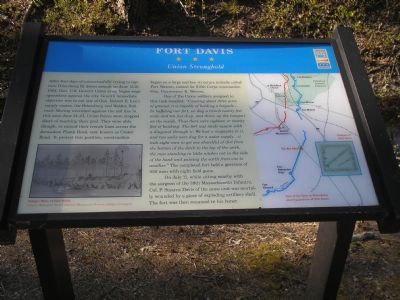
Fort Davis
Union Stronghold
Photographed by Bill Coughlin, April 22, 2007
1. Fort Davis - Union Stronghold
One of the Union soldiers assigned to this task recalled: “Covering about three acres of ground, it is capable of holding a brigade…. In building our fort, we dug a trench twenty feet wide and ten feet deep, and threw up the rampart on the inside. The fort was made square with a diagonal through it. We had a magazine in it, and two wells were dug for a water supply…it took eight men to get one shovelful of dirt from the bottom of the ditch to the top of the work, the men standing in little nitches cut in the side of the bank and passing the earth from one to another.”
this page online
One July 11, while sitting nearby with the surgeon of the 39th Massachusetts Infantry, Col. P. Stearns Davis of the same unit was mortally wounded by a piece of exploding artillery shell. The fort was then renamed in his honor.
Erected by Virginia Civil War Trails.
Topics and series. This historical marker is listed in this topic list: War, US Civil. In addition, it is included in the Former U.S. Presidents: #18 Ulysses S. Grant, and the Virginia Civil War Trails series lists. A significant historical month for this entry is June 1864.
Location. 37° 11.512′ N, 77° 22.504′ W. Marker is in Petersburg, Virginia. It is at the intersection of Flank Road and Crater Road (Highway 301), on the left when traveling east on Flank Road. Touch for map. Marker is in this post office area: Petersburg VA 23805, United States of America. Touch for directions.

Regionally, this marker is in Central Virginia. It is also in the American South and specifically in the Upper South. Globally, it is in North America, the Western Hemisphere, the Western World, and the Anglosphere. Historically,
Photographed by Craig Swain, November 22, 2008
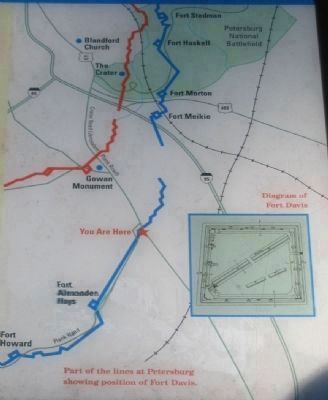
2. Petersburg Fortification Map
Note that based on the diagram of Fort Davis, this was a square redoubt, with a "parados traverse" in the middle running diagonally. The internal traverse was designed to trap shot that landed into the fort interior to prevent additional damage.
Other nearby markers. At least 8 other markers are within 2 miles of this marker, measured as the crow flies: A different marker also named Fort Davis (about 500 feet away, measured in a direct line); Col. George W. Gowen Monument (approx. 0.8 miles away); Fort Hays (approx. 0.9 miles away); Lincoln In Petersburg (approx. 0.9 miles away); Pennsylvania Monument (approx. 0.9 miles away); Old Men and Boys of Petersburg (approx. 0.9 miles away); Battery 31 (approx. 1.1 miles away); The Battle of Jerusalem Plank Road (approx. 1½ miles away). Touch for a list and map of all markers in Petersburg.
More about this marker. A drawing on the lower left shows a "Fatigue party at Fort Davis." A map on the right side shows other nearby fortifications used in the siege of Petersburg along with an engineering diagram of Fort Davis.
Also see . . . The Civil War Siege of Petersburg. (Submitted on November 28, 2007, by Craig Swain of Leesburg, Virginia.)
Photographed by Bill Coughlin, April 22, 2007
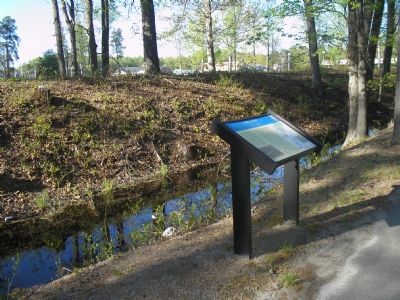
3. Fort Davis Civil War Trails Marker
Photographed by Craig Swain, November 22, 2008
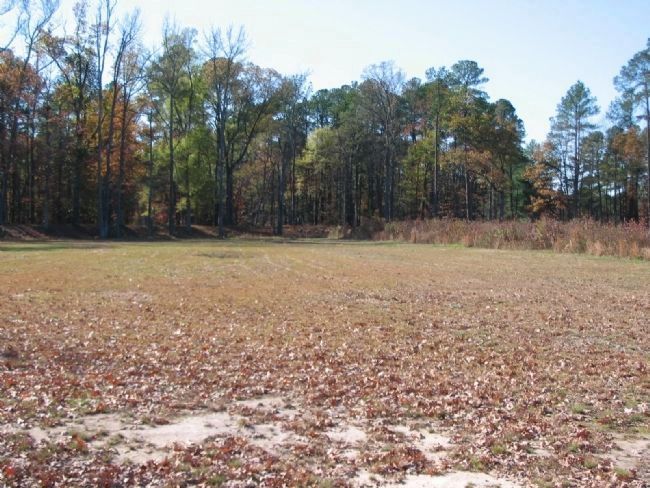
4. Fort Interior
From the sally port (entrance) on the old Jerusalem Plank Road side (eastern face) of the fort. This view looks across the parade ground, with the south wall on the left and the traverse on the right, meeting at the southwest corner of the fort.
Credits. This page was last revised on February 2, 2023. It was originally submitted on November 18, 2007, by Bill Coughlin of Woodland Park, New Jersey. This page has been viewed 3,858 times since then and 79 times this year. Last updated on April 17, 2022, by Anonymous of Fredericksburg, Virginia. Photos: 1. submitted on November 18, 2007, by Bill Coughlin of Woodland Park, New Jersey. 2. submitted on December 24, 2008, by Craig Swain of Leesburg, Virginia. 3. submitted on November 18, 2007, by Bill Coughlin of Woodland Park, New Jersey. 4. submitted on December 24, 2008, by Craig Swain of Leesburg, Virginia. • Mark Hilton was the editor who published this page.
