Near Batchawana Bay in Algoma District, Ontario — Central Canada (North America)
The Trans-Canada Highway
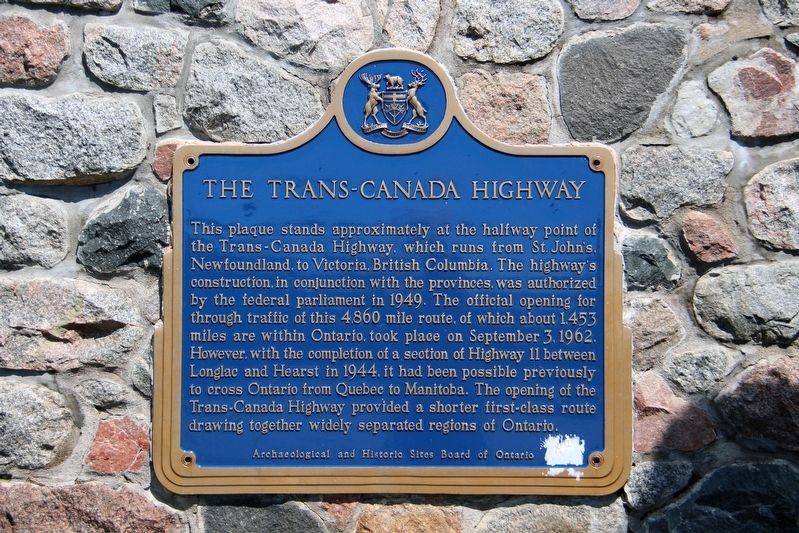
Erected by Archaeological and Historic Sites Board of Ontario.
Topics and series. This historical marker is listed in this topic list: Roads & Vehicles. In addition, it is included in the Canada, Ontario Heritage Trust series list. A significant historical date for this entry is September 3, 1962.
Location. 46° 55.696′ N, 84° 25.52′ W. Marker is near Batchawana Bay, Ontario, in Algoma District. It is on Trans-Canada Highway (Provincial
this page online

Regionally, this marker is in the Sault Ste. Marie and Algoma Area and in Northern Ontario. It is also in Central Canada. Globally, it is in North America, in the Great North Woods, on the Great Lakes, on Lake Superior’s North Shore, in the Western Hemisphere, in the Western World, and in the Anglosphere. Historically, it finds itself in what was once a British colony, the Viceroyalty of New France, the Haudenosaunee (Iroquois) Confederacy, and Rupert’s Land.
Other nearby markers. At least one other marker is within walking distance of this marker: Chippewa Falls / Chutes de Chippewa (a few steps from this marker).
Also see . . . Trans-Canada Highway. Wikipedia entry on the cross-country road, which actually is a system of interconnected roads offering multiple routes. (Submitted on April 19, 2022, by Duane and Tracy Marsteller of Murfreesboro, Tennessee.)
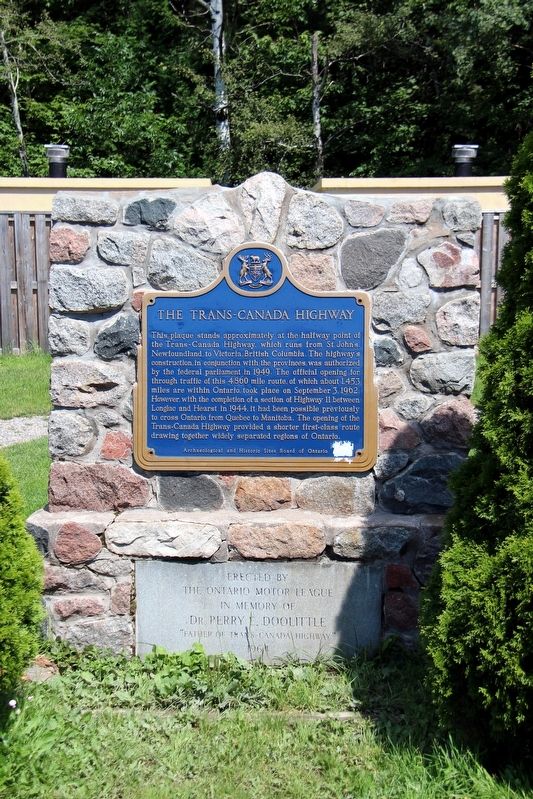
Photographed by Duane Marsteller, August 5, 2017
2. The Trans-Canada Highway Marker
Credits. This page was last revised on April 19, 2022. It was originally submitted on April 19, 2022, by Duane and Tracy Marsteller of Murfreesboro, Tennessee. This page has been viewed 852 times since then and 96 times this year. Photos: 1, 2. submitted on April 19, 2022, by Duane and Tracy Marsteller of Murfreesboro, Tennessee.
