Aiken in Aiken County, South Carolina — The American South (South Atlantic)
St. Thaddeus Church
Photographed by Mike Stroud, July 2008
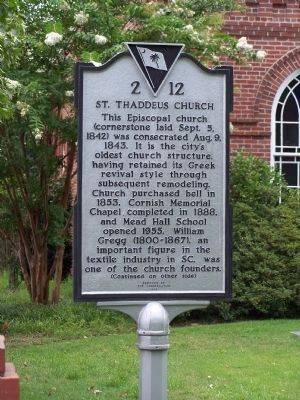
1. St. Thaddeus Church Marker (front)
This Episcopal Church (cornerstone laid Sept. 5, 1842) was consecrated Aug. 9, 1843. It is the city’s oldest church structure, having retained its Greek revival style through subsequent remodeling. Church purchased bell in 1853, Cornish Memorial Chapel completed in 1888, and Mead Hall School opened 1955. William Gregg (1800–1867), an important figure in the textile industry in SC, was one of the church founders.
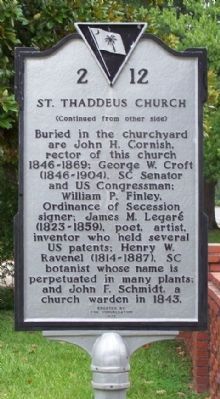
Buried in the churchyard are John H. Cornish, rector of this church 1846–1869; George W. Croft (1846–1904), SC Senator and US Congressman; William P. Finley, Ordinance of Secession signer; James M. Legaré (1823–1859), poet, artist, inventor who held several US patents; Henry W. Ravenel (1814–1887), SC botanist whose name is perpetuated in many plants; and John F. Schmidt, a church warden in 1843.
Erected 1992 by The Congregation. (Marker Number 2–12.)
Topics and series. This historical marker is listed in these topic lists: Architecture • Cemeteries & Burial Sites • Religion & Religious Structures. In addition, it is included in the South Carolina Historical Markers series list. A significant historical year for this entry is 1843.
Location. 33° 33.689′ N,
this page online

Regionally, this marker is in Greater Augusta and in the Midlands. It is also in the American South and specifically in the Deep South. Globally, it is in North America, the Western Hemisphere, the Western World, and the Anglosphere. Historically, it finds itself in what was once the territory of the Mississippian Culture, one of the original Thirteen Colonies, one of the Confederate States of America, and the Antebellum South.
Other nearby markers. At least 10 other markers are within walking distance of this marker: 1953 Gas Explosion (about 500 feet away, measured in a direct line); An Early Aiken Park (about 600 feet away); The Augusta And Aiken Railway (about 600 feet away); Aiken's Jewish Merchants (about 600 feet away); Aiken (about 600 feet away); Woodmen Of The World
Photographed by Mike Stroud, July 2008
2. St. Thaddeus Church Marker (reverse)
Another marker is no longer nearby. South Carolina Canal & Rail Road Company (was about 700 feet away but has been replaced with another marker now near it).
Regarding St. Thaddeus Church. National Register of Historic Places :
St. Thaddeus Episcopal Church (added 1984 - Building - #84000518) •
♦Pendleton and Richland Sts., Aiken
♦ Historic Significance: Event
♦Area of Significance: Religion, Community Planning And Development ♦Period of Significance: 1825-1849, 1850-1874, 1925-1949
♦Owner: Private
♦Historic Function: Religion
♦Historic Sub-function: Religious Structure ♦Current Function: Religion
♦Current Sub-function: Religious Structure
Also see . . . St. Thaddeus Episcopal Church. Although St. Thaddeus Episcopal Church has been important in the history of the town of Aiken since its construction ca. 1842, it is also important for its association with the Aiken Winter Colony. (Submitted on September 17, 2008, by Brian Scott of Anderson, South Carolina.)
Additional commentary.
1. St. Thaddeus Episcopal Church
St. Thaddeus Episcopal Church, located at the corner of Pendleton and Richland Streets in Aiken, was constructed ca. 1842. In 1926 the church was extensively remodeled according to the design of Albert Simons of Charleston. Originally a simple frame, weatherboarded building, St. Thaddeus is now stuccoed and had Greek Revival proportions. The three-bay facade features a pedimented Doric portico which shelters
Photographed by Mike Stroud, 2008
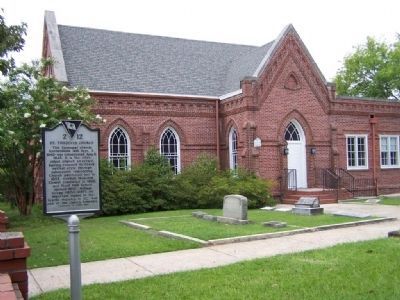
3. St. Thaddeus Church and Marker
Significance
Although St. Thaddeus has been important in the history of the town of Aiken since its construction ca. 1842, it is also important in association with the Aiken Winter Colony. Many of the Winter Colonists belonged to the congregation of St. Thaddeus reflect the wealth and sophistication of its congregation during the Winter Colony era and illustrate the impact of the Winter Colony on the community. (Source: National Register nomination form.)
— Submitted January 6, 2011, by Brian Scott of Anderson, South Carolina.
Photographed by Mike Stroud, 2008
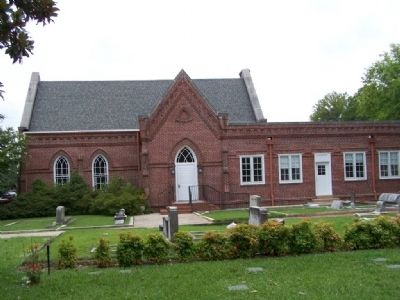
4. St. Thaddeus Church and cemetery
Credits. This page was last revised on January 20, 2026. It was originally submitted on August 13, 2008, by Mike Stroud of Bluffton, South Carolina. This page has been viewed 2,998 times since then and 63 times this year. Last updated on June 4, 2009, by Mike Stroud of Bluffton, South Carolina. Photos: 1, 2, 3, 4. submitted on August 13, 2008, by Mike Stroud of Bluffton, South Carolina. • Craig Swain was the editor who published this page.
